Client Request
The client’s main goal was to increase the number of leads and significantly reduce their cost, since the current ad performance didn’t meet business expectations.
At the time of the request, the campaigns were already running, but they lacked structure, logic, and ongoing optimization. That led to three core problems:
- The traffic wasn’t relevant.
- Budget was being consumed without measurable impact.
- Cost per conversion was so high that scaling made no sense.
The key expectation was to turn advertising from a “just running ads” activity into a controllable lead-generation tool with a predictable cost per lead.
Initial Actions
At the start of the collaboration, we ran a comprehensive audit of the Google Ads account to get a complete, objective view of how the existing campaigns were performing and what kind of traffic they were bringing in.
As part of the audit, we reviewed in detail:
- Campaign structure and the logic behind it.
- Search query quality and relevance.
- Analytics goal setup and the accuracy of conversion tracking.
- How well landing pages matched the ad messaging.
- On-site user behavior and the key drop-off points.
This end-to-end review helped us clearly identify weak spots in the current strategy, understand what was driving low performance, and build a step-by-step plan to improve traffic quality and reduce cost per conversion.
Once the audit was complete, we moved into deep account optimization. It was clear that the existing campaign structure was limiting Google’s algorithms and holding performance back.
The core issue was diluted data and weak signals. Similar ad groups were repeated across multiple campaigns, and keyword types overlapped, giving the system too many competing options for delivery. Broad-match keywords collected impressions faster and absorbed most of the budget, while exact, high-intent queries didn’t get enough volume to build statistically meaningful data for optimization.
On top of that, branded and non-branded queries were mixed within the same campaigns, which made performance analysis even harder. Over time, this led to:
- Less control over which search terms were triggering ads.
- A less predictable cost per conversion.
- Inefficient budget distribution across keywords.
- No clear view of which ad groups and queries were driving the strongest business results.
To fix this, we rebuilt the account structure from the ground up:
- Separated campaigns by query intent and geography.
- Removed irrelevant and duplicate ad groups.
- Refined keywords and search terms, focusing on high-intent traffic.
The next strategically important step was changing the primary optimization goal. Previously, campaigns were mostly optimized for product downloads, while the business priority was registrations. We switched the main conversion to registrations and replaced the landing page with one better aligned to that action. This helped attract higher-quality traffic and increased the likelihood of hitting the key business objective.
At the same time, since product downloads were still an important step in the user journey, we assigned different values to each conversion type and switched to the “Maximize conversion value” bidding strategy. This allowed the algorithms to allocate budget more effectively: registrations became the top priority, while other meaningful user actions were still taken into account.
Once we collected enough high-quality data and established clear audience signals, we launched a Performance Max campaign based on the updated audiences, creatives, and search signals.
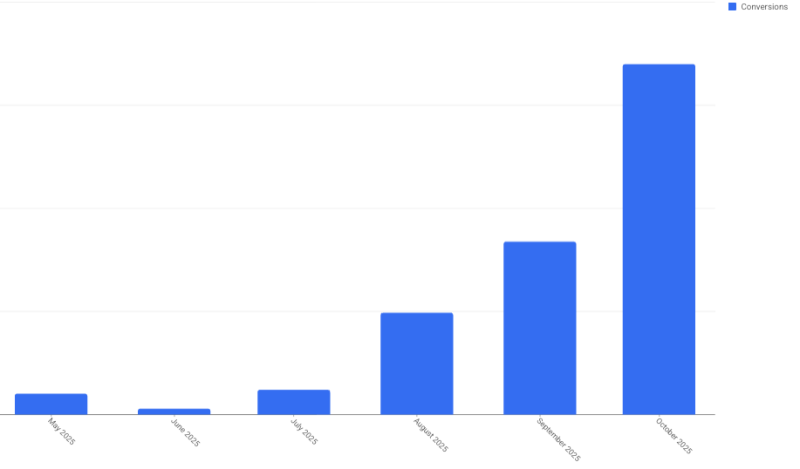
As a result of comprehensive optimization—from account structure to bidding strategy—we delivered a steady flow of qualified registrations, significantly improved campaign efficiency, and built a solid foundation for scaling results further.
Current Results
At this stage, we’ve achieved a significant increase in conversions and a major reduction in their cost, confirming the effectiveness of the chosen strategy.
Campaign performance is steadily improving, and the account is now a controlled system, ready for further scaling. At the same time, we keep refining settings, testing new approaches, and strengthening what already works, so performance continues to improve, and the channel reaches its full potential.

Next Steps
Going forward, we aim to scale the results we’ve already achieved and attract more customers by adding new ad formats and expanding into additional channels. We plan to launch campaigns on Bing and Meta to reach a wider share of the target audience and reduce reliance on a single source of traffic.
Besides, advertising performs best in synergy. People rarely convert on the first touch—they come back to the site, notice the brand in different places, and only then register. With more platforms in the mix, we can reinforce the message, keep the company top of mind, and support users throughout the decision journey, rather than losing them after the first visit.
At the same time, we’ll keep developing the strategy: testing new ideas, validating hypotheses, and improving what already works. Our goal is to build an acquisition system that’s not only effective today, but stable and scalable for long-term growth.