Goal: increase the online store’s revenue using Google Ads.
How We Achieved the Result
When working with online stores, we usually start with queries that include product or brand names, avoiding broad-match queries, to boost performance from the outset and then gradually scale results.
But this case was different. With a mono-brand in the home goods niche, we had no product or brand queries to work with except for the client’s own brand, which accounted for no more than 10% of total traffic. Significantly increasing revenue in such a situation is quite challenging.
We went all in right away, trying to reach users as broadly as possible, starting from the very top of the funnel and keeping their attention all the way through to purchase.
What Worked Really Well
Dynamic remarketing is our top performer for conversions. In this case, it worked great both as a closing tool for purchases and as a mid-funnel driver, supporting other advertising channels.
We showed banner ads to users who:
- Viewed a product: they saw banners featuring the product they had viewed.
- Added items to the cart: they saw banners featuring the product sitting in their cart.
The first option drove much more traffic and revenue, while the second delivered cheaper conversions.
Don’t always judge a tool by conversions alone: look at how it helps warm up users who arrive from other channels.
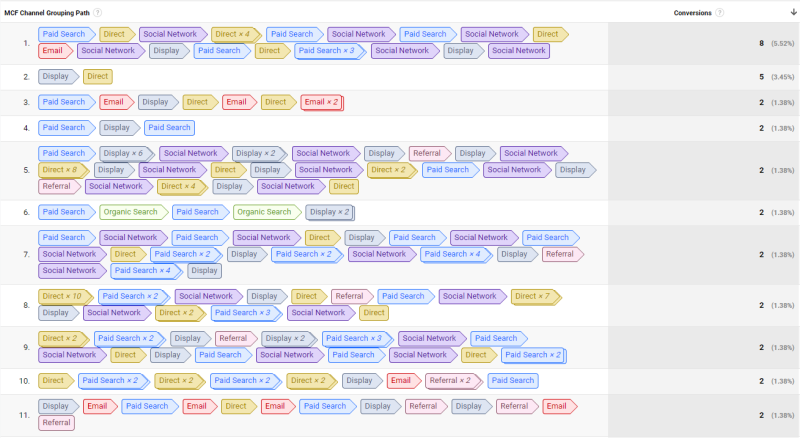
This shows how dynamic remarketing contributes to the conversion path, even though it’s often not the last-click source
Working with Branded Traffic
We started with a strong brand that already had existing demand, but besides the official representative, Marie Claire products were also sold by other stores. After reviewing the search results for branded queries, we noticed that, alongside us, competitors such as Wikipedia and an online magazine also appeared in the listings.
We can be found, but the user is still left with a choice of at least three competitors below us — and that’s assuming Google Shopping doesn’t appear above the organic results. Or, as in the first case, the user might simply overlook our client’s site altogether.
For a business, it’s far too costly to lose a user one step away from purchase — especially when you’ve already paid for contact with them multiple times. By adding Google Shopping, launching branded search PPC campaigns, and adding the site to Google My Business, we fully claimed the first screen for branded queries.
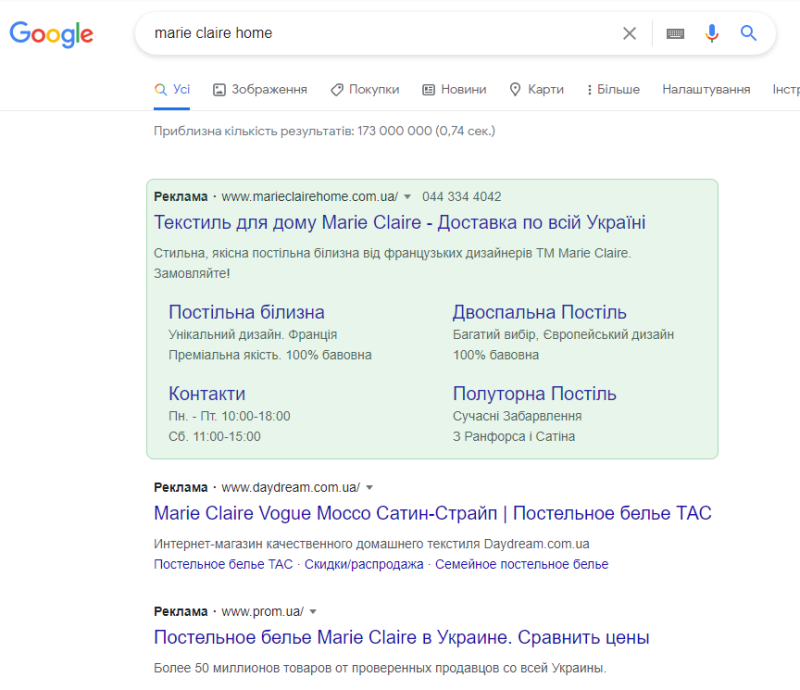
If you’ve already built demand for your brand, that doesn’t mean people will easily find you. Check what the search results actually look like for your queries, and work to improve them.
Google Ads immediately helped achieve several goals:
- Increased traffic volume.
- Converted users who arrived through other advertising channels.
- Solved the problem of losing branded traffic.
- Google Ads became a stable source of conversions and revenue.
Conclusion
Paid promotion isn’t just about direct conversions. It’s also a tool for assisted conversions that helps retain users and increases the likelihood of driving them to a purchase.
Being in the top 3 isn’t always enough — you should aim to dominate as many of the top results as possible, even for your own branded queries. This boosts the return on all of your marketing investments.
Even when using proven methods, always question them against your own situation, since every project has its own unique goals and current business and market context.
If you’re interested in promoting your online store, get in touch with us, and we’ll answer all your questions.