

This story started with a client request for an audit. Despite steady investments in advertising and a consistent flow of traffic, the OSTRIV team faced a systemic issue: their planned sales and marketing performance targets were not met. In reality, the business was in a situation where the ad budget was spent, and clients were acquired. Still, the final results (sales, profitability, and return on investment) didn’t meet expectations or the goals set for the marketing team.
That’s why the client approached us with a request for an in-depth audit of their advertising system, aiming to:
- Identify bottlenecks holding back growth;
- Understand exactly where efficiency was lost;
- Find additional growth points to improve results without increasing budgets.
It’s important to note that the client didn’t see the audit as a formal check-up, but as a decision-making tool. That’s why it included not just a list of issues and growth points, but also clear, practical steps needed to improve campaign performance.
Based on the audit results, the client decided to move forward with full-scale cooperation, as the recommendations showed a strong understanding of the business context and real potential for scaling results.
About OSTRIV
OSTRIV is a multi-brand eCommerce project with thousands of SKUs and a complex assortment structure. Its concept is to offer clients high-quality products with history and character.
The assortment is divided into three main segments:
- Women’s;
- Men’s;
- Kids’.
Within the women’s and men’s segments, the store offers clothing, footwear, accessories, bags, and even a home category. The kids’ segment includes clothing, footwear, and accessories. Each segment also has a sales category, which comes with its own demand patterns and advertising logic.
Another layer of complexity comes from the constant rotation of collections: launching new arrivals, moving them into the core assortment, and eventually into sale. Combined with seasonality, this requires a flexible advertising model that can quickly adapt to changes in demand and shifting business priorities.
Start of cooperation and the first breakthrough (June – December 2024)
Our work on the project began with a detailed audit of the advertising accounts and analytics setup. At the first stage, we focused on fixing technical issues, restructuring campaigns, and cleaning up the data used by Google’s algorithms for learning.
Here’s what really drove results during this period:
- Deep analysis and systematic optimization. We didn’t just tweak settings, but conducted a retrospective analysis of data from previous years. This helped us identify bottlenecks in the sales funnel and uncover previously overlooked growth points.
- Synergy between Performance Max and display campaigns. We took a full-funnel approach: Demand Gen and display campaigns worked on reach and brand awareness, building delayed demand. At the same time, Performance Max efficiently converted this “warmed-up” traffic into actual sales.
- Infrastructure preparation. We paid special attention to accurate conversion tracking, enabling Google’s algorithms to target the ideal customer profile.
- Flexible budget management. During peak periods, we moved from rigid planning to real-time budget reallocation, prioritizing the best-performing product categories.
Winter sale season as the first checkpoint
The winter sale season is traditionally the peak sales period of the year for fashion eCommerce. That’s why we needed to prepare the advertising system in advance to get through this period as efficiently as possible without losing control of performance.
Work around Black Friday became a separate stage and included a set of tactical decisions aimed at capturing peak demand. We even turned this into a standalone case study, breaking down all actions and results of the Black Friday 2024 campaigns in detail.
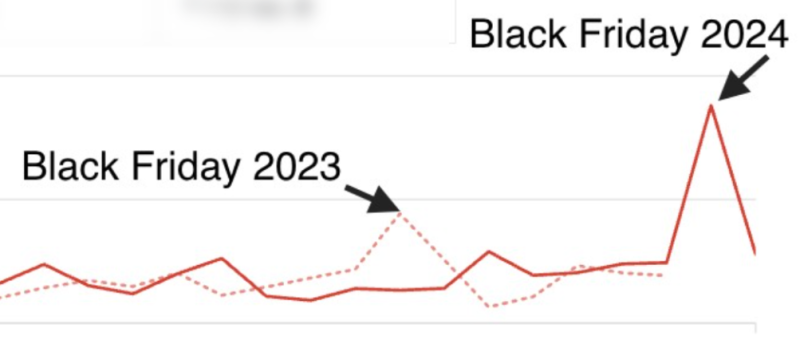
Black Friday 2024 results (compared to the same period last year):
- Number of orders: +97%;
- Average receipt: +97%;
- Cost per acquisition (CPA): –39%.
Thanks to the smart distribution of promotional offers, we ensured a smooth transition into the winter sale season. This helped avoid the typical drop in sales in December that often follows the biggest sales event of the year.
You can check out the full Black Friday 2024 case study.
New records and scaling (2025)
For this project, 2025 marked a turning point in both scale and quality of growth. While 2024 was mainly about building the foundation and capitalizing on peak periods, in 2025, we shifted to systematic performance management throughout the entire year. Scaling was controlled, with a strong focus on profitability, manageability, and stability, even if that meant temporarily stepping back from aggressive growth.
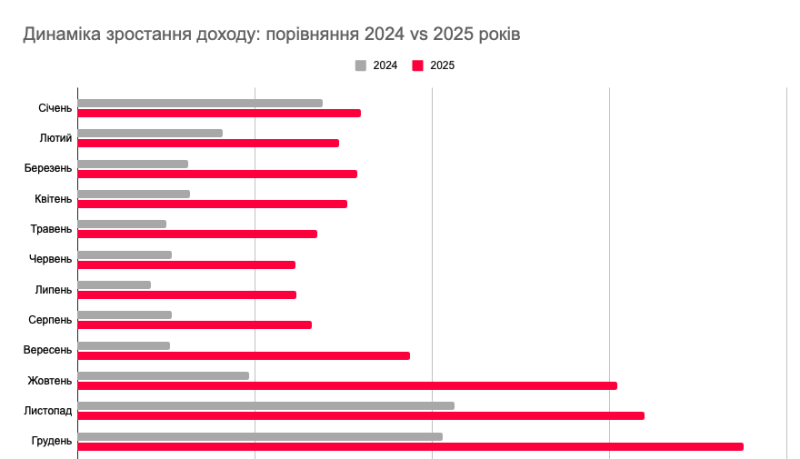
When comparing revenue dynamics between 2024 and 2025, what stands out is not short-term spikes but consistent growth across almost every month. The second half of 2025 is especially telling: results didn’t just outperform the previous year, but established a new, higher baseline revenue level that remained stable month after month.
Key results for 2025 compared to 2024:
- Number of orders: +310.23%;
- Cost per acquisition (CPA): –28%;
- Revenue: +208.57%.
These results weren’t driven by increasing budgets, but by rethinking how we work with assortment, data, and optimization priorities.
That’s why we focused on four strategic areas in 2025 that allowed us to:
- Improve control over the advertising system;
- Unlock the potential of a broader product assortment;
- Shift the focus from volume to profitability;
- Create synergy between PPC, SEO, and awareness channels.
Let’s break down each of these areas.
Product feed restructuring and “hygiene”
By 2025, Custom Labels in Google Ads had already become a standard tool for mid- to large-scale eCommerce projects. However, our main contribution wasn’t just adding labels, but a complete restructuring of the product feed into a more logical and manageable system.
We reorganized the feed to:
- Simplify filtering and day-to-day work with the assortment;
- Create a clear product hierarchy for Google’s algorithms;
- Enable segmentation not by formal attributes, but based on the actual logic of OSTRIV’s assortment, its multi-brand structure, and the lifecycle stages of collections (new arrivals, core assortment, sale).
This approach gave us much more flexibility in managing advertising strategies. Products were grouped into logical segments with different optimization goals, scaling scenarios, and priority levels.
As a result, the product feed stopped being just a data source for campaigns. It became the foundation for systematic assortment management in advertising, in which each product group was optimized for its specific role within the overall strategy.
“Zombie products” revival
Another focus area was working with so-called “zombie products” — items that were getting little to no traffic because most of the budget was concentrated on bestsellers.
We selected products with minimal clicks over the past 30 days and moved them into a separate campaign.
Results:
- These items started generating consistent sales;
- Sales funnel expanded without overheating bids on top-performing SKUs.
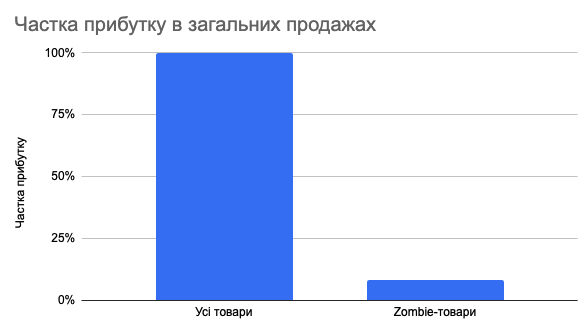
While “zombie products” didn’t become the main revenue driver, they still contributed to profit, accounting for about 8% of total revenue.
This allowed us to monetize a part of the assortment that previously wasn’t reaching its potential, without negatively affecting the performance of core product groups.
Transition to Value-Based Bidding (tROAS)
Once we had accumulated enough high-quality data, we gradually shifted from optimizing for the number of conversions to optimizing for their value.
Instead of switching strategies abruptly, we implemented value-based bidding step by step, testing different approaches on specific product segments and then scaling them across the entire account.
During this process, we trained the system to interpret business priorities better: orders with higher average receipts and margins received more weight than a large number of low-value transactions.
This approach involved a conscious trade-off. In certain periods, the cost of acquiring clients increased, but overall profitability and net profit consistently improved.
Halo effect and media impact
In 2025, we treated PPC not as an isolated channel but as part of a broader marketing ecosystem, where paid traffic, organic search, and display campaigns reinforced one another.
Testing upper-funnel formats such as Demand Gen and Video campaigns yielded a strong brand presence effect. Users interacted with display and video ads, then returned later and converted through search or Shopping campaigns.
Beyond direct demand generation, Demand Gen campaigns also became an important signal source for Performance Max algorithms. With more interaction points, the system gained a deeper understanding of the target audience’s behavior, which improved the overall optimization of product campaigns.
We didn’t attribute all growth to a single channel but observed a clear correlation:
- Total revenue across all channels grew by 207%;
- Branded and direct traffic increased;
- User journey to conversion became shorter.
Overall, this confirmed that PPC in 2025 was not just driving immediate sales but also acting as a demand catalyst, strengthening both Performance Max and organic channels.
Wrapping up
This case shows that sustainable growth in eCommerce doesn’t come from one-off campaigns but from systematic work with data, assortment, and advertising strategy. Starting in 2024, we gradually built a manageable advertising model that can adapt to seasonality, collection changes, and evolving business priorities.
In 2025, the focus shifted from volume to profitability and stability, allowing us to significantly improve key metrics without losing control over performance.
The work continues in 2026 with a focus on further scaling, developing assortment strategies, and strengthening cross-channel synergy.