How We Helped a Manufacturing Company Find a B2B Client That Booked Its Production Capacity for a Year
Client: Brave technics
Product: High-precision metal milling and plastic injection molding services
Business Model: B2B contract manufacturing
Main Business Goal
Most manufacturing companies evaluate advertising campaigns by the number of leads they generate. For Brave technics, however, lead volume was not the most important metric.
The company needed large manufacturing partners that could keep its production capacity consistently booked for months at a time. That is why our KPI was not the number of inquiries but their actual business value.
Client Request
The client was not looking for more leads for the sake of volume. The real objective was to attract larger B2B customers capable of providing stable production demand for months at a time.
For a manufacturing business, dozens of small orders do not always create the desired economic impact. One large contract, on the other hand, can make production planning easier, improve equipment utilization, and create the foundation for a long-term business relationship.
At the start of our cooperation, the company did not have an established digital acquisition system for reaching this type of customer. The main challenge was to determine which advertising channels, approaches, and messages would work best for attracting large manufacturing partners.
The client’s key expectation was to build a marketing system that could generate a steady flow of qualified B2B leads and help attract companies interested in long-term cooperation.
The First Steps
We did not begin by launching ads right away. The first priority was to build a marketing strategy around the type of customer Brave technics actually needed: not just businesses looking for parts, but larger B2B companies capable of becoming long-term production partners.
We analyzed the market, identified the main customer segments, and studied how potential buyers searched for manufacturing contractors. We paid close attention to search intent and the signals that helped distinguish larger manufacturing companies from small businesses looking for one-time or low-volume orders.
Based on this analysis, we segmented the target audience, created separate advertising messages for different production services, and selected the channels and tools we wanted to test.
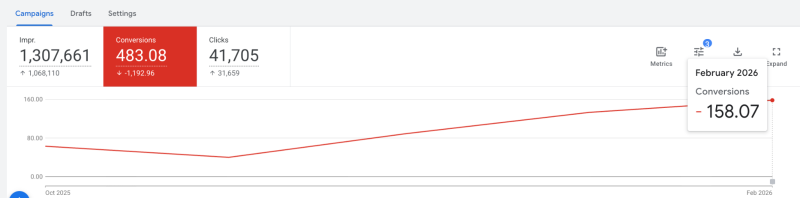
We started with Google Ads, where search campaigns quickly became the main source of early results. The first conversions appeared within the first month. By month three, conversion volume was 150% higher than at launch, and by month five, it had tripled.
Changing How We Measured Results
The first Google Ads campaigns confirmed that there was real demand for the company’s services. Leads started coming in during the first month, and their number continued to grow over time. Still, we soon discovered that conversion volume alone was not a useful measure of success.
Together with the client, we reviewed which inquiries had the potential to turn into large manufacturing contracts. We then updated the landing pages, changed the way conversions were tracked, and kept only the interactions that represented real business value.
At first, the results looked unusual because the total number of conversions went down. Their quality, however, improved significantly, which was the result we actually wanted.
Google Captured Active Demand, but We Needed More
As the campaigns matured, their performance became more consistent. We scaled the approaches that performed best, tested new ad messaging, and continued improving the campaign structure. Then we faced a different challenge.
Google works extremely well when someone is already searching for a manufacturing partner. What it cannot do is let you build your own list of companies you specifically would like to work with. To reach those businesses proactively, we needed to expand beyond search advertising.
LinkedIn Became the Next Channel to Test
Our next goal was to reach the people who could actually influence or make decisions about manufacturing partnerships. LinkedIn Ads offered the most precise way to do that, with targeting based on company industry, size, revenue, and other business criteria.
Before launching any campaigns, we first analyzed whether LinkedIn could give us meaningful access to the decision-makers in the MilTech segment. After confirming that the audience was there, we launched several tightly targeted campaigns and a separate company-focused campaign aimed at businesses most likely to need the client’s services.
At the same time, we did not treat LinkedIn as the primary lead generation channel. We saw it primarily as another way to create contact with the right companies and decision-makers.
This distinction mattered because not every prospect converted through a lead form. Some reached out directly to the client through LinkedIn messages or moved to other communication channels. For that reason, measuring performance only by platform conversions would have understated the channel’s value.
LinkedIn gave us another way to reach the target audience, but the main business objective was still unresolved — finding a large manufacturing partner.
We Started Selling Trust Along With the Service
The next step was to test another hypothesis that could potentially move us closer to the desired result. The client already had a line of its own products that clearly demonstrated the quality of its manufacturing and the capabilities of its CNC equipment. We assumed that instead of promoting only manufacturing services, we could also advertise finished products. This would give potential customers a chance to experience the quality firsthand and see what the company was capable of producing.
We believed this could become one of the strongest proofs of the company’s manufacturing capabilities. If a potential client purchased a finished product and was satisfied with its quality and workmanship, the barrier of trust would become much lower.
To test the idea, we launched Meta Ads campaigns using interest-based targeting, a product catalog, and remarketing. Within the first few weeks, the campaigns began generating steady sales. The products were well received by the audience because buyers could get a high-quality item at a relatively accessible price, with a level of execution that stood out from many competing options.

The hypothesis proved effective almost immediately. However, over time, we noticed that most customers made only one purchase.
Selling the product itself was never the end goal. We wanted to maintain a relationship with potential B2B buyers who could eventually become customers for the company’s manufacturing services. That is why we launched separate remarketing campaigns: one for previous buyers to encourage repeat purchases and another for users who had added a product to their cart but had not completed the purchase.
This became the most important marketing decision of the entire year. We achieved the client’s main business objective by attracting a large B2B customer that booked the company’s full production capacity for the next year.
The company first discovered Brave technics through a product ad, placed an order, and tested the product in its own production environment. After seeing the quality firsthand, its team returned roughly three months later and requested a quote for serial manufacturing.
That contract was exactly the kind of outcome the entire marketing strategy had been built to achieve.
What Made the Strategy Successful
There was no single advertising channel that delivered the final result on its own.
Google Ads helped us capture existing demand and gradually improve lead quality. LinkedIn became an additional way to reach the right companies and strengthen the brand’s presence among the target audience. Meta Ads gave potential customers a chance to experience the quality of the products firsthand and reduced the trust barrier before a larger manufacturing partnership began.
Future Plans for the Project
After successfully building a system for attracting large B2B clients in Ukraine, the next stage of the project is expansion into the European market.
The business objective remains the same — find large manufacturing partners that can keep the company’s production capacity booked over the long term. We plan to begin with the Baltic states (Estonia, Latvia, Lithuania), where we see promising demand for contract manufacturing and high-precision machining services.
The strategy will be adapted to the realities of each market. This will include analyzing local demand, the competitive landscape, and potential customer behavior, developing new advertising messages, and testing the most effective channels for reaching B2B audiences.
At the same time, we will continue improving the existing advertising system, testing new hypotheses, and scaling the approaches that have already proven successful in Ukraine. Our goal is to build a predictable system for attracting large manufacturing clients in Europe and help Brave technics expand its presence beyond Ukraine.