




9 min reading
How Web Design Impacts Customer Experience


Just a few years ago, traditional search engines were the main source of organic traffic for most companies. At that time, SEO performance was usually measured by search engine rankings on platforms such as Google, organic visits, conversions, and website visibility for target keywords. Today, however, user behavior is gradually changing.
More users now turn to AI tools such as ChatGPT not only for general information but also to research companies, compare service providers, evaluate products, and get recommendations before buying. This makes the question of how to check brand mentions in AI increasingly relevant for businesses that want to understand how visible their company is and how often generative systems recommend it.
For businesses, this means the emergence of a new digital visibility channel. In the past, reaching Google’s top 10 was often enough. Today, brands also need to understand whether ChatGPT mentions them, whether those mentions are accurate, and whether the company appears in the types of prompts potential customers use when researching a purchase. This is the core of AI Visibility.
In this article, we explain what brand AI visibility is, how to check brand visibility, which queries and prompts to use during the analysis, which metrics to track, and why even well-known brands sometimes don’t appear in ChatGPT answers.
With the rapid development of generative artificial intelligence, user behavior has started to change. More and more people are asking questions directly in ChatGPT, expecting to receive a ready-made answer with recommendations for companies, services, or products. As a result, alongside traditional SEO, a new direction is gradually emerging — GEO and AI Visibility.
AI visibility is your brand’s presence and citation in AI-generated responses. It determines whether the model mentions your company for relevant prompts, how accurately it describes your products or services, whether it recommends your brand alongside competitors, and which sources it uses to generate such responses.
Unlike Google, which gives users dozens of results to choose from, ChatGPT often recommends only a few companies, or even just one. This makes appearing in a ChatGPT response just as important as ranking highly in organic search results.
At the same time, AI visibility doesn’t replace traditional SEO; it complements it. Brand visibility in ChatGPT should be viewed as a separate indicator of digital presence: strong Google rankings don’t guarantee ChatGPT will recommend your company, just as the brand’s absence from AI-generated answers does not always mean that the website has weak SEO.
ChatGPT analyzes a much broader set of signals: brand authority across the information landscape, mentions on industry-specific resources, content quality, the company’s digital reputation, citations in publicly available sources, and many other factors. For this reason, traditional SEO metrics alone are no longer enough for businesses to evaluate their digital visibility.
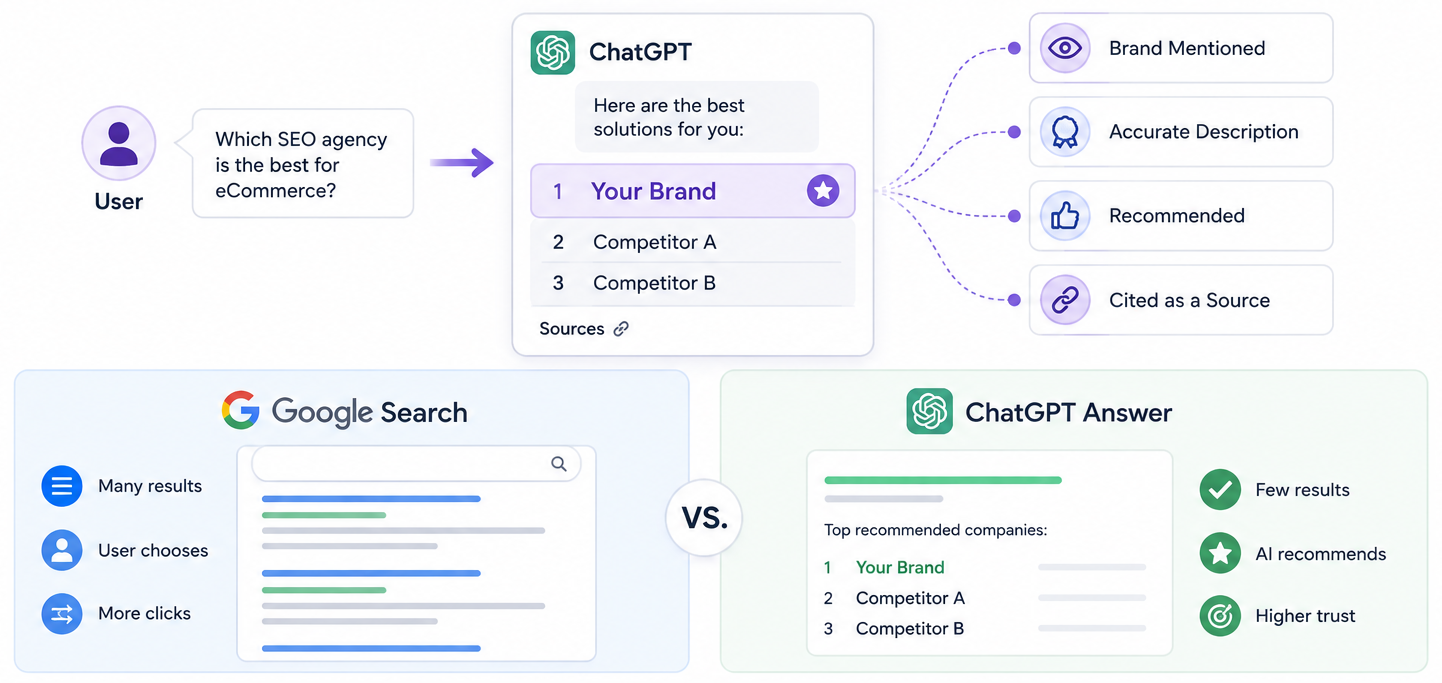
AI visibility is especially relevant for companies in highly competitive niches, where potential customers often ask ChatGPT about the best service providers, software solutions, agencies, or product manufacturers. If competitors are regularly mentioned in the responses while your brand is absent, you may be losing a new channel for attracting potential customers, even if your website ranks well in Google.
That is why regular AI visibility checks are becoming another part of digital analytics, alongside tracking search rankings, organic traffic, and conversions. They help you understand how ChatGPT views your company, whether your brand is represented strongly enough in the model’s responses, and where you need to improve to strengthen your digital presence.
Checking brand visibility in ChatGPT starts not with analyzing traffic or technical metrics, but with modeling the real behavior of a potential customer. In SEO, we check which queries a website ranks for in Google. With ChatGPT, however, you need to understand whether the model recommends your company in response to prompts that your target audience might actually use.
Keep in mind that the same brand can get completely different results depending on how the query is phrased. For example, ChatGPT may answer branded questions correctly but fail to recommend the company among competitors for commercial queries. Or, conversely, it may mention the brand in topic-specific lists while incorrectly describing its specialization or range of services. That is why evaluating AI visibility based on a single prompt scenario isn’t enough.
In practice, we recommend testing ChatGPT with several query types that match different stages of the potential customer journey — from users who already know the company’s name to those who are only looking for a solution to their problem or comparing different service providers. This approach provides a more objective picture of how well the brand is represented in the model’s responses and when it loses visibility.
Another key requirement is to conduct all checks under the same conditions. Use Temporary Chat so that previous conversations do not influence ChatGPT’s responses. If a company operates across multiple markets, test each country and language version separately, as the model’s recommendations can vary significantly by local context.
Another important point is not to limit the analysis to a one-time check. ChatGPT’s responses gradually change as the model evolves, new information sources appear, and the information landscape itself changes. Therefore, conduct AI visibility tracking regularly using the same set of prompts. This type of brand monitoring in ChatGPT makes it possible to track changes over time, assess their impact on the brand’s digital presence, and respond promptly if the company begins to lose visibility in ChatGPT responses.
Next, we will examine how to measure brand visibility, the types of queries worth using, and the information each one provides.
The most informative way to check brand visibility in ChatGPT is to test for so-called “niche prompts.” These are queries in which the user does not yet know a specific company and asks ChatGPT to recommend providers, agencies, or service companies in a particular niche.
These prompts model the initial stage of choosing a contractor, when a potential customer is only beginning to explore the market. If a company regularly appears in these recommendations, ChatGPT sees it as a notable player in its category.
When conducting the check, use queries that are as close as possible to real user behavior. For example:
When evaluating the results, do not focus only on whether the brand is mentioned but also on its position among competitors. If a company consistently appears among ChatGPT’s top recommendations, this indicates a high level of AI visibility. You should also check whether the model accurately describes the company’s specialization and whether it recommends the company in irrelevant categories.
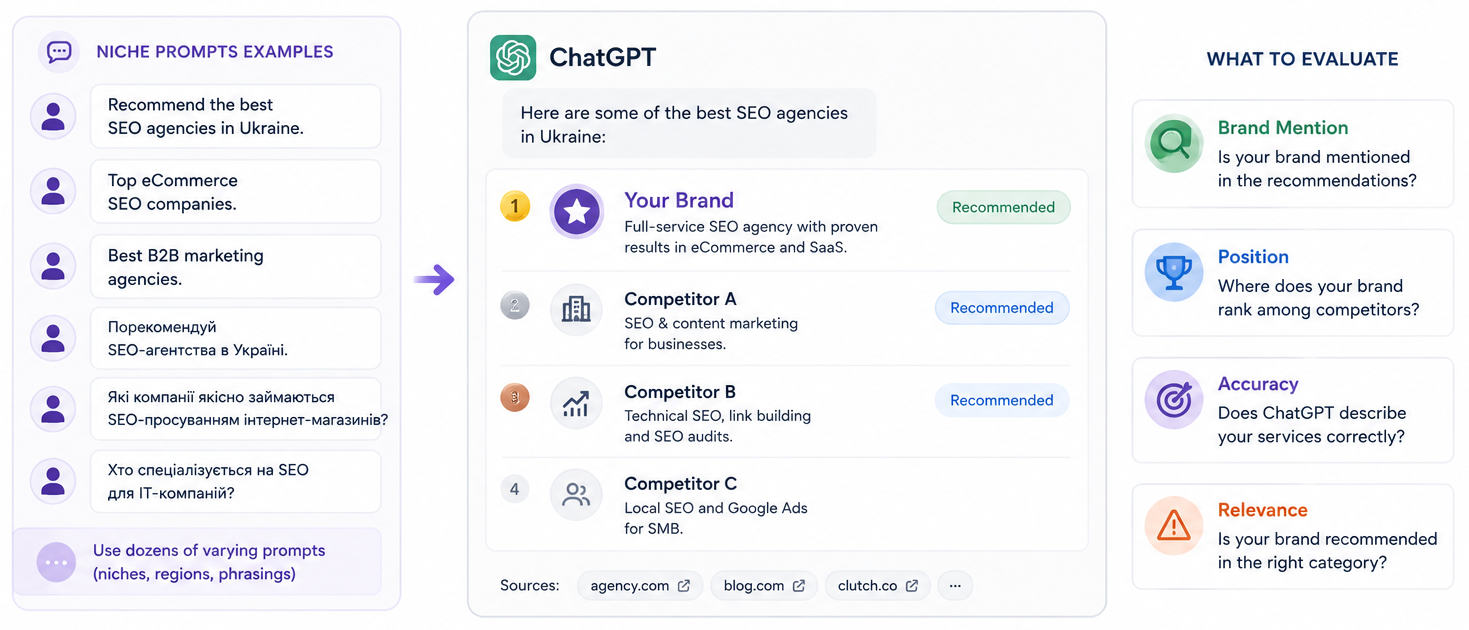
For an objective assessment, we recommend using dozens of similar prompts covering different areas of the company’s business, regions, and variations in wording. These prompts help determine how well the brand is represented in ChatGPT when a potential customer is choosing a provider or partner.
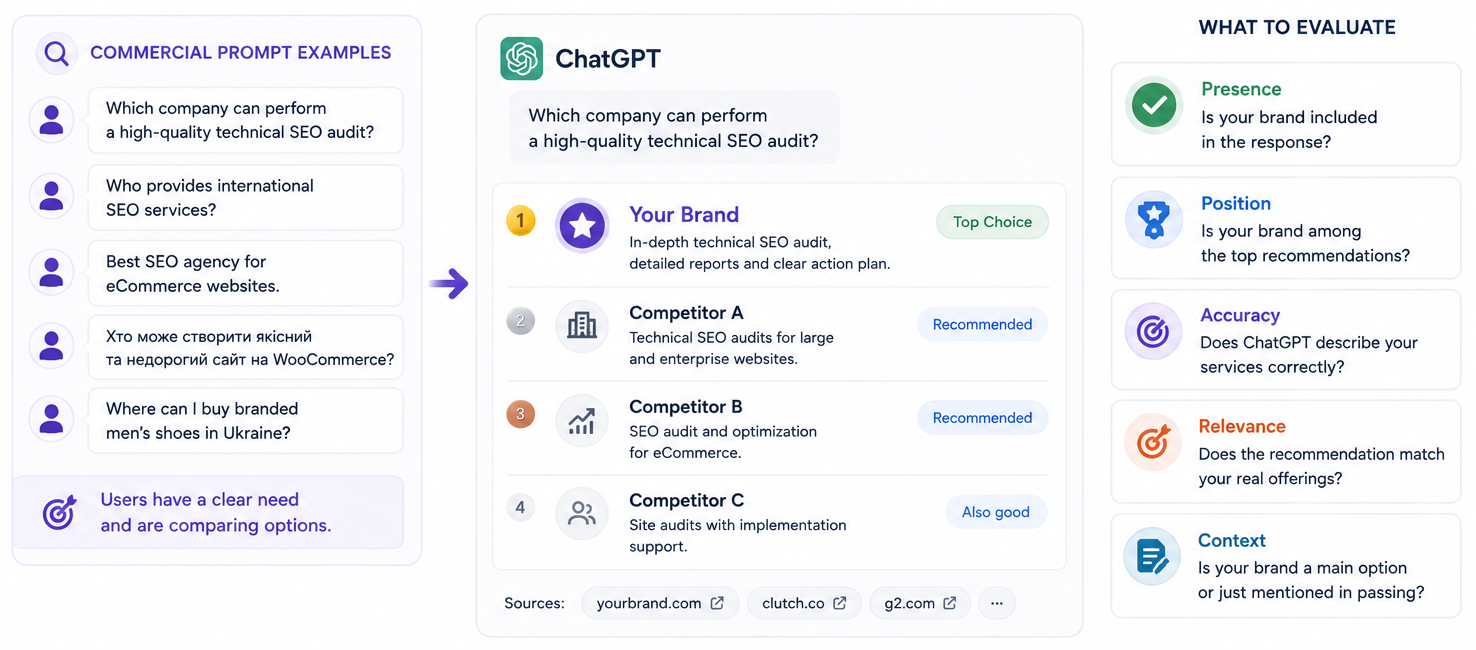
If niche prompts show whether a company appears in the general list of recommended providers, commercial queries evaluate a more important aspect: whether ChatGPT recommends your company to users already looking for a specific solution, product, or service.
These prompts model a situation in which a potential customer has already defined their need and is picking between several possible options. For example, they are not simply looking for an “SEO agency,” but want to find a company to promote an eCommerce website, a local business, or a SaaS product. For most businesses, this type of query has the greatest value because it is closest to the point when a potential customer decides whether to make a purchase or get in touch.
For an SEO agency, examples might include:
The same approach applies to other industries. If a company specializes in software development, you might test queries such as “Who can build a high-quality, affordable WooCommerce website?” For eCommerce, an example could be “Where can I find brand-name men’s shoes in Ukraine?”
When reviewing the results, look beyond whether the company is mentioned and consider the context of the recommendation. Check whether ChatGPT presents the brand as a primary suggestion or includes it among many competitors, how accurately it describes the company’s specialization, and whether the recommendation reflects the business’s actual products or services.
You should also test multiple variations of the same query. Users can describe the same need in dozens of different ways, and ChatGPT often returns different recommendation lists depending on the specific wording. For example, “best SEO company” and “best SEO company for eCommerce” can produce entirely different lists of companies. This analysis clarifies how ChatGPT recommends brands across different phrasings and combinations of user intent.
Another way to track brand visibility in AI is to analyze informational prompts. These prompts have no direct commercial intent, but they show whether ChatGPT draws on your company’s expert content as an information source. They help you evaluate how well your brand’s content marketing performs in the generative search ecosystem.
Unlike commercial prompts, informational queries focus on the topics covered in articles, guides, research, and other content already published on your company’s blog. The goal is to determine whether ChatGPT cites your content, uses it as a source for answers, and associates your brand with expertise in specific areas.
For an SEO company, informational prompts might include:
The approach is the same in other niches: build queries around the key topics your company regularly covers in blog posts, news updates, or expert content.
During the analysis, look beyond whether the brand is mentioned in an answer. When checking brand mentions in ChatGPT, assess whether the model uses your website as an information source and cites individual articles. Also consider whether those articles compete with content from other companies or industry publications. If ChatGPT regularly uses competitors’ articles in its answers but leaves out your content, this may suggest that your website’s informational content lacks authority or visibility.
In this situation, you can evaluate citations of your brand’s content in ChatGPT separately.Look at how often the model references your company’s content and which topics it uses as sources. This helps distinguish simple brand mentions from situations where the brand’s content directly contributes to the answer.
It is also useful to assess topic coverage. For example, a company may have dozens of blog articles, but ChatGPT uses them for only a few specific topics. This helps identify which content clusters are already establishing the brand’s expertise and which still need further development or updates.
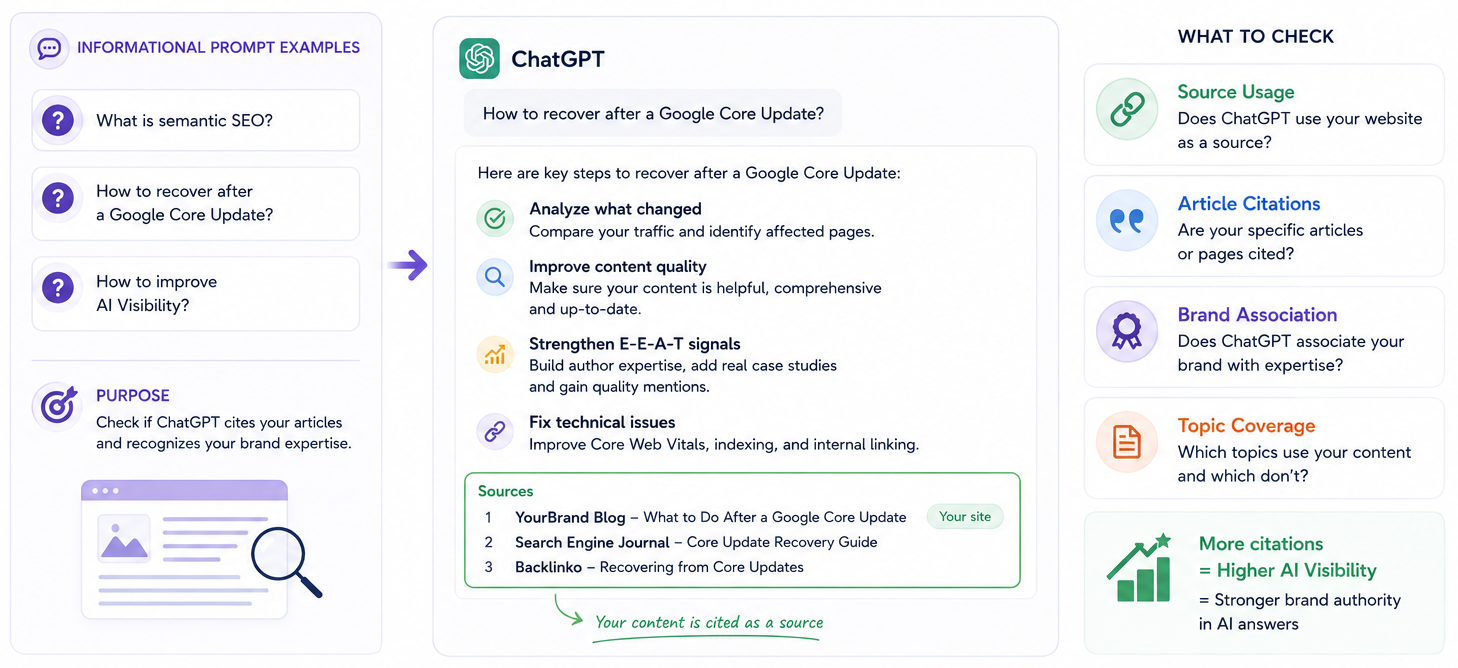
Informational queries provide the clearest indication of how effectively content improves a brand’s AI visibility. The more often ChatGPT uses a company’s content to generate its answers, the more likely the model is to view that brand as an authoritative source of information in its industry.
Unlike traditional SEO, where you can evaluate performance by rankings, organic traffic, or clicks in Google Search Console, there is currently no single standard for measuring AI visibility in ChatGPT. OpenAI does not provide businesses with separate analytics showing how often a brand appears in the model’s responses or which queries lead to it being recommended to users.
For now, the main way to evaluate AI visibility is to regularly test the same set of prompts. Use the same niche-specific, commercial, and informational queries at consistent intervals and document the results. This allows you to compare changes after launching new pages, publishing content, running PR activities, implementing GEO optimization, or making other changes that affect your brand’s digital presence.
When checking a website’s AI visibility, the number of brand mentions alone does not tell the full story. A broader analysis of ChatGPT responses provides much more useful information: how accurately the model understands your business, which pages it uses as sources, which competitors it recommends alongside your brand, and whether those recommendations align with your business priorities.
To measure a website’s AI visibility over time, record the results of these checks in a single table. This makes it easier to track changes for the same prompts and compare performance across different periods.
| Metric | What to Analyze | Why It Matters |
| Brand mention | Whether ChatGPT recommends your company without citing a source, how often it appears in responses, and where it appears relative to competitors | Helps measure your brand’s overall AI visibility for a specific prompt |
| Brand citation | Which articles or pages from your website ChatGPT uses as sources when generating a response | Shows how much your content contributes to your chances of being cited in model responses |
| Accuracy of company description | How accurately ChatGPT describes your business specialization, services, products, markets, and competitive advantages | Helps identify inaccuracies that affect how potential customers perceive your brand |
| Recommended products or services | Which specific products, categories, or services ChatGPT recommends to users | Helps you understand whether the model’s recommendations align with your priority business areas |
| Competitor presence | Which companies are recommended alongside your brand and which are mentioned more often | Helps assess the competitive landscape within ChatGPT, which can differ significantly from Google |
So, how do you measure a brand’s visibility in AI? When analyzing AI visibility, it is better not to rely solely on the total number of ChatGPT brand mentions. You should also track how often the brand appears across different types of queries, whether it shows up in competitor-related responses, how accurately it is described, and how many of its own pages are used as sources.
Also pay attention to new ChatGPT features that directly influence brand AI visibility. For example, OpenAI is already testing ChatGPT Shopping, which gives users product selections that include images, descriptions, prices, and links to stores.
Another area of development is local search integration. ChatGPT responses increasingly display local businesses together with Apple Maps or Google Maps, ratings, addresses, and other business information. For local businesses such as restaurants, medical centers, or brick-and-mortar stores, this type of presence can become just as important as traditional rankings in Google Maps.
If you monitor brand visibility in ChatGPT and find that it rarely mentions your company or does not recommend it at all, the model itself is not necessarily the problem. More often, the issue comes down to your brand’s digital presence and the quality of the information available for ChatGPT to use in its responses.
One of the most common reasons is low brand awareness across the broader information landscape. If independent sources, professional media outlets, industry-specific directories, lists of top companies, and authoritative websites rarely mention the company, ChatGPT has fewer reasons to recommend it alongside competitors. The model looks beyond your official website and also relies on the broader digital footprint your company has built online.
Expert content plays an equally essential role. If the website lacks high-quality informational content or does not cover the topics the target audience is searching for, ChatGPT simply will not have enough relevant sources to cite.
Website structure and clarity are another common issue. If pages lack a clear purpose, duplicate one another, contain conflicting information, or do not clearly explain what your company does and what it offers, the model has a much harder time understanding your expertise. As a result, ChatGPT may describe the business incorrectly or fail to recommend it altogether, even if the company is already well-established in its market.
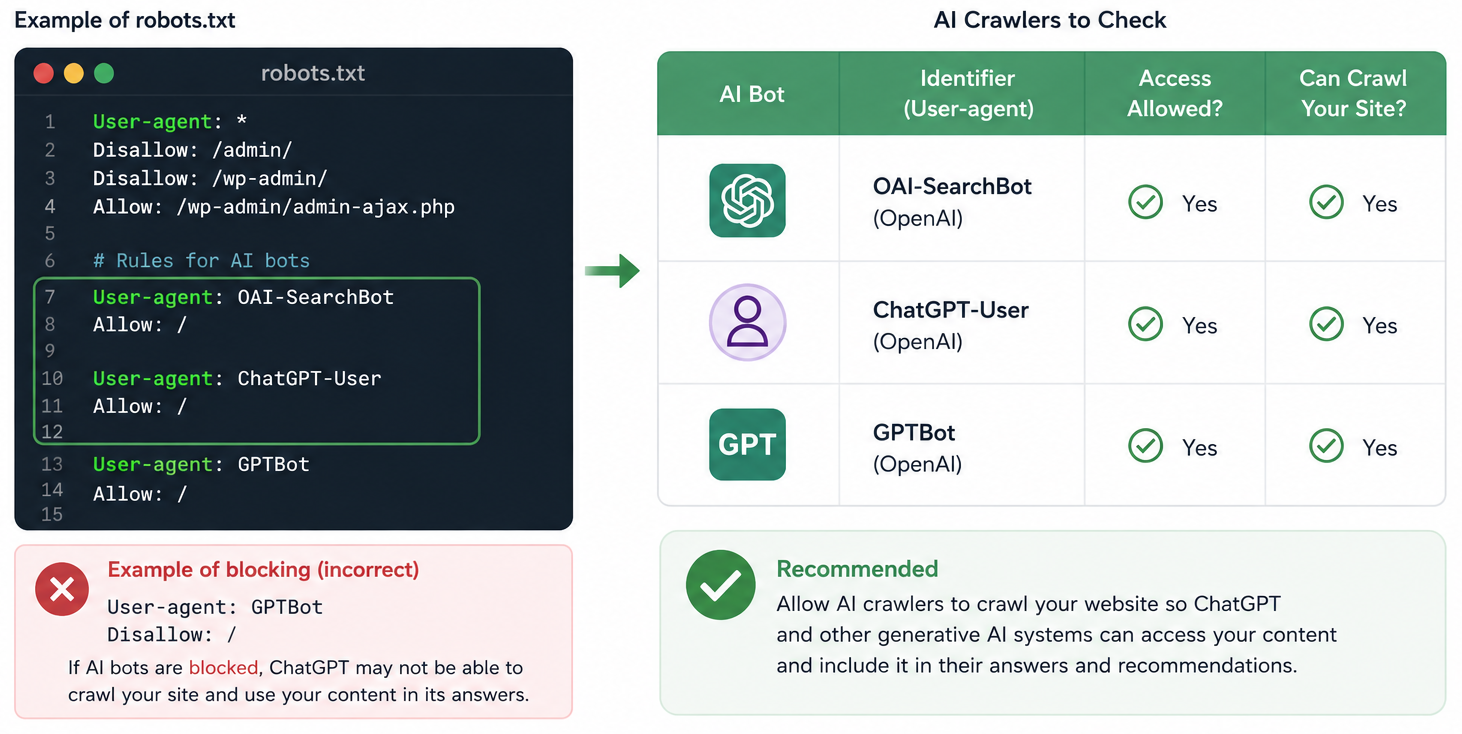
Finally, make sure your site is accessible to AI crawlers. If access to content is restricted through blocks in the robots.txt file, specific CDN or WAF settings, or other protection mechanisms, ChatGPT and other generative systems may not receive up-to-date information about your website. Therefore, checking brand citations in ChatGPT involves not only analyzing generated responses but also verifying the technical accessibility of pages that could potentially be used as sources.
First, we recommend checking access for the main ChatGPT AI crawlers, including:
If these bots are blocked or cannot fully crawl the website, your content may appear less often in ChatGPT responses.
For a comprehensive analysis, it is also crucial to evaluate not only individual responses but also the brand’s overall presence across different AI environments. This makes it possible to determine the brand’s visibility in AI search and whether it is represented consistently across different generative search scenarios.
That is why AI visibility is not something you check once and forget about. It is an ongoing process of monitoring and improvement. Companies that consistently build their expertise, strengthen their digital reputation, and improve content quality have a much better chance of gaining visibility in both Google search results and ChatGPT responses.
Brand visibility in AI search is becoming an increasingly important part of a company’s overall digital presence. Businesses that once competed primarily for higher positions in Google search results now target users looking for recommendations directly from AI systems. That is why ranking well in search is no longer enough. ChatGPT must also understand your business correctly, use your content as a source of information, and recommend your company in responses to relevant queries.
Regularly checking AI visibility helps you understand how ChatGPT perceives your brand at different stages of the customer journey: whether it recommends your company alongside competitors, uses your expert content, describes your services accurately, and presents the right products or solutions to users. A comprehensive analysis of niche-specific, commercial, and informational prompts provides a more objective picture and makes it possible to track changes over time.
If you want to track brand mentions in ChatGPT, identify which pages and materials are being used as sources, and understand how effectively your company is represented across AI systems, the Livepage team can conduct a comprehensive audit and develop a practical GEO strategy focused on long-term growth in AI search visibility.


“Livepage has proven to be a reliable source for rapid online growth. We started with 2,000 visitors per month. In 3 years together with Livepage we have reached 70,000 visitors and more than 100 leads from the site per month.”


“As for the results, we’ve been working together since 2015, and our traffic has increased 10x. I cannot say that Livepage was our first SEO company, but they have become the first SEO partner that helped us to achieve the success we were looking for.”


“Livepage delivers SEO efforts that have led to an increase in the site’s users, traffic, and conversions. The team uses a wide range of tools to achieve the client’s goals. They are attentive to the client’s needs, working with them in real-time and bringing in additional specialists when needed.”


“I am pleased with the quick task execution and the instant replies to my messages.”


“I like the complex approach that the Livepage team offers. Absolutely all team members work together; everyone is aware of what is happening on the project. We have one common goal – to increase our service sales, and the team is making every effort to achieve the goal as soon as possible.”


“We’ve been really impressed by how Livepage quickly understood our business and centred our PPC campaign around our objectives. We have achieved good results within a very short time in both revenue and ROI.”

“Everything is clear, timely, and understandable.”


“They have leveraged ideal opportunities to reach our business goals.”