



9 min reading
GA4 BigQuery Export: When You Really Need It


The impact of link building on AI search in 2026 is no longer about the “future of SEO” but about driving real business results. Data from 2025 showed that if a brand lacks authority and high-quality backlinks, it simply doesn’t get cited in Google AI Overview, ChatGPT, Gemini, or Perplexity.
Since 2022, generative AI has completely changed user behavior. People don’t click through links as much anymore. They get ready-made responses instantly. In 2025, around 60% of searches on Google ended without a click. And when AI Overview was present, the CTR of the #1 result dropped by an average of 34.5%.
So even if you rank #1 in Google, that is no longer a guarantee of traffic. Today, the real question is whether AI mentions your business.
AI systems don’t generate responses out of nowhere. They rely on sources that already have authority in search engines.
That’s exactly why SEO backlinks (link building) still matter in AI search:
Today, AI visibility is not just about being in the top 10 but about being mentioned in the response. If 76% of AI citations come from pages already ranking in the top 10, it becomes obvious that link building plays a critical role in AI search.
Back in 2022, the share of zero-click searches was much lower. By 2025, things changed dramatically: CTR for the #1 result on informational queries with AI Overview dropped from 5.6% to 3.1%. Meanwhile, users get their responses without ever visiting a website.
For businesses, this means:
AI search is reshaping the entire competition model. Before, the fight was for the top 3 positions in search results. Now, it is about becoming the source AI pulls responses from. Visibility is no longer measured only by traffic but by presence inside generative responses.
AI algorithms prefer brands and websites with strong authority signals: high-quality backlinks, media mentions, relevant sources, and expert content. In this context, link building is no longer just a way to improve rankings in Google but a way to build trust at the model level.
If you want to understand the broader value of backlinks, 10 reasons backlinks are important provides useful context. Data for 2025 confirms this:
AI basically “inherits” these trust signals. After analyzing 8,000 AI citations, Search Engine Land concluded that if you want to be cited by ChatGPT, you need to build authority. And authority is built through high-quality links.
AI algorithms still rely on authority shaped by backlinks, but they work more like “trust thresholds”. Until your website reaches a certain level of authority, even strong backlinks may not deliver noticeable results. But once you cross that threshold, every additional high-quality link amplifies the impact significantly.
It is similar to a credit score: if you are below a certain level, a few good actions won’t change much. However, once you pass that threshold, the system starts trusting you more, and every positive signal becomes much more powerful.
The focus on topical relevance also makes semantic link building services worth considering when building authority across related sources.
Practical approach:
In the context of AI search, links are no longer just a ranking factor but the foundation of trust signals that determine whether your brand will even be considered in AI-generated responses.
One of the key findings from Semrush is that nofollow links correlate with AI mentions almost as strongly as dofollow links. In their statistical analysis, both types of backlinks showed nearly the same level of correlation with being cited in AI responses.
This means generative AI models don’t ignore nofollow links. They actually treat them as meaningful signals of authority and relevance when forming responses to user queries.
In the Semrush article, there is a helpful visualization called “Follow vs. Nofollow Correlation with AI Mentions,” which compares how these link types impact how often a brand gets mentioned in AI responses (you can check the original article or ask the author to see the chart).
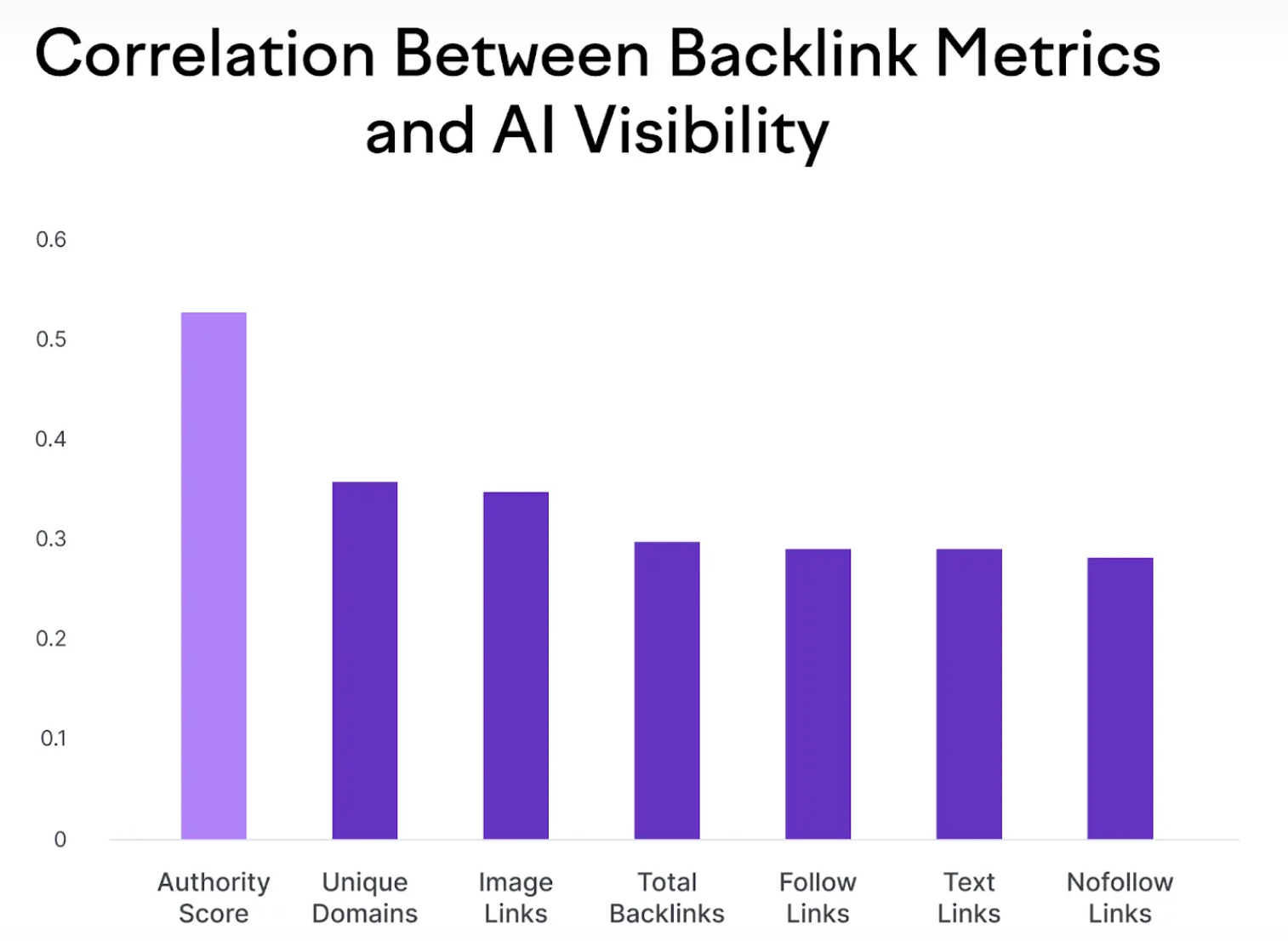
Where nofollow links usually appear and how to use them safely:
So, nofollow links are no longer a “minor” factor. In modern SEO, especially in the context of AI visibility, they play an important role as a source of trust and authority signals for generative models.
These principles are particularly relevant when developing link building for SearchGPT and other generative search platforms.
Strong visibility in AI search comes from a holistic approach that consistently builds brand authority and increases mentions across trusted sources.
Here are the key strategies that help you get into AI-generated responses:
Alongside digital PR and expert content, outreach backlinks can help expand the number of relevant referring domains. Taken together, these tactics don’t just increase the number of links but strengthen your brand’s authority in the eyes of AI. And that directly impacts how often you show up in AI-generated responses and how visible you are in this new search landscape.
Once you understand how link building impacts AI search and which strategies actually work, the next logical question is how you measure the results in practice.
In traditional SEO, we usually focus on rankings and traffic. But in AI search, these metrics no longer tell the full story. That’s why it is important to adopt new ways of measuring performance that reflect how generative responses actually work.
Key factors we use to evaluate performance:
It is also important to track performance using tools like Ahrefs AI Overview and Google Analytics.
AI Overview is a modern response format in generative search, where AI (like ChatGPT, Google SGE, Google Bard, and others) creates a summarized response to a user’s query, often without requiring them to visit a website. For businesses, this creates a whole new visibility paradigm. It is no longer enough to rank at the top of Google; what matters is whether AI recognizes your brand and treats it as a trusted source.
To better show how these metrics work in real life, let’s look at results from our clients where we implemented an AI-focused link-building strategy.
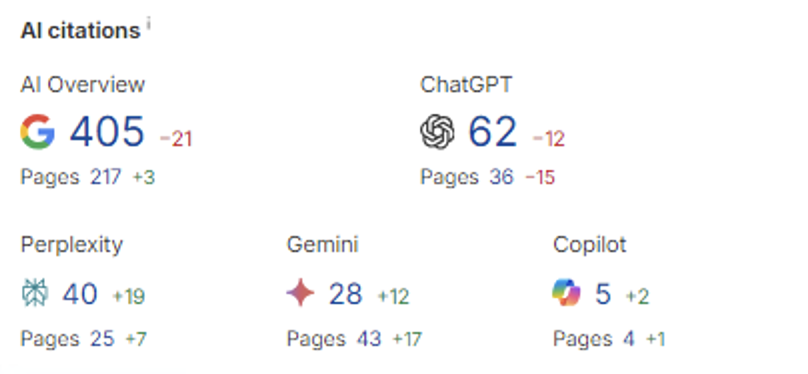
Over a year of working with our team, the brand’s AI visibility grew from almost zero to a consistent presence across key AI platforms.
At the start of the project, mentions in AI Overview, ChatGPT, and other generative systems were minimal or non-existent. The brand simply didn’t appear in AI responses for key informational queries.
Over the course of the year, we:
As a result, the brand now has hundreds of mentions in Google AI Overview, a stable presence in ChatGPT, Perplexity, Gemini, and Microsoft Copilot, and a growing number of pages being cited by AI models.
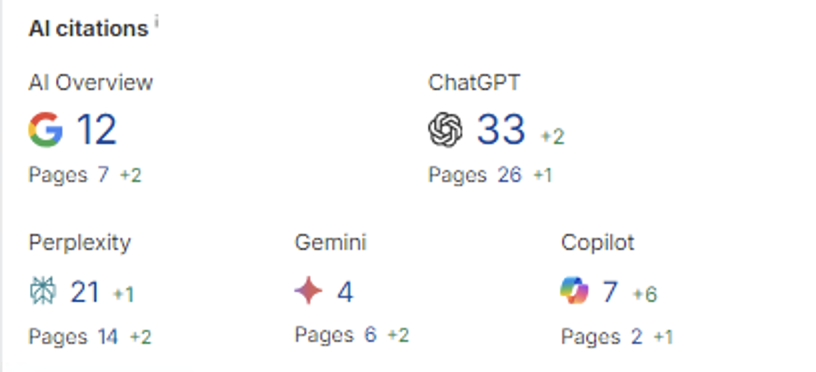
At the start, the Game Development client had almost no presence in AI search. The brand barely appeared in Google AI Overview, and mentions in other AI systems were rare.
What we see now:
As a result, we are seeing gradual brand solidification in AI responses, expanded content coverage, and growing authority within a niche market.
This creates a strong foundation for further scaling. Based on current trends, this direction has the potential for significant growth in AI visibility in the near future.
Google Analytics (GA) is a web analytics tool by Google that helps you track and analyze user behavior on your website or app. It shows where visitors come from, what they do on your pages, how long they stay, what actions they take, and what drives conversions.
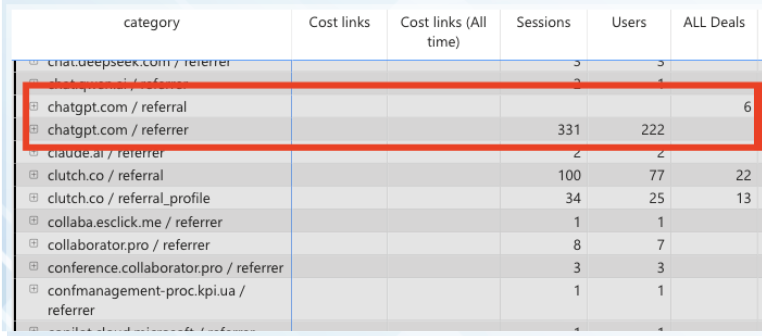
Data from GA4 clearly confirms the effectiveness of our AI-driven strategy:
This means AI search is bringing in real users, not just visibility. We are seeing actual traffic coming to the website. ChatGPT has become one of the most effective referral sources: unlike many other channels, it is driving real deals. These results are direct proof that AI SEO and link building work, turning AI mentions into actual business outcomes.
So, the combination of these metrics (mentions across AI platforms, share of voice in AI responses, growth in referring domains, increase in branded searches, along with data from Ahrefs AI Overview and Google Analytics) gives a complete picture of how effective an AI-focused strategy really is.
We are not just seeing growth in brand visibility in generative search, but how visibility turns into real business outcomes: broader reach, stronger authority, expanded content impact, and actual conversions. This kind of momentum shows that a brand is confidently securing its place in the AI search ecosystem, building a competitive edge, and laying the groundwork for scalable growth in the near future.
Our Apriorit promotion case can provide another practical example of how SEO and link building can support business growth.
In 2025, link building became one of the key factors determining whether your brand shows up in responses from ChatGPT, Gemini, Perplexity, and other AI systems. In 2026, its impact is only growing.
Generative search is no longer focused solely on traditional SEO signals. It builds responses based on sources it trusts. And as data from 2025–2026 shows, trust depends directly on domain authority, the diversity of mentions, and backlink quality.
Research also confirms that AI-focused link building doesn’t just drive mentions but brings in real users, measurable traffic, and actual revenue. The more often your brand is cited in generative search, the more users perceive it as a trusted source even before they visit your website.
A strong combination of authority, a diverse link profile, and consistent presence in generative sources gives your brand a real strategic advantage. And that directly translates into traffic, leads, and scalable business growth.
If you are looking to turn your brand into a successful example of AI search visibility, the Livepage team can help you build an effective link-building and AI visibility strategy tailored to your niche and business goals.


“Livepage has proven to be a reliable source for rapid online growth. We started with 2,000 visitors per month. In 3 years together with Livepage we have reached 70,000 visitors and more than 100 leads from the site per month.”

“As for the results, we’ve been working together since 2015, and our traffic has increased 10x. I cannot say that Livepage was our first SEO company, but they have become the first SEO partner that helped us to achieve the success we were looking for.”


“Livepage delivers SEO efforts that have led to an increase in the site’s users, traffic, and conversions. The team uses a wide range of tools to achieve the client’s goals. They are attentive to the client’s needs, working with them in real-time and bringing in additional specialists when needed.”


“I am pleased with the quick task execution and the instant replies to my messages.”

“I like the complex approach that the Livepage team offers. Absolutely all team members work together; everyone is aware of what is happening on the project. We have one common goal – to increase our service sales, and the team is making every effort to achieve the goal as soon as possible.”

“We’ve been really impressed by how Livepage quickly understood our business and centred our PPC campaign around our objectives. We have achieved good results within a very short time in both revenue and ROI.”

“Everything is clear, timely, and understandable.”


“They have leveraged ideal opportunities to reach our business goals.”