




9 min reading
GA4 BigQuery Export: When You Really Need It



Many companies invest in SEO but don’t always get the results they expect. Organic traffic isn’t growing, rankings remain unchanged, and new pages don’t make it to the top for months. The reason is often not a lack of specific SEO efforts, but rather an incorrect strategy, misplaced priorities, or mistakes that have accumulated over the years. In such situations, a business may need SEO consulting.
SEO consulting is a form of expert collaboration in which an SEO specialist evaluates the state of a website, identifies areas for growth, determines priority areas for development, and develops a plan of action. Unlike traditional SEO promotion, the main value of consulting lies not only in completing specific tasks but in making decisions that impact long-term results.
In practice, a company may have an in-house marketing team or work with a contractor, but organic traffic stops growing as a result. An independent outside perspective helps identify critical mistakes, review the SEO strategy, and focus on changes that will potentially have the greatest impact.
In this article, we’ll explore what is SEO consulting, how it differs from an SEO audit and comprehensive promotion, when a business should turn to an SEO consultant, what challenges an SEO consultant helps solve, and what the process entails.
Although SEO consulting, SEO audits, and comprehensive SEO promotion are often mentioned together, they are different forms of collaboration that address different business objectives. This is precisely why many companies do not fully understand which service is right for them.
SEO consulting is expert support that helps businesses make decisions regarding the development of their organic traffic channel. An SEO consultant analyzes the current state of a website, assesses its strengths and weaknesses, identifies areas for growth, and helps develop an SEO strategy and prioritize tasks. The implementation of these recommendations can be carried out by an in-house team, developers, marketers, or a third-party agency.
Comprehensive SEO promotion involves a broader scope of work. While consulting answers the questions “what needs to be done and why,” SEO promotion also involves implementation: technical optimization, work on semantics and content, building a backlink profile, monitoring rankings, and continuously refining the strategy.
SEO consulting should also not be confused with an SEO audit.
An audit is one of the consultant’s tools. Its main purpose is to comprehensively analyze a website, identify technical, content-related, and strategic issues, and prepare recommendations for resolving them. Once the report is delivered, the collaboration typically ends.
Consulting is broader in scope: it helps understand the root causes of problems, assess their impact on the business, set priorities, and, if necessary, oversee the implementation of recommendations.
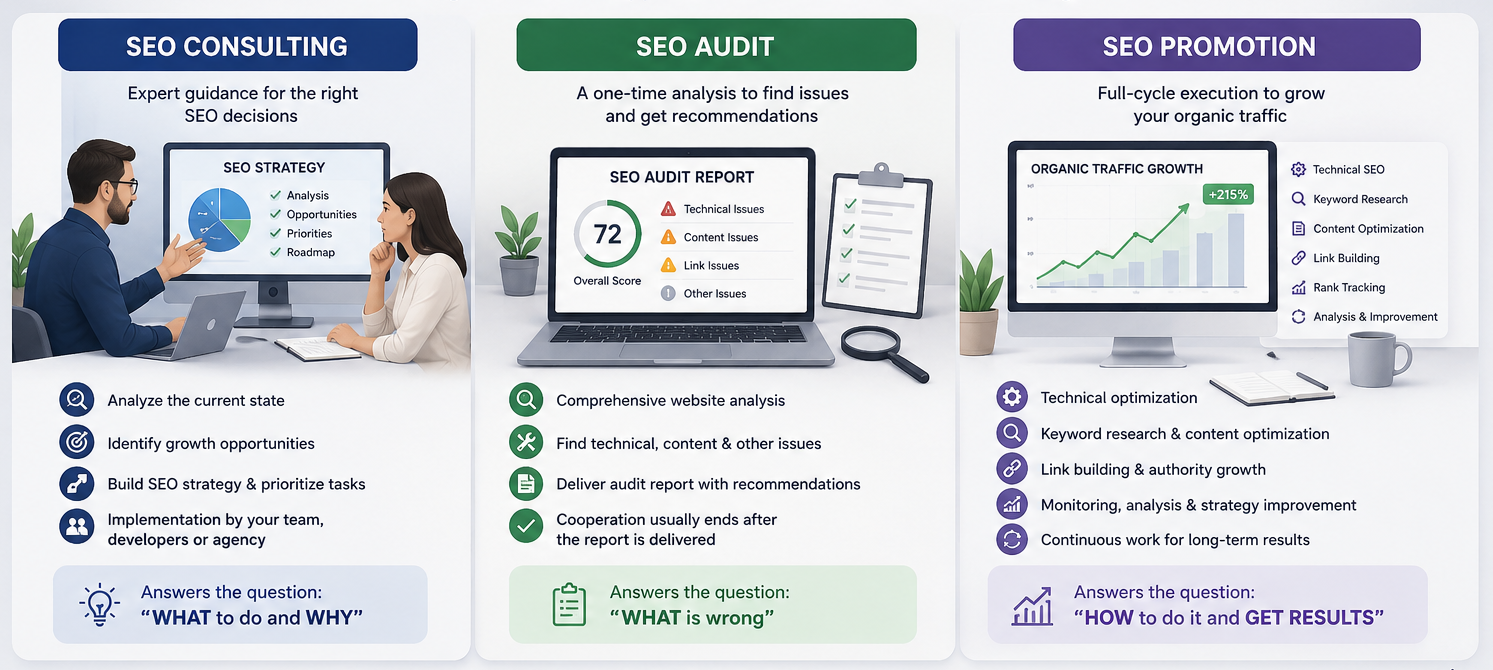
Therefore, an SEO audit and SEO consulting are not interchangeable services. If a company only needs a list of technical and content-related issues, an audit is sufficient. However, if the goal is to understand why SEO isn’t working, what steps to take next, and how to monitor results, it makes more sense to opt for SEO consulting.
If a company does not have an in-house SEO team and wants to fully outsource the development of its organic channel, it makes more sense to choose SEO promotion. If the company has a team but needs strategic support or an independent assessment, consulting will be a more flexible option.
SEO consulting is needed when a business identifies a problem but doesn’t understand its cause or can’t determine the right course of action. For example, a website isn’t growing despite regular SEO efforts, traffic drops sharply after a Google update, the team is preparing a redesign, or the company is planning to enter a new market. In each of these cases, it’s not enough to simply identify individual mistakes—it’s important to evaluate the entire promotion strategy, pinpoint critical areas, and understand which changes will have the greatest impact on the results.
A company may invest in SEO for months or years—regularly publishing content, optimizing pages, buying backlinks, and carrying out technical tasks—yet see no growth in traffic, search rankings, or leads. Often, the problem isn’t a lack of activity, but rather that these efforts aren’t guided by a unified strategy.
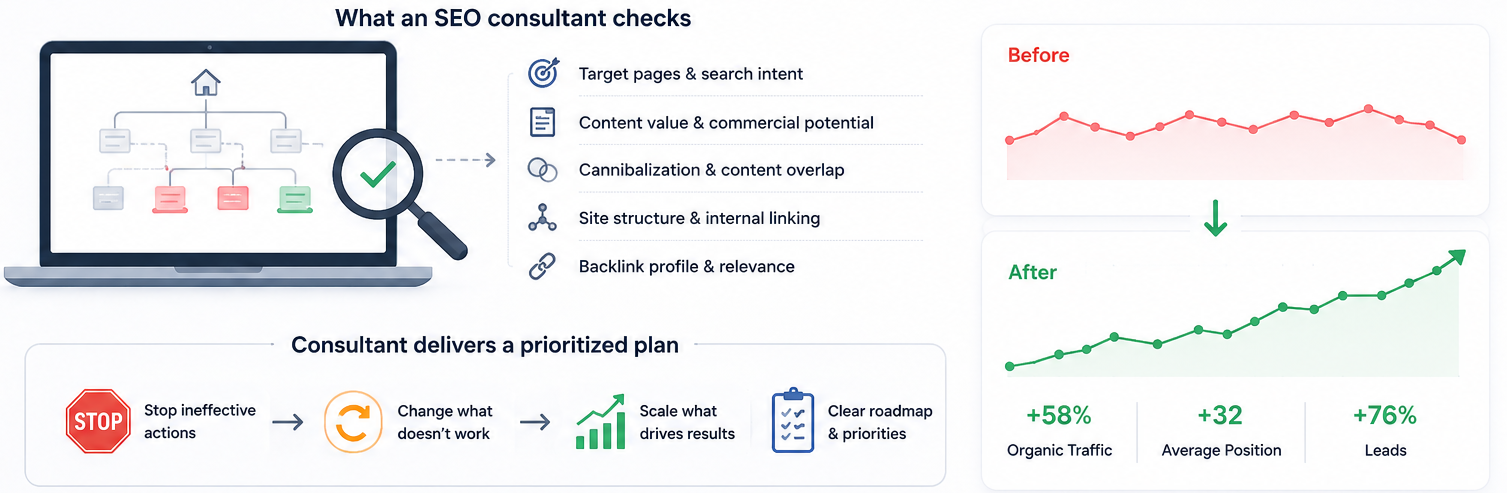
During the consulting process, it is important to verify whether the landing pages have been selected correctly, whether they align with search demand, whether they compete with one another, and whether they have commercial value. For example, a company may be spending significant resources on informational content that drives traffic but has almost no impact on sales. At the same time, core services may be promoted for overly competitive or irrelevant search queries.
It’s also important to assess the technical condition of the website, its structure, internal linking, and backlink profile. The content may be high-quality, but a weak structure or cannibalization prevents Google from identifying priority pages. Links may be acquired regularly, but they may not be strengthening priority pages or business areas.
The consultant’s task is not to add even more work, but to determine what should be stopped, changed, or scaled. As a result, the business receives a prioritized plan: what to fix immediately, which changes can yield faster results, and what needs to be developed in the long term.
A drop in organic traffic isn’t always related to Google algorithm updates. The cause could be technical changes to the website, indexing issues, lost pages, incorrect redirects, URL changes, content removal, a weakened backlink profile, or competitor activity. Sometimes a decline in analytics data can actually be caused by changes in tracking settings rather than a real loss of organic visibility.
The first step in SEO consulting is to verify whether the website has actually lost search traffic. To do this, we compare data from Google Search Console, analytics systems, keyword rankings, indexing, and the performance of specific directories or page types. This helps determine whether the decline affected the entire site or only specific categories, countries, language versions, or query clusters.
Next, we correlate the date of the decline with changes made to the site. For example, if traffic began to decline after a redesign, they check meta tags, canonical tags, page templates, internal links, JavaScript rendering, and content accessibility for search bots. If the drop coincided with a Google update, they analyze the pages that lost visibility and compare them to the pages that maintained their rankings.
The result should be the identification of the likely cause, the extent of the losses, and a recovery plan: ranging from restoring pages and fixing redirects to updating content, eliminating cannibalization, or revising the link-building strategy. It is important that the business receives not an abstract recommendation to “improve quality,” but a list of specific actions tied to the identified problems.
Pre-launch SEO consulting helps you avoid mistakes that are more difficult and expensive to fix after the site goes live. The design and development may be high-quality, but they might not take into account search demand, the logic behind the site structure, the necessary page types, URL formatting rules, and internal linking.
During the preparatory stage, the consultant helps develop the website’s structure based on semantics and business areas. This is especially important for websites with a large number of services, categories, locations, or language versions. Excessively grouping areas into a few pages complicates ranking, while excessive fragmentation creates many weak URLs with nearly identical content.
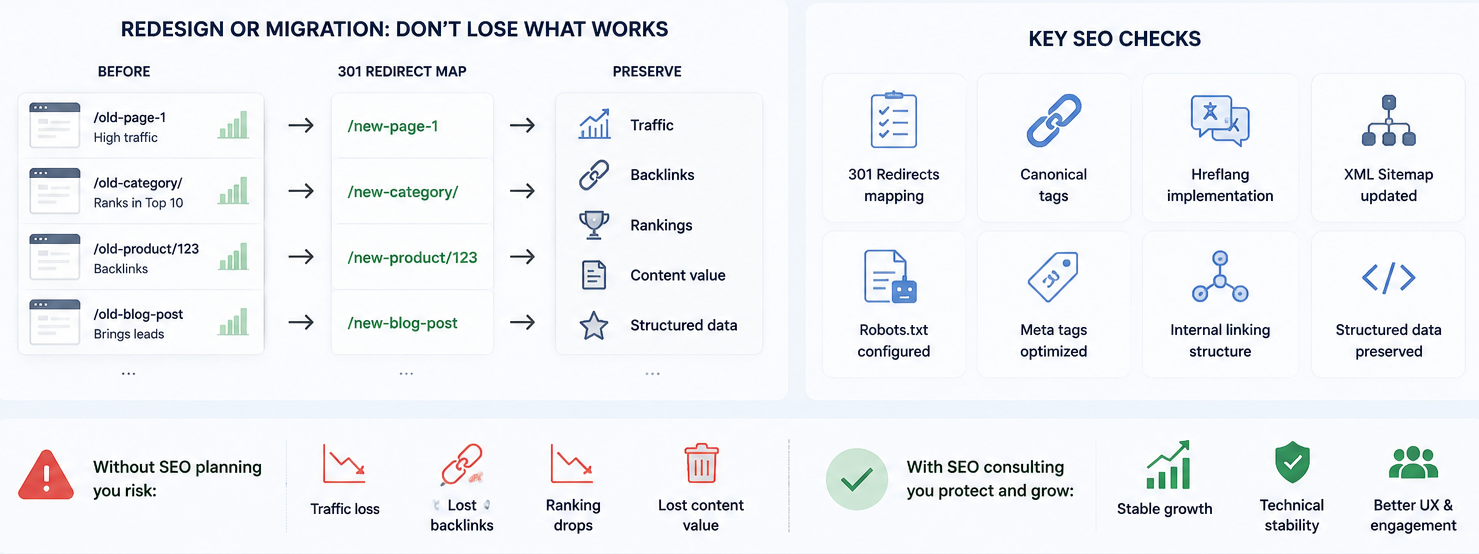
When it comes to redesigning or migrating an existing website, pages that drive traffic, have backlinks, or rank well are preserved in advance. For changed URLs, prepare a 301 redirect map and check canonical tags, hreflang attributes, sitemaps, robots.txt, metadata, and internal links. It’s also important not to lose content and structured data that help pages rank.
Before launch, a consultant can test the site’s beta version, and after launch, monitor indexing, redirects, response codes, and the performance of key pages. This significantly reduces the risk of a critical loss of organic traffic due to technical errors.
Scaling SEO isn’t just about increasing the number of articles or backlinks. It typically involves entering new markets, launching additional services, expanding the product range, creating localized pages, or developing multiple language versions of the website. Without prior analysis, this can lead to a scattered budget, duplicate pages, and competition among the company’s own business areas.
As part of SEO consulting, the potential of each new business area is first assessed: search demand, competition, commercial value, the website’s current rankings, and the resources needed to reach the top. This allows us to identify clusters with the best balance of potential, complexity, and business value.
For international expansion, we also take into account local semantics, language differences, domain or subdirectory structures, hreflang tags, and local competitors. Simply translating pages is usually not enough: people in different countries may search for the same service in different ways.
A separate task is to prepare internal processes for an increase in the volume of SEO consulting company work. The consultant helps establish templates for technical tasks, page optimization rules, content requirements, a priority system, and monitoring metrics. Thanks to this, scaling doesn’t turn into the chaotic creation of hundreds of URLs, but instead follows a clear model that can be supported by the content team, developers, and marketers.
What is included in SEO consulting services depends on the business’s objectives, the current state of the website, and its stage of development. For a new project, the main focus may be on demand research, structure, and development requirements. For a website that is already being promoted, it becomes more important to review the strategy, identify the causes of stagnation, and monitor the quality of the work performed.
Therefore, SEO strategy consulting for a website should not be reduced to a one-size-fits-all list of recommendations. The format of SEO consulting for a website is tailored to specific objectives: first, the consultant must understand the business model, goals, priority products, and resources, and only then analyze the website and develop a growth plan.
The process begins with understanding how the company generates revenue and what role organic search should play in its marketing strategy. The consultant identifies priority products and services, target markets, geographic reach, the typical customer, the sales cycle, and the value of various conversions.
SEO should not be evaluated solely by the number of clicks. An informational section may drive a lot of traffic but have almost no impact on sales. At the same time, a few niche commercial pages with lower traffic may generate the majority of organic leads. Therefore, priorities are determined not only by search volume but also by commercial potential.
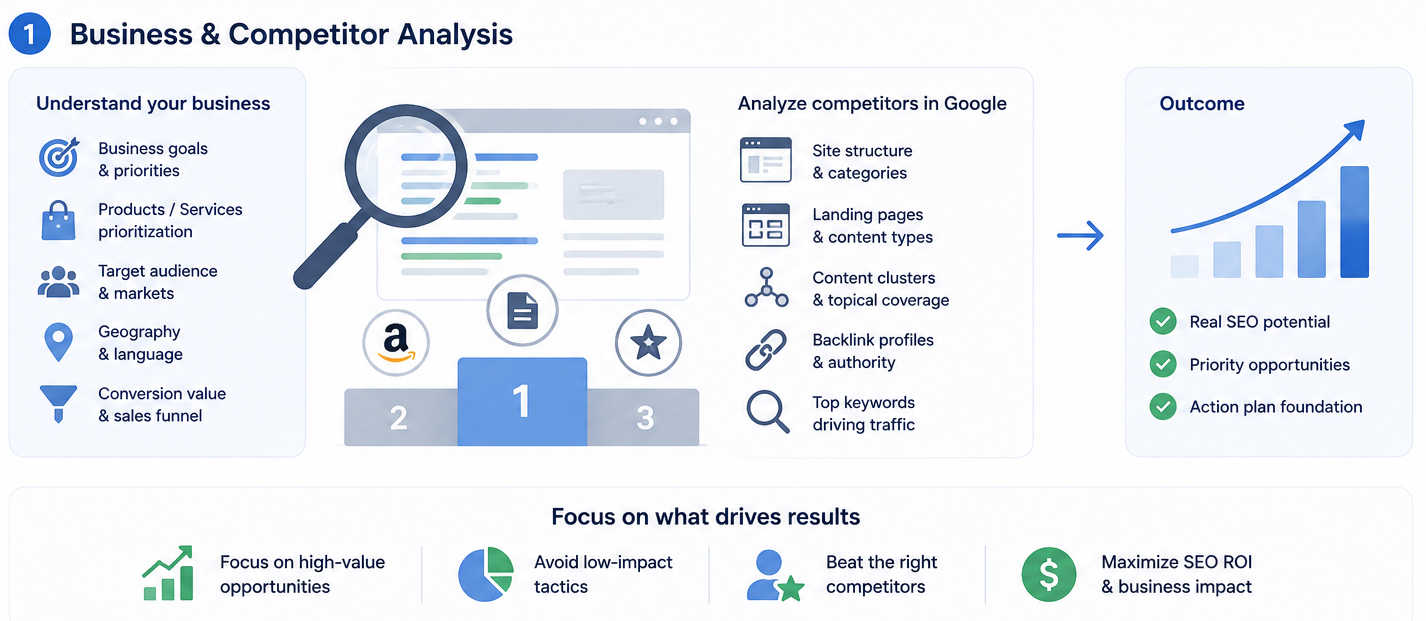
At the same time, competitors in search results are analyzed. They do not always coincide with the companies that a business considers its direct market competitors. On Google, a website may compete with marketplaces, aggregators, major media outlets, niche services, or local companies that have optimized specific groups of search queries more effectively.
During competitive analysis, we evaluate website structure, featured categories and services, types of landing pages, content clusters, backlink profiles, and the search queries through which competitors drive traffic. The goal is not to copy their approach, but to understand the niche’s requirements, identify missed growth opportunities, and determine where the business can develop a stronger offering.
The result of this stage is an understanding of the project’s true SEO potential: which areas should be prioritized, where competition aligns with the website’s capabilities, which pages need to be created, and what resources will be required to achieve the desired results.
After analyzing the business, we conduct a comprehensive SEO audit. Its goal is not simply to compile a list of errors from specialized services, but to identify the factors that are actually limiting the website’s visibility and to determine how much they impact the results.
The technical portion covers checking indexation, response codes, redirects, canonical URLs, robots.txt and sitemap files, duplicate pages, URL parameters, pagination, and internal linking. For multilingual or international websites, we also analyze hreflang tags and the structure of language versions.
A separate check is performed to determine whether Google can fully crawl and display the main content. This is especially important for websites built on JavaScript frameworks, where text, links, or metadata may only appear after certain scripts have executed. Loading speed, mobile responsiveness, and the stability of page templates are also evaluated.
Content analysis determines whether pages align with search intent, cover the topic comprehensively, and do not compete with one another. We check semantics, headings, metadata, text structure, internal links, duplication, and keyword cannibalization. For commercial pages, it is also important to assess whether they contain the information users need to make a decision.
When analyzing a backlink profile, we evaluate the dynamics of donor domains, the quality and relevance of links, anchor text, target pages, and potential risks in future link building. It is important to understand whether the links support priority pages and whether the current dynamics match those of competitors.
All issues are prioritized based on their impact and the complexity of implementation. Critical errors that block indexing or lead to the loss of pages should not be treated on the same level as minor meta tag adjustments.
An SEO strategy transforms research and audit findings into a coherent development plan. It determines which issues to address first, which pages to optimize, which query clusters to target, and how to allocate resources among technical optimization, content, and link building.
First and foremost, we define goals and performance metrics: organic leads, sales, revenue, visibility of commercial queries, or growth in specific categories. Overall traffic alone isn’t always indicative, as it can increase due to informational pages without impacting business results.
Next, a plan for developing the site’s structure and content is formulated: creating new landing pages, expanding categories, updating content, eliminating cannibalization, and building thematic clusters. For each area, we identify target queries, search intent, the page’s role in the funnel, and links to other sections of the site.
Technical tasks are integrated into the strategy, taking into account the development team’s capabilities. If resources are limited, the consultant distinguishes critical changes from those that can be deferred to later stages.
The link-building strategy must also align with business goals: we identify pages that need strengthening, the required growth rate for new domains, acceptable anchor text distribution, and relevant types of linking sites.
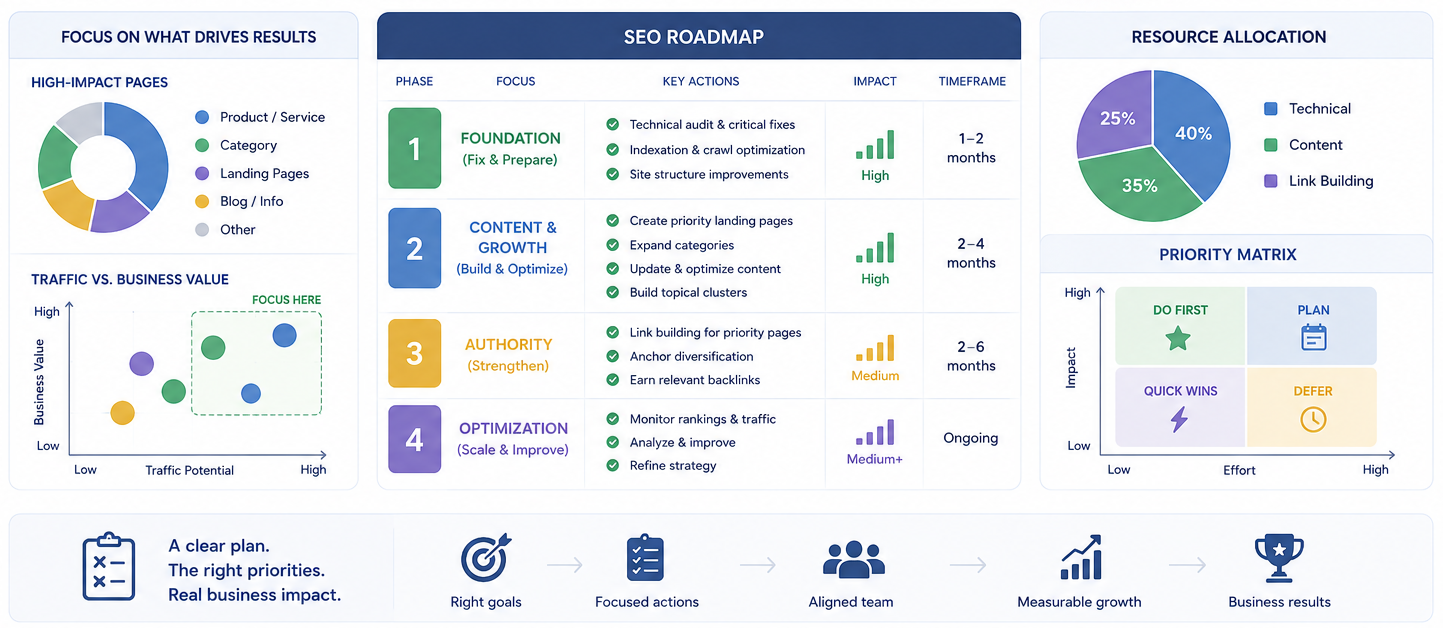
As a result, the company receives a realistic roadmap with phases, priorities, responsible parties, and evaluation criteria. It takes into account the budget, developer availability, the content team’s capabilities, and expected timelines.
Even a high-quality audit and a detailed strategy will not yield results if the recommendations are misunderstood, partially implemented, or postponed indefinitely. Therefore, an important part of consulting is providing support to the team during implementation.
A consultant helps translate recommendations into clear tasks for developers, copywriters, designers, and marketers. Technical specifications describe not only the requirements but also the logic behind the functionality, exceptions, and validation criteria.
Additional questions or technical limitations may arise during implementation. For example, the CMS may not support the proposed solution, a template change may affect several page types, or developers may suggest an alternative. The website SEO consultant evaluates such trade-offs and helps choose a solution that avoids new risks.
After implementation, the following are always checked: response codes, indexing, canonical tags, metadata, internal links, and content display. Monitoring is especially important after migrations, redesigns, and large-scale template changes.
Ongoing support also includes regular analysis of results. The consultant tracks changes in rankings, organic traffic, conversions, and the visibility of priority pages, and adjusts the plan as needed. If a specific solution does not yield the expected results or the competitive landscape changes, the strategy is adapted.
Thus, the outcome of consulting is not merely an audit or a strategy document, but expert support ranging from identifying problems and growth opportunities to verifying implemented solutions and assessing their impact.
A prime example of how SEO consultancy for businesses helps transition from isolated tasks to a systematic strategy is our collaboration with OSTRIV, an online store for branded clothing. The client turned to Livepage for comprehensive SEO consulting and a technical audit following a redesign, migrations, and previous SEO work performed by another contractor. The goal was to assess the site’s current state and determine whether it had a solid foundation for further growth.
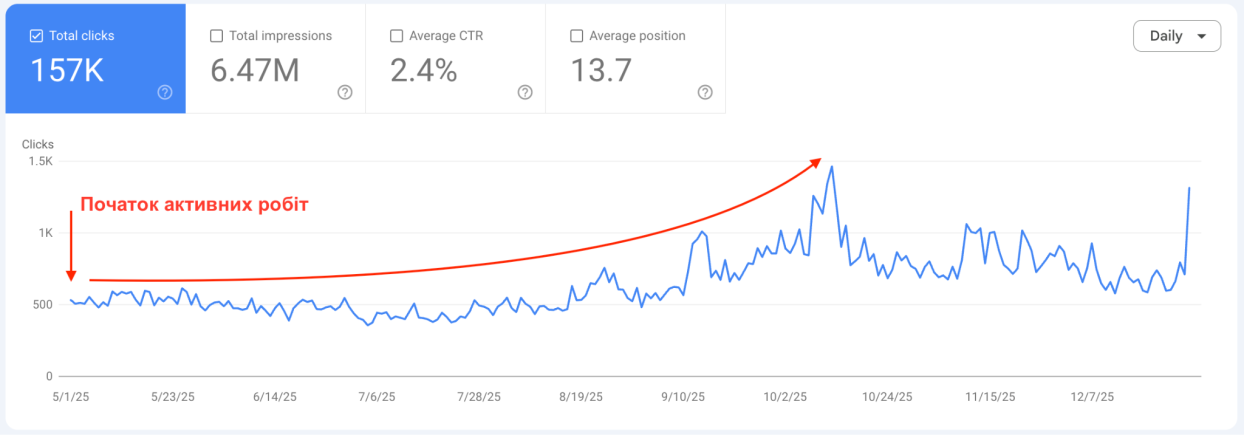
Previous marketing efforts did not give the business a sense of control over the situation. Despite regular work, the website did not show stable growth, and structural changes created new problems. Therefore, the main goal of the audit was not simply to identify individual errors, but to explain what exactly was hindering the site’s visibility and which solutions needed to be implemented first.
During the analysis, we identified systemic technical issues: widespread redirects in internal linking, incorrect canonical tags, duplicate pages, outdated URLs in the sitemap, and indexing problems. Formally, the site functioned correctly for users, but it sent a large number of conflicting signals to Google. Under these conditions, scaling up content, brand pages, and link building was not advisable.
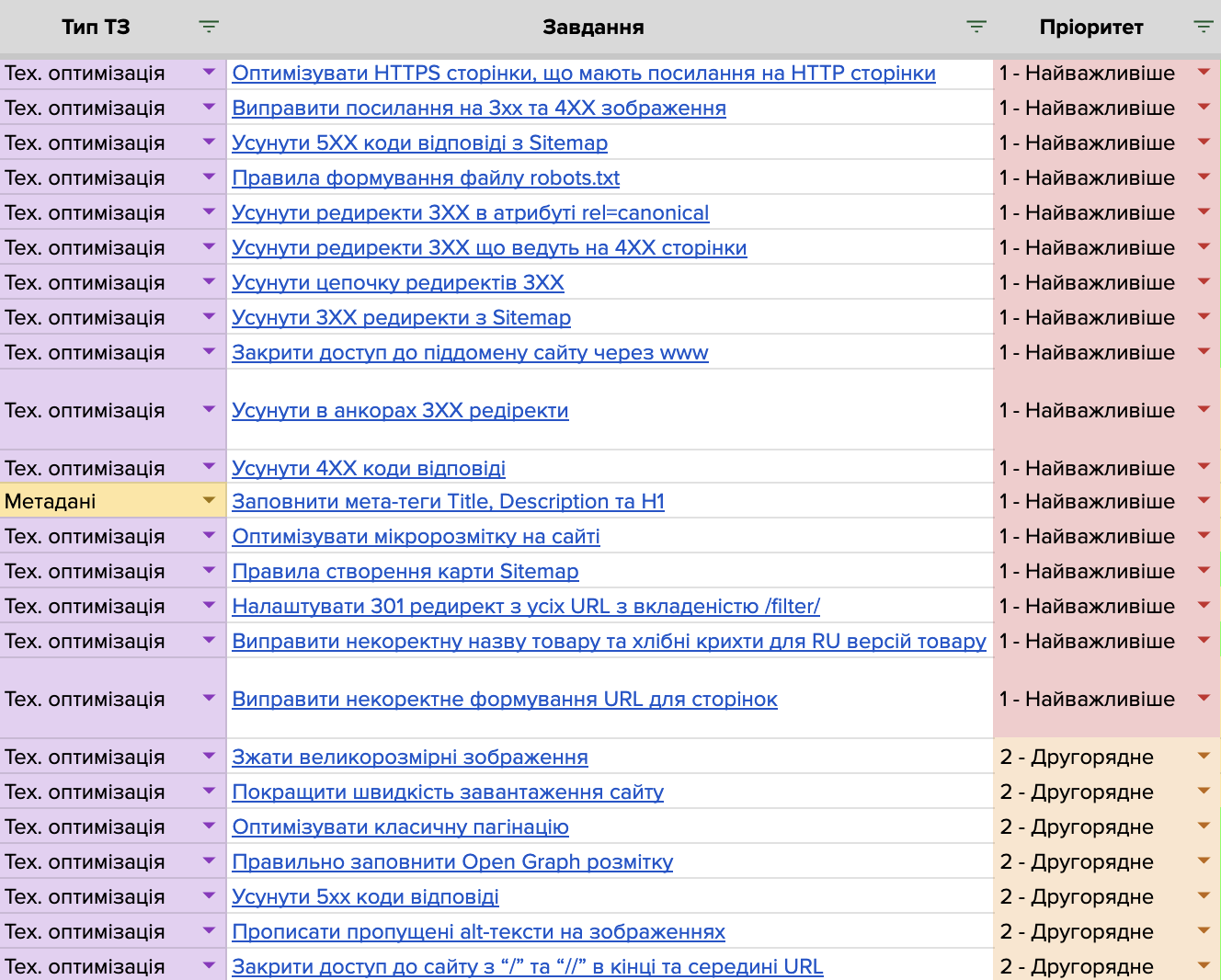
The results of the SEO consultation served as the foundation for our team to move forward with a comprehensive promotion strategy. Initially, the team focused on stabilizing the website’s technical infrastructure, streamlining its structure, and eliminating duplicate content and redirects; only then did they move on to developing semantic structure, optimizing brands and categories, and improving internal linking and the external profile.
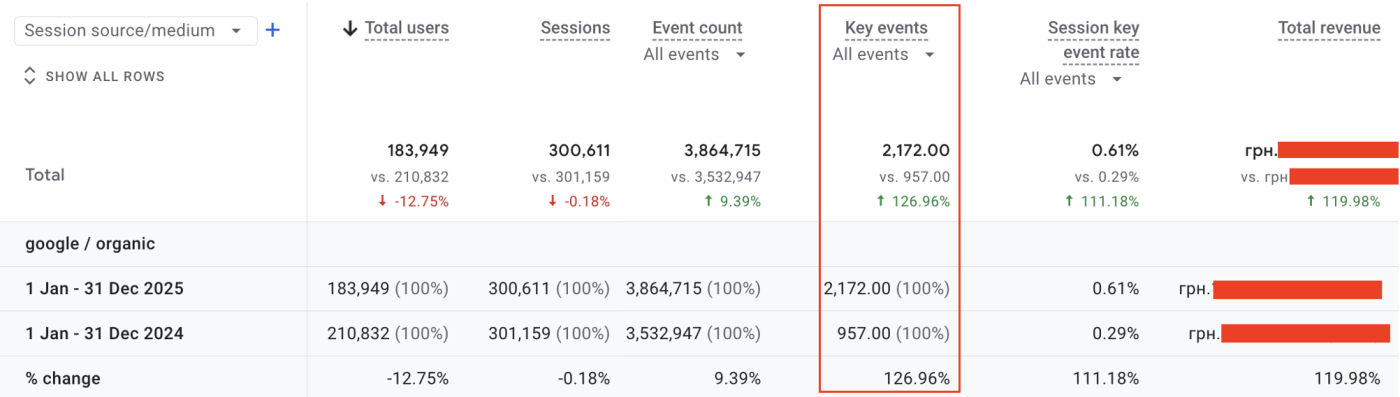
As a result, the share of top-10 keyword queries increased from 21% to 49%, and the number of new conversions rose by 127%. This case study clearly demonstrates that SEO consulting need not be a one-time audit, but rather a starting point for systematic work, where a business first obtains an objective picture of its situation and then invests in scaling up on a stable technical foundation.
Why is SEO consulting necessary? First and foremost, to obtain an independent assessment of a website’s condition, understand the causes of problems, and identify priority actions. This is not a one-time consultation or an alternative to SEO promotion, but rather expert guidance in making strategic decisions.
If you want to understand how search engine optimization consulting works, just look at the process: first, the business and website are analyzed; then, problems and opportunities are identified; a strategy is developed; the team is helped to implement it; and the results are evaluated.
When is SEO consulting needed? The service is most valuable when important decisions need to be made: before launching a new project, migrating or redesigning a website, entering new markets, or when organic traffic isn’t performing as expected. In such situations, a timely expert assessment helps avoid costly mistakes, set priorities correctly, and focus resources on the changes that drive results.
At Livepage, we view consulting as a comprehensive process that combines business analysis, an in-depth website audit, strategy development, and support for its implementation. If you’re planning to scale your business, launching a new website, or want to understand why your SEO isn’t delivering the expected results, reach out to the experts at Livepage. We’ll help you assess the current situation, identify priority areas, and develop a practical plan for the long-term growth of your organic traffic.


“Livepage has proven to be a reliable source for rapid online growth. We started with 2,000 visitors per month. In 3 years together with Livepage we have reached 70,000 visitors and more than 100 leads from the site per month.”


“As for the results, we’ve been working together since 2015, and our traffic has increased 10x. I cannot say that Livepage was our first SEO company, but they have become the first SEO partner that helped us to achieve the success we were looking for.”


“Livepage delivers SEO efforts that have led to an increase in the site’s users, traffic, and conversions. The team uses a wide range of tools to achieve the client’s goals. They are attentive to the client’s needs, working with them in real-time and bringing in additional specialists when needed.”


“I am pleased with the quick task execution and the instant replies to my messages.”


“I like the complex approach that the Livepage team offers. Absolutely all team members work together; everyone is aware of what is happening on the project. We have one common goal – to increase our service sales, and the team is making every effort to achieve the goal as soon as possible.”


“We’ve been really impressed by how Livepage quickly understood our business and centred our PPC campaign around our objectives. We have achieved good results within a very short time in both revenue and ROI.”

“Everything is clear, timely, and understandable.”


“They have leveraged ideal opportunities to reach our business goals.”