



1 min reading
Review of Cooperation with Livepage from MISSIA Bridal



A website can attract thousands of visitors every day and still generate no sales. Traffic by itself does not convert into profit without a properly configured system for capturing and retaining contact information.
In this article, we’ll break down what lead generation is, how leads are classified, which acquisition channels actually work, and how to avoid mistakes that waste your budget.
Lead generation is the process of attracting potential customers and collecting their contact information for subsequent conversion into buyers. The goal of lead generation is to create a predictable, measurable flow of interested users that does not depend on external factors such as seasonality or market fluctuations.
What is lead generation in practice? It is a mechanism that turns a visitor’s interest into a specific action — providing an email address or phone number, submitting an inquiry form, and so on.
A business that approaches lead generation systematically gains several advantages: the company no longer depends on random demand, sales managers work with real inquiries, and the marketing campaign delivers measurable results.
A lead is a visitor who has shown interest in a product or service and left their contact information: name, email address, phone number, or social media profile.
What are leads in simple words? In a broader sense, a lead is the key link between marketing and sales, without which the sales funnel simply would not exist. Leads are classified by their level of readiness to buy, from initial interest to an active intention to close a deal.
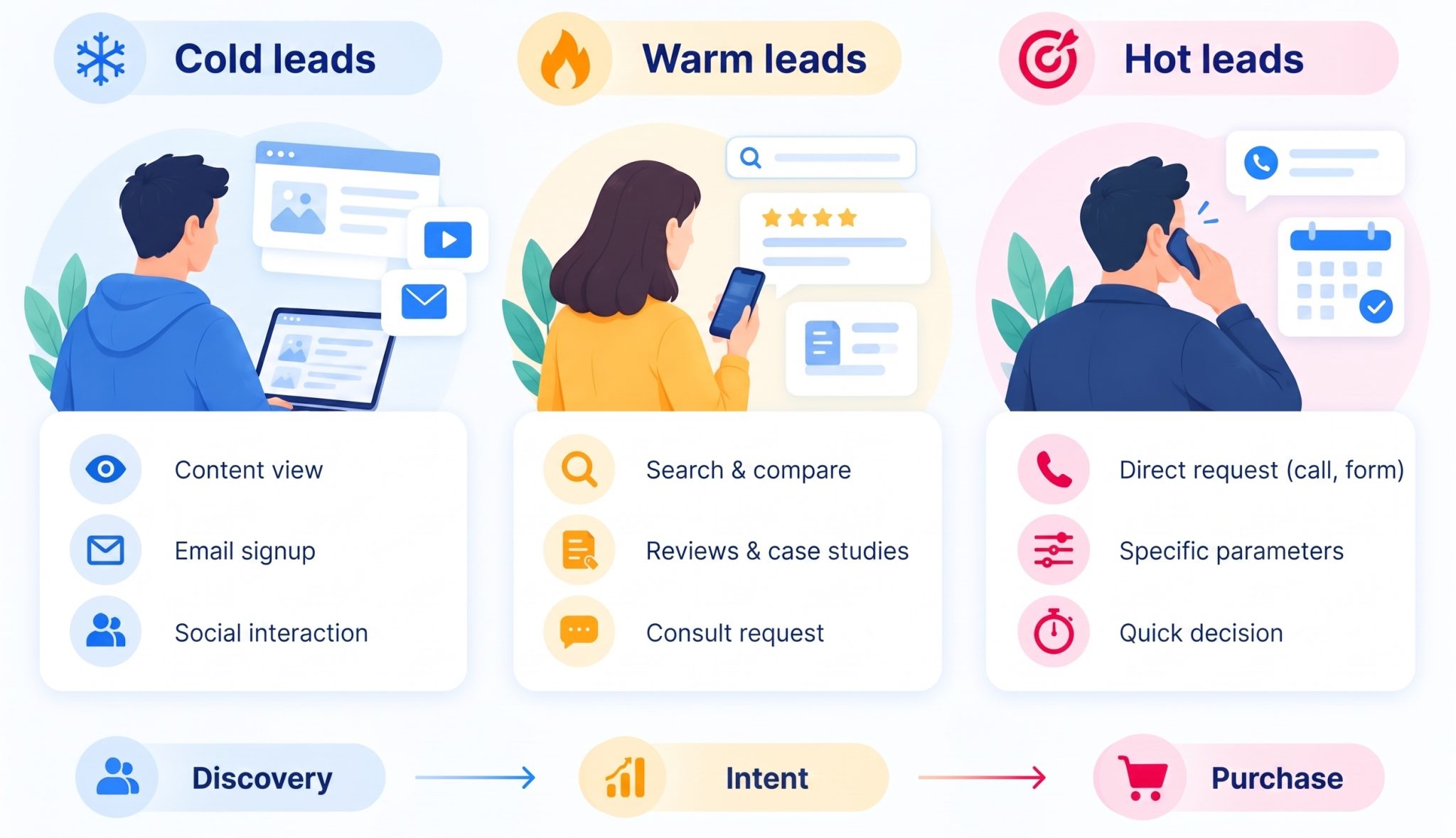
Cold leads are users who have encountered a brand or product for the first time and do not yet have a clear intention to buy. At this stage, marketing’s task is to nurture the audience through useful content, email campaigns, and retargeting. These leads should not be handed over to the sales team, as doing so demotivates the team and lowers the funnel’s overall CR (Conversion Rate).
Warm leads are potential customers who have already identified their problem and are actively looking for a solution. They compare providers, read reviews, and look through case studies. With warm leads, you can move into a more focused conversation by offering a call, a free audit, or a consultation.
Hot leads are the most desirable segment for any business because they are ready to make a purchase in the near future, have already formulated their request, and are looking for a specific provider. Response time to a hot lead directly affects the likelihood of closing the deal, and every hour of delay reduces conversion.
Most companies eventually face the problem of unstable sales. Lead generation helps:
Lead generation strategies fall into two main categories, depending on who initiates the contact — the customer or the business.
Inbound lead generation attracts potential customers through useful content, videos, and social media, allowing people to find you on their own while searching for answers to their questions. With this approach, leads are motivated users who already know what they are looking for. They tend to be higher quality, but they take longer to acquire. The key tool here is website SEO optimization, which provides stable search visibility without constant advertising expenses.
Outbound lead generation means proactively contacting potential customers through cold email, PPC advertising, lead generation services, and cold outreach on social media. The business initiates contact first instead of waiting for organic demand. Outbound delivers faster results but requires a larger budget and clear segmentation to avoid wasting resources on an irrelevant audience.
Both approaches complement each other: inbound builds trust and reduces customer acquisition costs in the long run, while outbound provides a quick start and a predictable flow of inquiries.
Effective lead generation starts with understanding who your target lead is. Not everyone who shows interest is a future customer.
To qualify a potential buyer, you first need to determine:
Without clear answers to these questions, any lead generation agency or in-house marketing department will attract irrelevant traffic.
To turn audience interest into real actions, you need to build a consistent strategy. Below are proven techniques that will help you automate this process and attract high-quality customers.
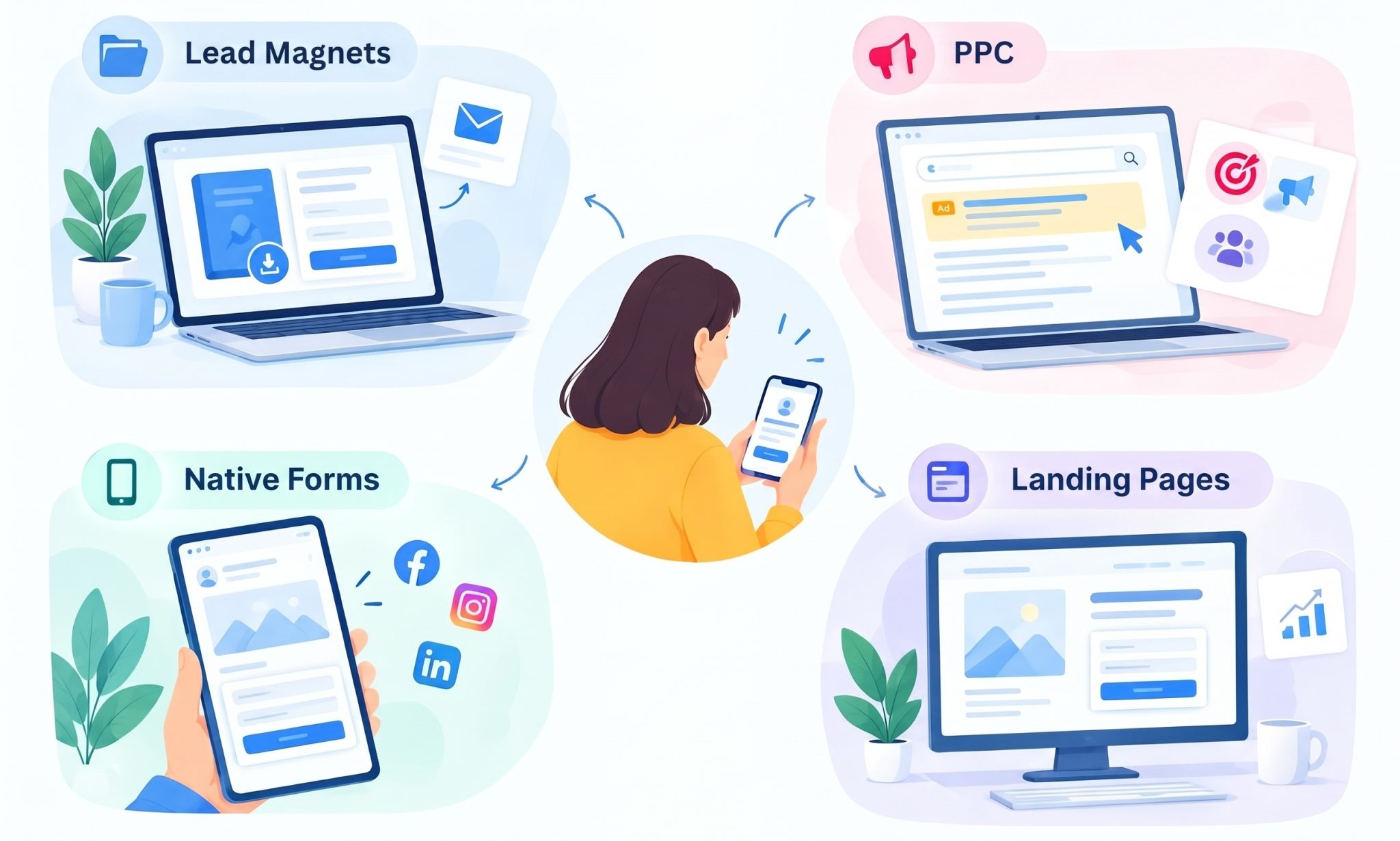
Offer free value in exchange for contact information: checklists, templates, audits, or access to a webinar. An effective lead magnet solves one specific problem for the target audience and provides value immediately after it is received.
Google Ads captures hot leads at the moment of active search: the user already knows what they need and is looking for a solution right now. Meta Ads and LinkedIn Ads are effective for directly targeting audiences based on interests, job title, and behavior. These channels cover different stages of the lead generation funnel and complement each other.
Lead generation forms on Facebook, Instagram, and LinkedIn allow you to collect leads without sending users to an external website. The form opens directly in the feed, and the data is automatically pulled from the user’s profile. This works especially well for mobile audiences and campaigns with broad reach.
Landing pages help turn website visitors into leads by guiding them toward one specific action. The key principles of landing pages are: one offer — one CTA; as few form fields as possible (for the first step, a name and contact information are enough); and a clear headline that immediately answers the question, “What will I get?”
Modern lead generation services automate the collection, processing, and analysis of contact data at every stage of the funnel. Here are the main tools.
CRM systems record every lead, track the acquisition source, and monitor the deal stage. Without a CRM, it is impossible to measure channel effectiveness and scale what works.
Analytics tools show how users behave on a website (where they pause, when they leave, and what prevents them from converting).
Used to launch, test, and optimize campaigns with precise targeting of the target audience.
Automation connects a lead generation service with a CRM. When a lead from a website form automatically enters the database, the sales manager receives a notification instantly, without any manual action.
Effective management is impossible without accurate measurement of results. We have compiled the main lead generation metrics in the table below.
| Metric | Formula | What It Shows | When to Use It |
| CPL (Cost Per Lead) | Channel spend ÷ number of leads | Сost of acquiring a single lead | Comparing channels with one another and reallocating budget toward the most effective ones |
| CR (Conversion Rate) | Leads ÷ visitors × 100% | Percentage of visitors who became leads and leads who became customers | Evaluating traffic quality and landing page effectiveness |
| MQL vs SQL Ratio | SQL ÷ MQL × 100% | Number of marketing leads that reach the sales department | Assessing alignment between marketing and sales and identifying traffic quality problems |
| CAC (Customer Acquisition Cost) | Total marketing spend ÷ number of new customers | Actual cost of acquiring a single customer | Comparing CAC with LTV: if CAC ≥ LTV, the model will not be profitable |
| ROMI/ROI | (Revenue from marketing − costs) ÷ costs × 100% | Return on marketing investment | Strategic decisions about scaling or stopping a channel |
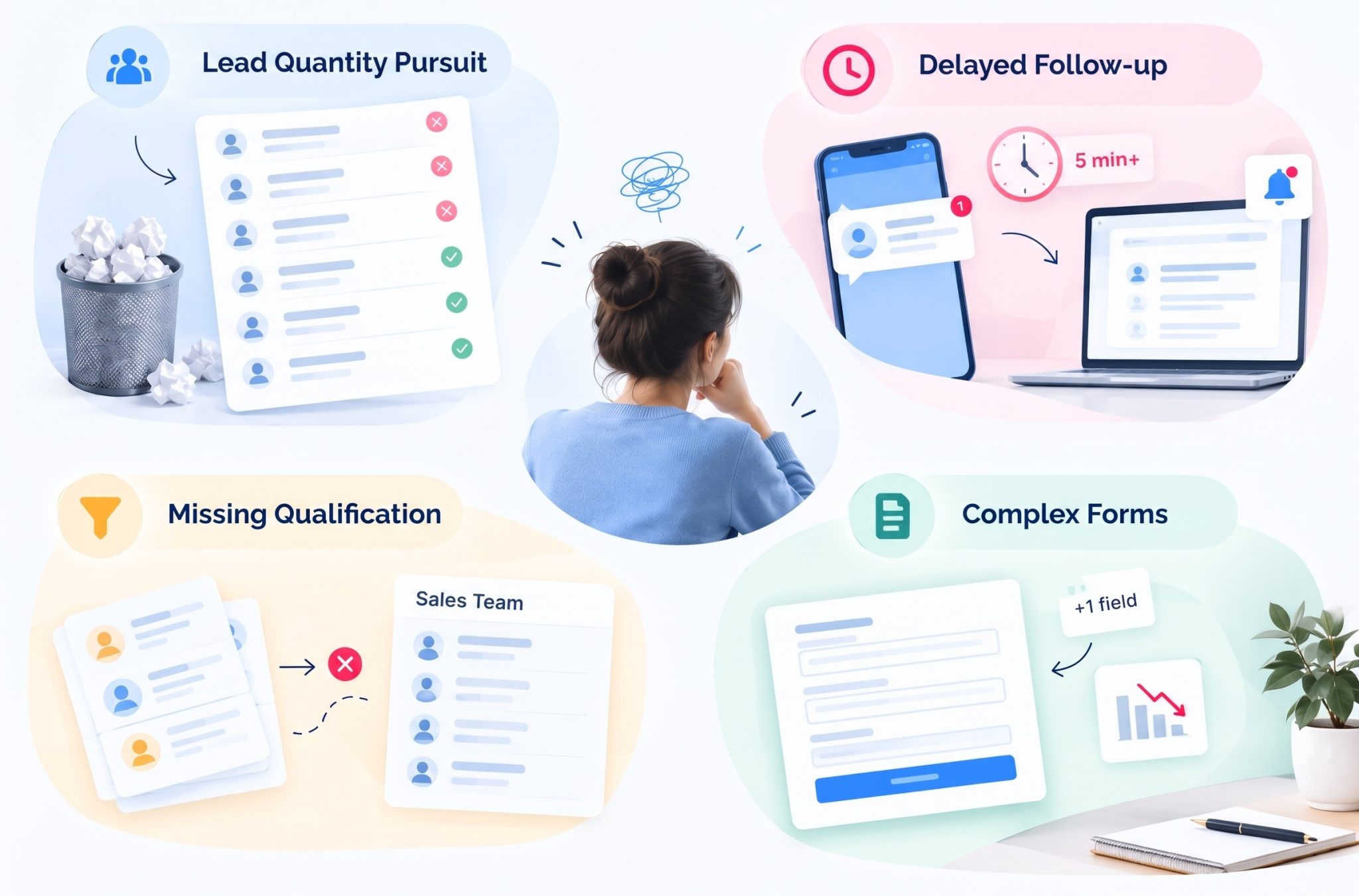
Sometimes, trying to acquire a customer at any cost ends up wasting your budget without delivering results. The most common mistakes include:
Solution: Define a clear target lead profile and set up targeting for a relevant audience.
Solution: Set up an automatic notification for the sales manager as soon as a new lead appears in the CRM.
Solution: Make basic qualification criteria a mandatory stage of the funnel.
Solution: For the initial contact, a name and phone number are enough. Collect additional details later.
Livepage is a lead generation company that specializes in building systematic customer acquisition processes through SEO, PPC, and content marketing. Here is what you get when you work with us.
We take a systematic approach to lead generation: audience analysis, channel selection, analytics setup, A/B testing of offers, and continuous optimization. The entire cycle is handled by one team and aligned around a shared goal.
We work with businesses of all sizes. There is no fixed minimum budget to get started. Instead, we build the right strategy around the resources available and define clear KPIs from the first month of our partnership.
Each project has a dedicated manager who understands the business context, answers questions at a convenient time, and provides weekly reports. No support queues and no impersonal responses.
It is important to us that the leads we generate convert into sales. That is why we work closely with our clients’ sales teams and adjust the strategy based on actual results.
Livepage has completed hundreds of projects in competitive niches across three markets, so we know what lead generation looks like in practice. Our accumulated experience allows us to anticipate common mistakes and shorten the time from launch to the first result.
Ready to build a customer acquisition system? Submit a request, and we will audit your current lead generation setup.
Our company specializes in lead generation email marketing services to help you grow your client base effectively.
Lead generation is an ongoing process that involves testing hypotheses, optimizing the funnel, scaling channels that prove effective in practice, aligning marketing and sales, continuously measuring performance, and being ready to adapt. There is no universal system for generating leads that works the same way for everyone, but there is a strategy that is right for your business and can be built through consistent analysis, testing, and optimization.
Contact us to find the best SEO lead generation services and strategy for your business.
A lead generation manager is responsible for building and managing the system for attracting potential customers. Their responsibilities include selecting and setting up channels, analyzing campaign performance, qualifying leads, and passing them to the sales department.
The cost per lead (CPL) varies depending on the industry, channel, and geography. In B2B, CPL is usually higher than in B2C because of the narrower audience and longer sales cycle. For accurate benchmarks in your niche, contact specialists: without analyzing a specific market, any “average” figures will only be approximate.
To clearly distinguish a lead from a customer in sales, the simplest dividing line is whether the purchase has been completed. A lead has shown interest and provided contact information but has not yet made a purchase. A customer has already paid for a product or service. The sales funnel lies between the two and includes qualification, communication, objection handling, and closing the deal.
Signs of a low-quality lead include inaccurate contact information, a person not remembering why they submitted an inquiry, and a lack of budget or genuine need. If such leads appear consistently, it is a sign that you should review your targeting or the offer that is attracting an irrelevant audience.


“Livepage has proven to be a reliable source for rapid online growth. We started with 2,000 visitors per month. In 3 years together with Livepage we have reached 70,000 visitors and more than 100 leads from the site per month.”


“As for the results, we’ve been working together since 2015, and our traffic has increased 10x. I cannot say that Livepage was our first SEO company, but they have become the first SEO partner that helped us to achieve the success we were looking for.”


“Livepage delivers SEO efforts that have led to an increase in the site’s users, traffic, and conversions. The team uses a wide range of tools to achieve the client’s goals. They are attentive to the client’s needs, working with them in real-time and bringing in additional specialists when needed.”


“I am pleased with the quick task execution and the instant replies to my messages.”


“I like the complex approach that the Livepage team offers. Absolutely all team members work together; everyone is aware of what is happening on the project. We have one common goal – to increase our service sales, and the team is making every effort to achieve the goal as soon as possible.”


“We’ve been really impressed by how Livepage quickly understood our business and centred our PPC campaign around our objectives. We have achieved good results within a very short time in both revenue and ROI.”


“Everything is clear, timely, and understandable.”


“They have leveraged ideal opportunities to reach our business goals.”