



1 min reading
Review of Cooperation with Livepage from MISSIA Bridal


AI-generated content has quickly become one of the go-to tools in modern digital marketing. For businesses, it is a fast way to scale a website: create dozens of topical pages, cover more keywords, and drive extra organic traffic without spending tons of time or budget on copywriting.
But in reality, it’s not that simple. Mass-producing AI content without a clear SEO strategy often leads to the opposite result: ranking drops, traffic loss, and weaker page performance in search. The reason is that search engines like Google do not care how content is created. They evaluate its quality, relevance, and actual value for users. That’s why understanding the impact of AI-generated content on SEO is critical if you are planning to scale.
In this article, we will break down how AI content affects search rankings, why it sometimes fails to perform, what the most common risks of using AI-generated content for SEO are, and how to use AI content without harming SEO instead of letting it work against you.
The rapid rise of AI content is directly tied to the need to scale SEO without increasing resources. In competitive niches, the number of pages and the speed of publishing often determine how much demand a website can capture. That’s where AI looks like the perfect solution. It can generate texts, product descriptions, articles, and even page structures at scale without growing your team.
For many companies, this became the answer to covering a wide semantic range without huge copywriting costs. It is especially relevant for eCommerce, SaaS, and content-heavy projects, where websites can have hundreds or even thousands of pages. In these cases, AI helps launch new pages faster and gain visibility in search more quickly.
But here’s the catch: speed alone does not guarantee results. Numerous businesses treat AI as a shortcut to “automatic traffic growth”. And that’s exactly where one of the common mistakes when using AI content for websites happens.
Without a clear approach to semantics and the target audience, even a large number of pages will not deliver the expected results. We have covered this in more detail in our article on why SEO does not work without a properly defined audience, because understanding the user is what determines whether your content (no matter if it is written by a human or generated by AI) will actually perform.
Another big factor is how accessible these tools have become. Whereas creating content meant involving a whole team of copywriters, editors, and SEO specialists, today, even a small business can generate texts in minutes. This lowers the barrier to entry for competitive SEO, but it also floods search results with similar content, making competition even tougher.
That’s exactly why AI content has gone mass adoption, not just because it works, but because it seems easy. And while it can absolutely be useful, uncontrolled use often surfaces the core problems with using AI-generated content on websites at the ranking stage.
So the real problem with AI content is not the tool itself but how you use it.
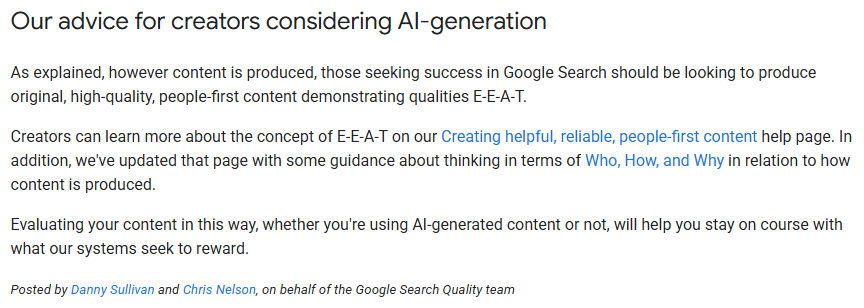
The official position of Google is pretty clear: the search engine does not evaluate how content is created, but evaluates its quality and usefulness. In other words, the fact that content is AI-generated is not a ranking issue by itself.
What actually matters is whether the content aligns with the Helpful Content System, Google’s algorithm that determines how useful, relevant, and user-focused a page is. If a page is created exclusively “for search engines” rather than real people, or if it does not provide unique value, it will lose visibility regardless of whether it was written by a human or generated by AI.
This is exactly where the main problems with using AI-generated content on websites show up. In most cases, it is produced at scale without deep analysis of user needs, often as generic or templated text. These pages might get indexed, but rarely hold stable top positions in search results because they do not send strong enough signals of uniqueness or expertise. The same applies when you try to optimize existing content with AI, when a page can actually drop in rankings or even fall out of the index entirely.
Ranking factors like E-E-A-T (Experience, Expertise, Authoritativeness, Trustworthiness) play a huge role here. In YMYL niches, like healthcare, legal services, or finance, Google evaluates content quality much more strictly. If a page does not demonstrate real experience or expert input, it becomes significantly harder to compete, even if it technically matches relevant keywords.
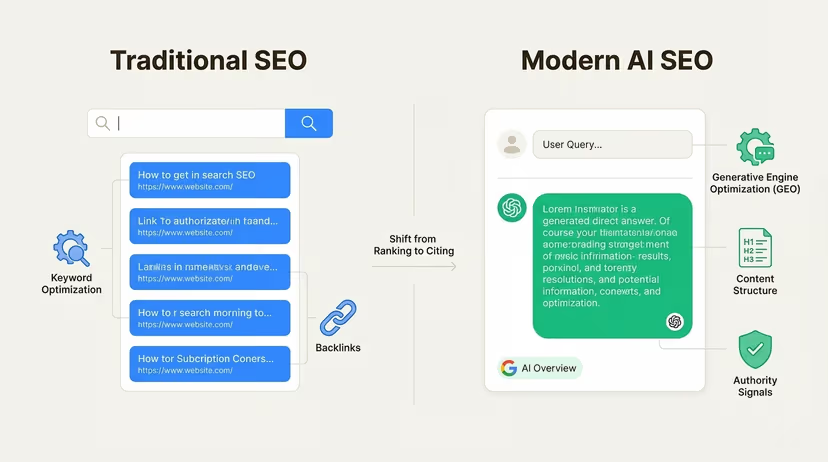
With the rise of AI-driven search, the way content gets selected is also evolving. This directly impacts how AI content affects website SEO performance. If you want your content to appear in AI-generated responses, whether in ChatGPT or Google AI Overviews, it needs to be properly optimized and structured. You can read more about this in our article on how to optimize your website properly so that it is cited in AI responses.
So, does AI content hurt SEO? Not by itself. Though its mass use without quality control and fact-checking almost always leads to ranking problems. And the core issue is not the tool but the approach behind how it is used. These trends become even more important as the expected changes from the new AI search continue shifting how users discover trustworthy information online.
The biggest risks of using AI-generated content for SEO are not about the tool itself but its application. Problems usually start when content is generated without a clear understanding of semantics, website structure, or the role each page plays.
In those cases, websites end up with a large volume of pages that overlap in meaning, do not match user intent precisely, or simply do not offer enough value to rank. This leads to blurred topical relevance, ranking drops, and weaker organic performance.
One of the main reasons why AI-generated content doesn’t rank in Google is its templated nature. Even when generating content for different queries, AI models often reuse similar structures, phrasing, and content blocks. As a result, you get content that looks different but does not actually add anything new.
If your content provides no new value, like real experience, unique insights, or a clearer response, there is no reason for it to rank higher than existing pages. Google will prioritize content that genuinely covers the topic better, not content that just rephrases what is already out there.
And the more you rely on mass AI generation, the bigger this issue becomes. You end up filling your website with pages that do not support each other but just create “noise” in the structure. Over time, this can harm your website’s overall quality signals.
AI-generated content is, by nature, generalized. It doesn’t rely on real company experience, case studies, or internal expertise unless you explicitly feed that data into it. That’s why these texts often sound “correct” but remain superficial. If a page does not demonstrate real value or expertise, it becomes much harder to compete in search results.
It is also important to understand that E-E-A-T is not built by text alone. It is shaped by the full context: authorship, relevant external mentions, website structure, and strong internal linking. If AI content is not integrated into this system, it does not strengthen your website but can actually weaken your overall expertise signals.
Can traffic drop after using AI-generated content? Yes. AI can produce content that looks logical, but does not fully match what users are actually searching for. This happens due to the lack of a deep understanding of the business concept and target audience: the model generates generalized content that does not always address a specific need or solve a user’s problem.
For example, a query may have clear commercial intent, but the resulting text turns out to be informational. In this case, the page is formally relevant to the topic but does not satisfy user intent and, as a result, does not generate the expected traffic. This directly explains how AI content affects organic traffic.
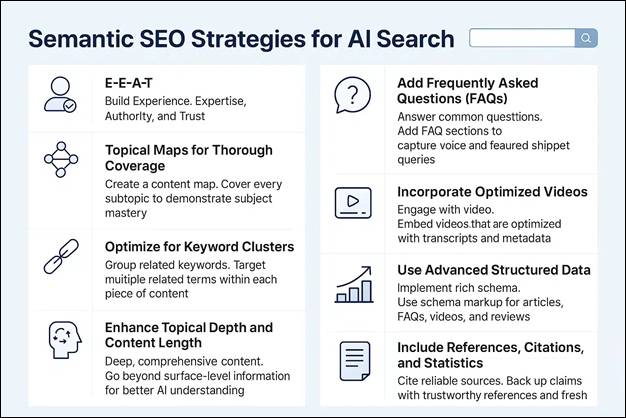
Keyword structure is also often affected: either keywords are used too broadly, or important modifiers that shape demand are missing. That’s why it is critical to understand how to avoid traffic loss caused by unbalanced semantics, because even high-quality content will not deliver results without a properly structured semantic foundation.
When AI content is generated at scale, it often results in multiple pages targeting very similar or even identical topics. This may look like an attempt to cover more keywords (for example, building a pillar content system), but in practice, it leads to cannibalization.
In this situation, several pages start competing with each other for the same queries. Instead of strengthening one strong page, the website spreads relevance and link equity across multiple weaker ones. As a result, none of them achieves stable top positions in search results.
This is especially common in blog content or informational sections of commercial websites, where topics naturally overlap. Without a clear structure and proper semantic clustering, the number of pages keeps growing, but SEO performance does not. You can read more about this in our article on why it is important to structure your blog content properly to avoid SEO cannibalization.
To avoid mistakes when using AI-generated content, you need to understand how to apply it correctly. Despite the risks, AI content can be a powerful tool in SEO. It significantly speeds up content workflows from idea generation to drafting texts and building page structures. However, it cannot replace expert-driven content created by the business itself, semantic analysis, content planning, or strategic decision-making.
That’s why effective use of AI content is based on combining automation with human input: AI helps streamline processes, while copywriters and editors are responsible for content, accuracy, and alignment with business goals. Next, let’s look at the key principles that allow you to apply how AI content affects website SEO performance in a positive direction.
The key principle is simple: treat AI as a tool, not a substitute for specialists. AI can quickly generate a text structure, suggest phrasing options, or gather baseline information for a draft. However, it cannot fully understand your business context, real-world experience, or the specifics of your target audience.
That’s why content created purely by AI without any refinement often looks “technically correct” but not convincing. It lacks case studies, real examples, and arguments that actually build trust in the brand. As a result, this kind of content may not only rank worse, but also convert users into potential customers less effectively.
A practical approach is to use AI to generate a draft, and then enhance it with your own expertise: insights, experience, case studies, and so on. That’s what creates real value for both users and search engines. This creates a balanced workflow where automated AI solutions for promotion complement expert review instead of replacing it entirely.
One of the most common mistakes when using AI content for websites is generating content without any prior work on semantics. In that case, AI produces a generalized “on-topic” text, but not something tailored to specific search queries or the user’s pain points.
Before generating content, you should clearly define:
Without this, even a well-written text will not deliver results, because it will not match what users are actually searching for. This is exactly where the foundation of traditional SEO is built, and AI should work within this logic, not replace it. As generative search continues evolving, GEO optimization for AI naturally becomes another layer of content optimization rather than a separate discipline.
How to avoid mistakes when using AI-generated content starts with reviewing and refining it before publishing. This goes beyond grammar or style. It is also about the substance: factual accuracy, relevance to the topic, logical flow, and real value for the reader.
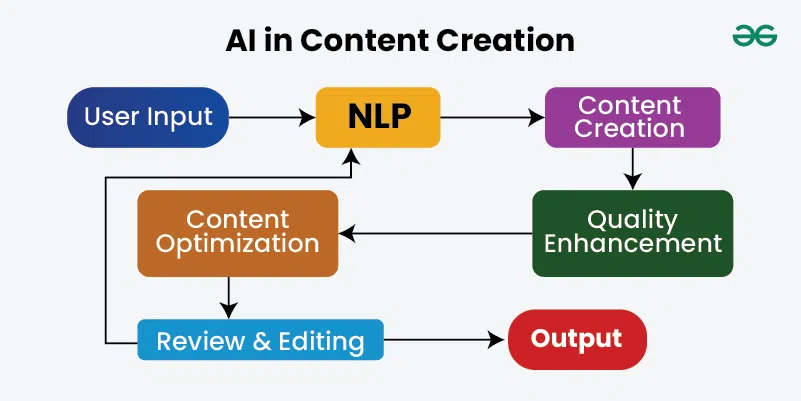
In practice, this means every piece of content should go through proper editing:
You should also check whether the page actually meets the user’s needs. Quality control is exactly what separates effective use of AI from mass content production that does not deliver results.
One of the key factors that determines whether AI-generated content will be useful for SEO is the prompt quality. It directly impacts whether you end up with vague, “about nothing” content or a relevant piece that can actually rank and drive traffic. AI works strictly within the instructions it’s given, so if those instructions are unclear or too generic, the output will be just as weak.
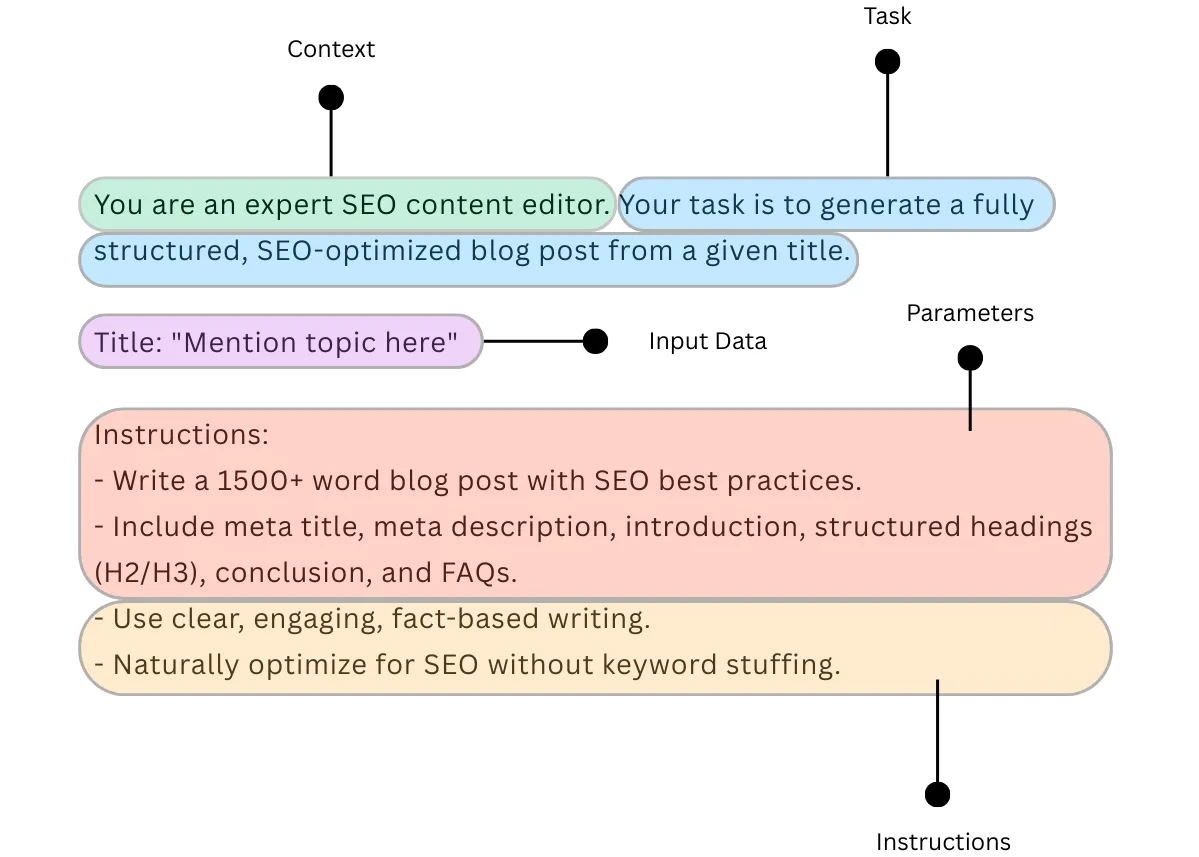
To give AI-generated content a real chance to rank, your prompt should include essential SEO elements:
The more precise your prompt is, the less time you will spend editing and the higher the chances you will get content that actually meets your expectations.
Weak prompt: “Write an article about the benefits of green tea for an online store that sells Chinese teas”.
In this case, AI will generate a generic piece based on popular references from across the internet without a clear structure, without targeting specific search queries, and without any connection to a defined audience. Content like this has little to no chance of ranking consistently in search results. This is one of the clearest examples of why AI-generated content doesn’t rank in Google when prompts lack precision.
Effective prompt: “Write an SEO blog article for a healthy food eCommerce store on the topic: ‘7 reasons to drink green tea for better health and productivity’. Target audience: office workers aged 25–45 who are interested in a healthy lifestyle. Goal: explain the benefits of green tea and guide readers toward a purchase. Primary keyword: ‘benefits of green tea’. Supporting keywords: ‘for health’, ‘for productivity’. Structure: intro, 5–6 sections (excluding the intro), a separate block about choosing tea, and a conclusion with a CTA. Style: expert but easy to understand for readers outside the niche.”
In the second case, AI gets a clear understanding of the task, structure, and expected outcome. The resulting content is much closer to SEO requirements and usually needs only minor tweaks instead of a full rewrite later on.
It is worth looking at a practical case from our team that clearly shows how understanding the impact of AI-generated content on SEO and applying it correctly does not just avoid harming rankings but can actually unlock new traffic channels.
As part of our work with a client, we used a combined approach that blended AI-generated content, manual copywriting, and analysis of sources already being cited in responses from AI platforms like ChatGPT and Perplexity. Based on this, we created content for external placements, including guest posts and link-building articles.
The key idea was to go beyond standard SEO content with backlinks and instead create content that matches real user queries in AI search and is structured in a way that makes it easy to get cited in generative responses. Choosing the right platforms also played a big role: we focused on websites that were already showing up in LLM-generated responses and had solid authority.
In this process, AI was mostly used as a tool for building basic structures, analyzing topics, and generating drafts, while the final content was refined by copywriters with the right semantics, user intent, and quality requirements in mind. This approach allowed us to combine the speed of AI with real expertise.
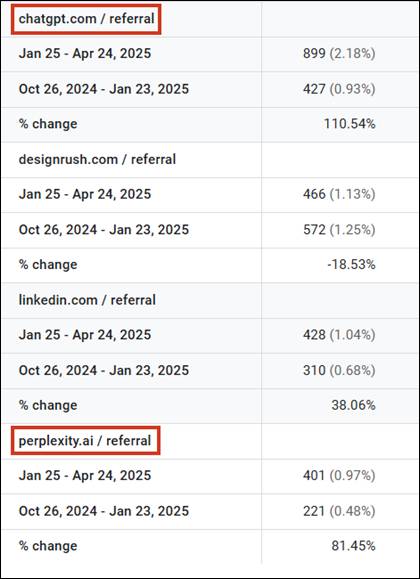
As a result, within just the first three months, we managed to double the number of visits coming from AI search queries. On top of that, the traffic was more targeted. Users did not just land on the website but engaged with it and submitted inquiries. The brand also started showing up more often in AI-generated responses as a relevant source.
Similar enterprise level product optimization case study for Apriorit examples also show that sustainable SEO growth depends on structured optimization rather than content volume alone.
The impact of AI-generated content on SEO is not negative on its own. But when it is used at scale without proper control, it almost always leads to ranking drops, traffic loss, and an overall decline in how search engines evaluate your website.
The main risks of using AI-generated content for SEO appear when content is created for quantity rather than value. In those cases, even a large number of pages will not deliver results. In fact, they can dilute relevance and make it harder to promote the website.
At the same time, AI can be a powerful tool if it is used as part of the SEO process, not as a replacement for it. Combining automation with proper semantic work and expert-level editing by professional copywriters allows you not only to avoid mistakes when using AI-generated content but also to scale your website the right way.
If you are looking to integrate AI content into your SEO strategy without risking your traffic and rankings, the Livepage team can help you build the right approach from semantic analysis to quality control at every stage of SEO growth.


“Livepage has proven to be a reliable source for rapid online growth. We started with 2,000 visitors per month. In 3 years together with Livepage we have reached 70,000 visitors and more than 100 leads from the site per month.”


“As for the results, we’ve been working together since 2015, and our traffic has increased 10x. I cannot say that Livepage was our first SEO company, but they have become the first SEO partner that helped us to achieve the success we were looking for.”


“Livepage delivers SEO efforts that have led to an increase in the site’s users, traffic, and conversions. The team uses a wide range of tools to achieve the client’s goals. They are attentive to the client’s needs, working with them in real-time and bringing in additional specialists when needed.”


“I am pleased with the quick task execution and the instant replies to my messages.”


“I like the complex approach that the Livepage team offers. Absolutely all team members work together; everyone is aware of what is happening on the project. We have one common goal – to increase our service sales, and the team is making every effort to achieve the goal as soon as possible.”


“We’ve been really impressed by how Livepage quickly understood our business and centred our PPC campaign around our objectives. We have achieved good results within a very short time in both revenue and ROI.”


“Everything is clear, timely, and understandable.”


“They have leveraged ideal opportunities to reach our business goals.”