



9 min reading
GA4 BigQuery Export: When You Really Need It


Today, most location-bound businesses are aware of the importance of a strong online presence and understand the direct impact of local SEO and a well-set Google Business Profile on their revenue, growth, and competitiveness. Hence, they strive to optimize their strategies and embrace the best promotion tools to stand out on the regional digital landscape and win their local market. Google Local Pack is one such tool that can work wonders for local businesses seeking to attract more nearby customers.
What is the Google Local Pack? Why does it matter for your SEO strategy? How to rank in Local Pack results? Let’s find out.
Key Takeaways:
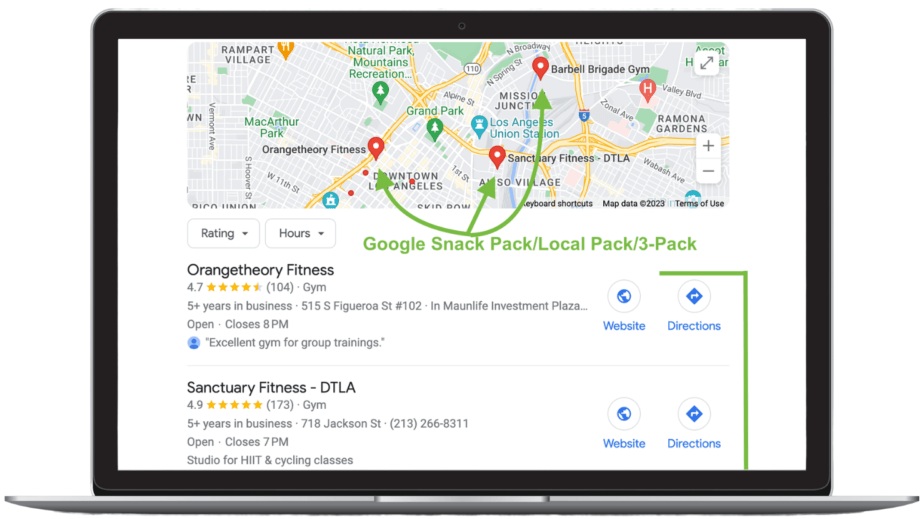
If you’ve ever searched for something like a “pet-friendly restaurant near me,” you’ve already seen a small map with a few leading business listings right at the top of the search results. This little section is called Google Local Pack, also known as the Google 3 Pack, Google Map Pack, Local 3-Pack, or Snackl Pack. It highlights only three local listings for a specific location-based query, hence the name.
For the top three results, Google displays a quick business overview, including not only a company name but also a physical address, operating hours, location photos, website links, star rating, and review count. It also features action buttons that let users call the business or get driving directions directly from the SERP. Google retrieves this info from the company’s Google Business Profile (GBP), which has evolved from the Google My Business dashboard and now uses New Merchant Experience (NMX) profile management directly within SERPs, so merchants can see their profiles as their prospects perceive them. Importantly, an active and fully optimized GBP is the most valuable asset for local SEO and the key to getting to Google’s top three local search results.
Professional local SEO optimization services help businesses coordinate website improvements, citations, reviews, and local authority building within one strategy.
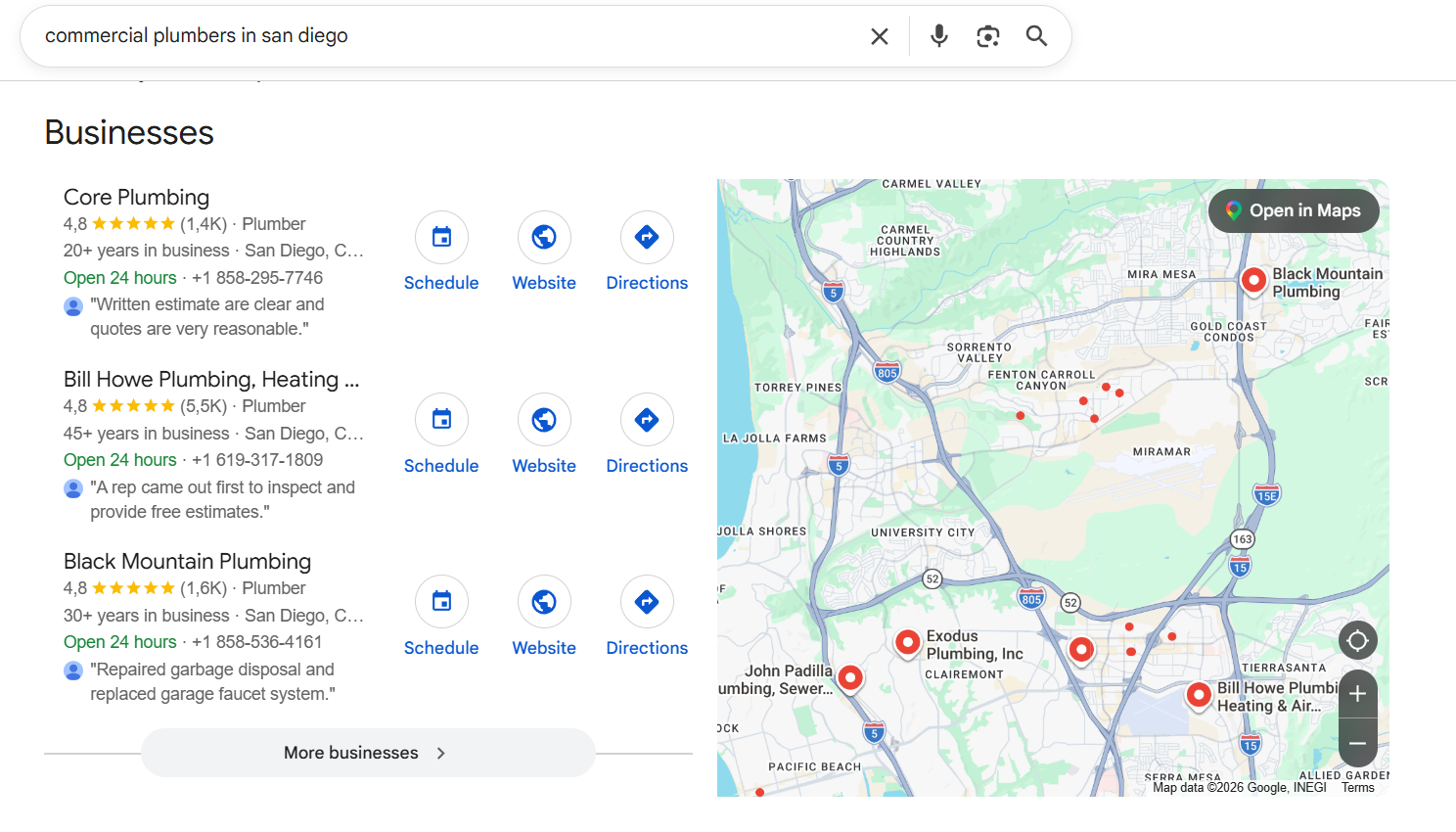
When processing localized search queries, Google categorizes them into informational exploration and commercial transactions. Those queries differ in local search intent, which ultimately determines the Local Pack results layout. So, basically, you’ll come across two major result types: those grouped into “Places” and those grouped into “Business.” Though your query is business-related anyway, “Business” results imply a strong commercial intent.
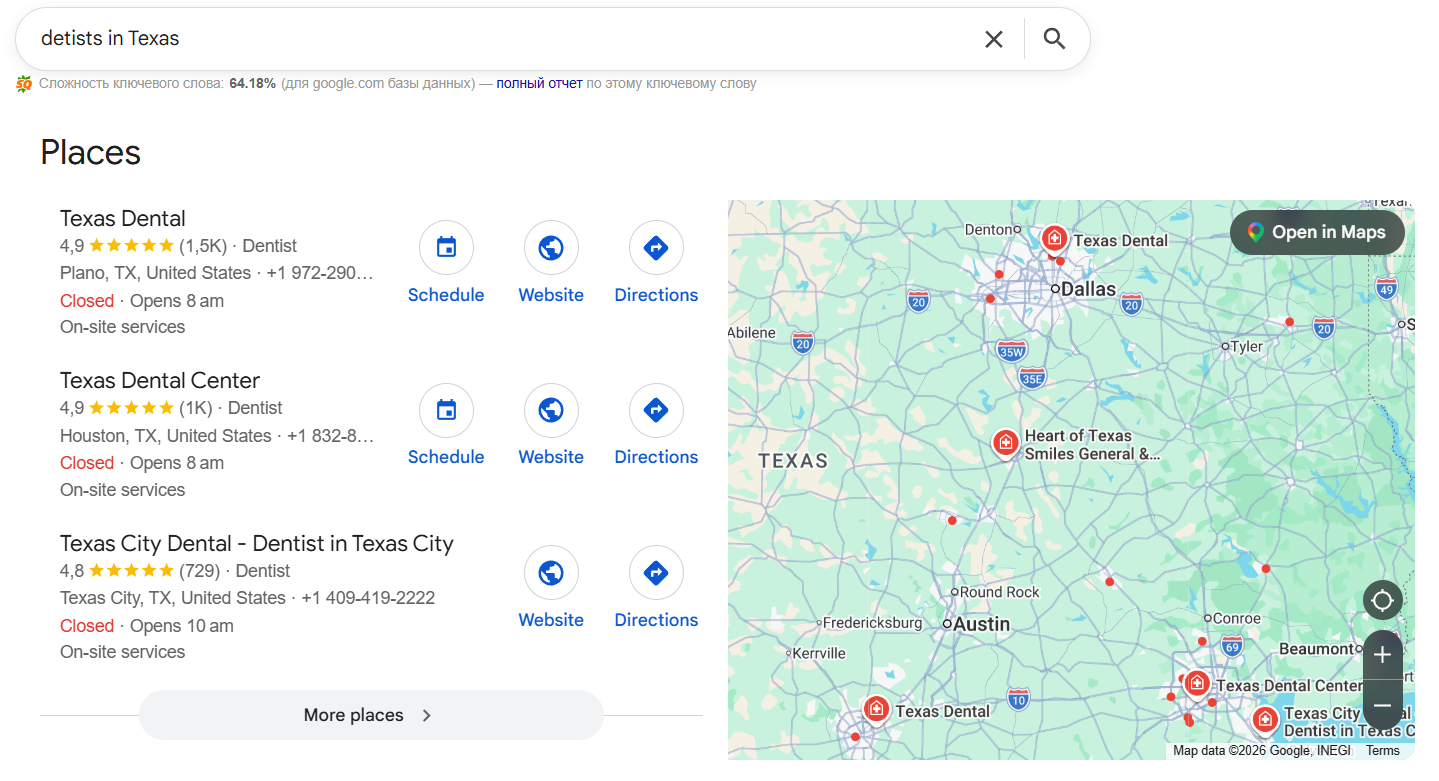
Meanwhile, the “Places” pack pops up for queries leaning toward leisure, recreation, personal services, or informational search.
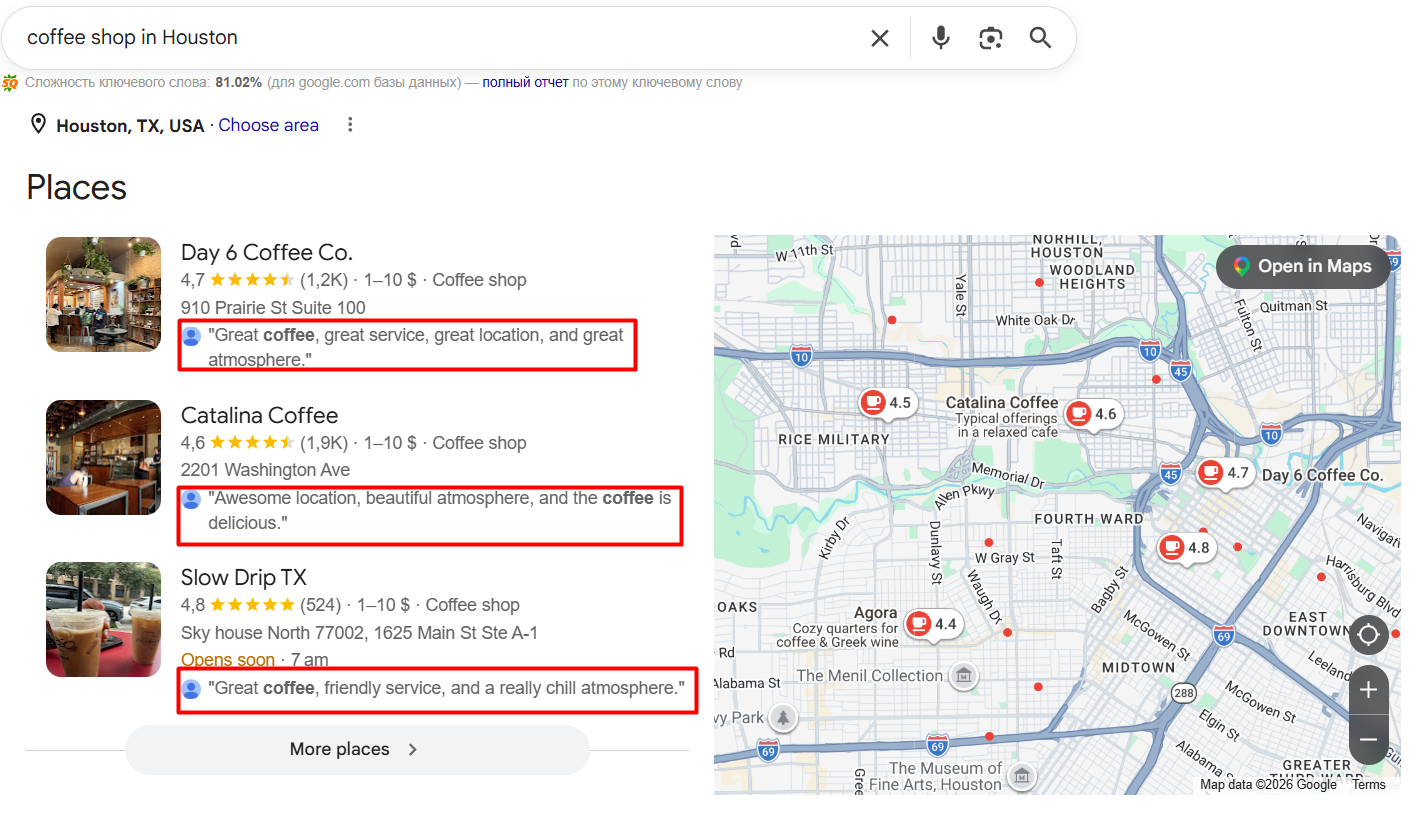
Notably, for commercial and service-oriented queries, you can also spot review snippets in the local pack. These are quotes from real business reviews that algorithms draw as local justifications and authentic service quality validation from past clients, appreciated as a strong trust signal by potential customers. While Local Snack Pack results alone win over 42% of clicks, review snippets further increase CTRs and strongly impact CTR distribution inside the pack, providing contextual relevance for each specific search.
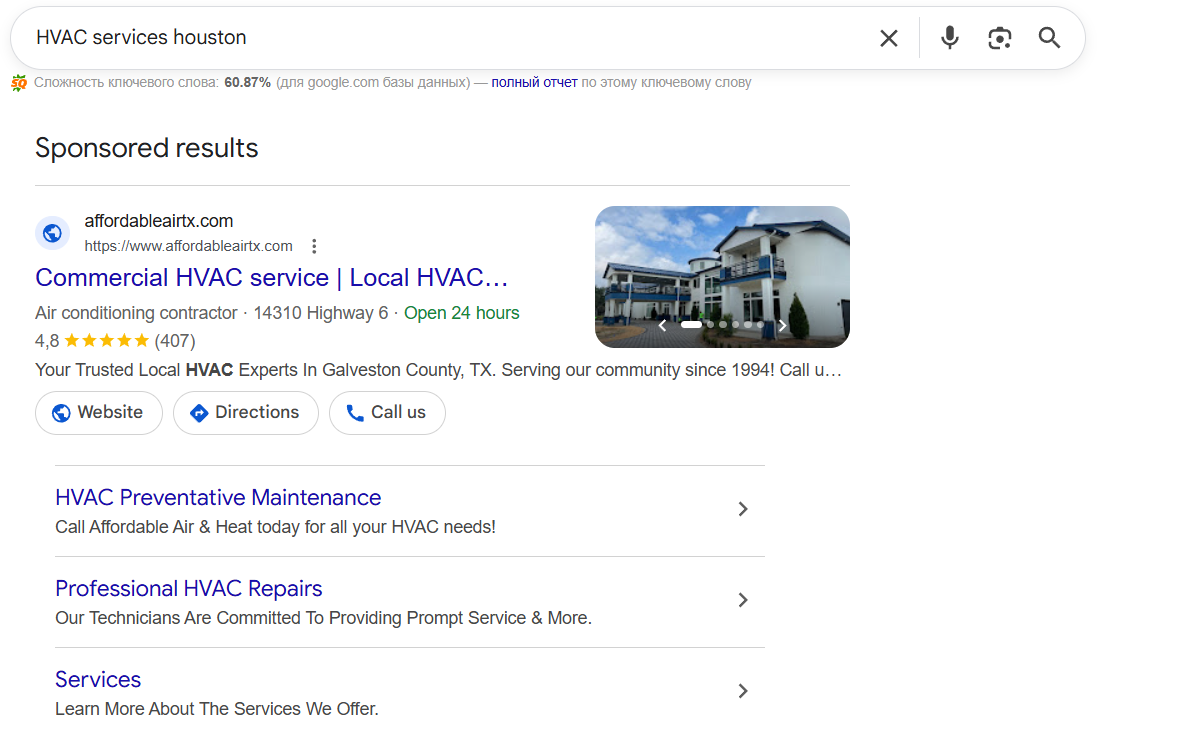
All of the above results refer to organic local search and should not be confused with the Local Search Ads. A standard Local Pack is organic and free. Earning a position there depends on your local relevance, business authority, and Google Business Profile optimization. The Local Service Ads pack is a paid service. It appears at the very top of the SERP and comes as “Sponsored results” or “Google verified” results.
Achieving long-term Local Pack visibility usually requires a complete SEO service that combines technical optimization, content, reputation management, and local authority building.
Is the so much-discussed Google Local Pack SEO really important for your business? While a quick answer is “yes,” let’s outline the exact benefits of Google Local Pack for a small business.
We know that Google algorithms are tricky and never stay the same. Yet, the Locak Pack ranking system still rests on three major pillars — relevance, proximity, and prominence. And this is actually the answer to “How does Google Local Pack work?” The system closely evaluates local businesses for these three aspects.
A recent study also demonstrates an explicit shift in cross-impact between local and organic rankings. Our SEO specialists have also noticed that Google tends to avoid duplicating businesses from the Local Pack in organic search results. If previously organic rankings directly impacted your local rankings, now, it’s just the opposite. This diversification sets a new scene for local SEO and is presumably aimed at helping local brands better compete with bigger names that used to confidently dominate local and organic searches alike. Understanding Local Pack ranking factors helps businesses build better local search strategy focused on visibility, relevance, and long-term growth.
Yet another trend impacting local SEO is Google AI Overviews local search results that often appear for complex and more targeted queries. AI Overviews prioritizes direct answers, informative reviews, structured website data, and valuable content.
A place in a Google Local Pack can boost your local visibility, attract more qualified leads, generate more calls and website visits, and finally, bring more high-intent customers to your door. So, how do you get to those coveted three spots? You certainly can’t rely on random luck and should develop a comprehensive local SEO strategy that smartly combines a few key elements. Here is how to optimize for Google Local Pack.
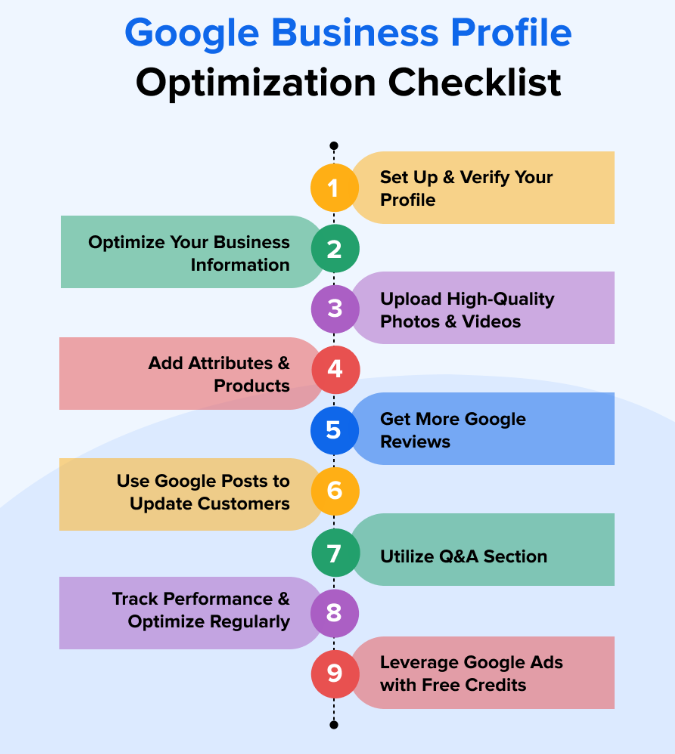
GBP is a solid base for your Local Pack success, as Google mainly pulls your company info from your business profile. Claim your listing and accurately fill out all sections.
Applying the optimization steps above will help raise local positions on Google while increasing visibility in competitive local search results.
A fully optimized and well-maintained profile helps Google understand what your business does, where it’s located, and whom it serves.
Serving as social proof for potential customers, reviews are also a prime Local Pack ranking factor and the core element in Google 3 Pack optimization, since they help Google evaluate your business authority and customer satisfaction. However, today, efficient review management for local SEO goes beyond just collecting as many positive reviews as possible and should be built around two key metrics closely analyzed by Google.
Consistent review inflow with a strong sentiment tells Google that you are a trusted business that remains active and successful in your area.
Your company’s NAP (Name, Address, and Phone Number) should be the same wherever your business is listed online, including your website, local directories, social media, etc. Avoid variations and different formats. NAP consistency helps Google confirm your business is legitimate and established.
A tip for keeping your NAP uniformity on the web is maintaining a master business information document that you regularly update and use every time you create a new citation, directory listing, or business profile. This will help prevent the tiniest inconsistencies, discrepancies, typos, and errors before they negatively affect your local rankings.
Local citations are mentions of your business info on online directories, platforms, and websites, helping search engines verify that your business is real, operates in a specific location, and serves a particular market.
When building citations, prioritize quality over quantity and focus on trustworthy platforms recognized as reliable business data sources by Google:
Your website still plays a supporting role in Local Pack rankings, giving additional context about your business location and authority. So, make sure your website content reinforces your local presence.
The creation of local landing pages allows businesses serving multiple locations to target unique search intent while avoiding generic location pages.
Google highly values backlinks as authority signals. For Google Map marketing, though, mentions in active community blogs carry more ranking power than those in global publications. So, to earn efficient local backlinks:
A well-established local backlink profile will maintain your community relevance and enhance business prominence.
While many business owners work hard to boost their visibility in local search, a few common mistakes can hurt your chances of ranking in the Google Local Pack. Check the list of the most frequent local SEO pitfalls and how to fix them.
An unexpected local ranking drop might happen due to one of the following critical statuses of your GBP profile:
Such inconsistencies in your business data as alternate phone numbers, old addresses, and business name variations across directories can confuse Google, reduce its confidence, and lower your listing ranking. You need to eliminate all discrepancies and rely on a unified document for business info.
Long periods without new reviews, large volumes of reviews generated at once, low review sentiment, and poor response rates to customer feedback are among the most common mistakes that throw your Local Pack rankings back. Refine your review acquisition and management strategy to make your review profile Google-friendly.
Your GBP might be perfectly healthy and streamlined, yet still ignored by Google and filtered out from the top three local results. Most often, this happens when Google treats you and your direct competitor as geographically and contextually similar, and your competitor wins through stronger prominence signals.
You can fix this issue by proving that you are a more relevant result for the target market by showing a deeper expertise, building high-authority local backlinks, improving review quality, and strengthening local trust.
Recent local search trends and generative AI impact push SEO experts to rethink local approaches and integrate advanced tracking, analytics, and performance measurement systems in their strategies to retain a competitive advantage in the local search that keeps changing.
The performance tab inside your NMX dashboard allows you to monitor key metrics that clearly indicate your local SEO success or failure. You can review website clicks, calls, direction requests, and bookings that come from your GBP, as well as your profile views and photo performance.
Traditional SEO ranking tools are not fit for local SEO, since local ranking can dramatically vary depending on the current searcher’s location and their proximity to the business, which might change as they walk or move a few feet away.
For local rank tracking, our specialists rely on platforms that use geo-grid tracking tools, such as BrightLocal Local Search Grid, Semrush Map Rank Tracker, and Local Falcon, that show rankings from dozens or hundreds of points within a target area. These tools visualize the spatial radius, showing the areas where your company stands strong in the Local Pack and where it falls behind.
One of the biggest local SEO challenges is measuring ROI. This is where UTM tracking, used in a combo with GA4, can become a game-changer. UTM parameters are tracking tags you can add to URLs to help GA4 identify the traffic sources and track your GBP performance more accurately. By adding UTMs to different GBP features and using GA4, you’ll be able to analyze user behavior and how users interact with your profile at different levels. You’ll identify high-performance features and detect weak ones to split your marketing budget more strategically.
Our target localization for service business in Canada demonstrates how adapting local SEO strategies to regional markets can significantly improve visibility and lead generation.
With 96% of customers searching for local businesses online, a position in the Google Local Pack gives your business a serious edge, boosting your chances to hit potential clients right when they are going to take action. So, start refining your GBP profile, optimizing for local SEO, and embracing advanced local analytics today to reap the benefits of being listed in the Google 3-Pack to the full.
Also, if you have ambitious plans to expand your business to other locations and service areas, you should be ready to upgrade to a more complex multi-location SEO strategy to appear in multiple Local Packs and establish a stronger presence in every market you serve while maintaining brand consistency across the organization.
There is no fixed timeframe for winning Google 3-Pack visibility. Your business’s local rankings depend largely on market competitiveness and location. Thus, if you operate in a low-competition niche in a small town, you can rank well in a few weeks or even sooner. Yet, for competitive markets, it will take longer to build prominence signals.
Service area businesses (SABs) can create local listings, but under certain conditions. If they don’t have a properly maintained physical office, they cannot display their address in GBP. In practice, though, businesses with specified physical addresses have higher chances of hitting the Local Pack.
You can only do that if you have a legitimate, dedicated office that operates during stated business hours, has a separate phone line, and can serve customers at that location.


“Livepage has proven to be a reliable source for rapid online growth. We started with 2,000 visitors per month. In 3 years together with Livepage we have reached 70,000 visitors and more than 100 leads from the site per month.”


“As for the results, we’ve been working together since 2015, and our traffic has increased 10x. I cannot say that Livepage was our first SEO company, but they have become the first SEO partner that helped us to achieve the success we were looking for.”


“Livepage delivers SEO efforts that have led to an increase in the site’s users, traffic, and conversions. The team uses a wide range of tools to achieve the client’s goals. They are attentive to the client’s needs, working with them in real-time and bringing in additional specialists when needed.”


“I am pleased with the quick task execution and the instant replies to my messages.”


“I like the complex approach that the Livepage team offers. Absolutely all team members work together; everyone is aware of what is happening on the project. We have one common goal – to increase our service sales, and the team is making every effort to achieve the goal as soon as possible.”

“We’ve been really impressed by how Livepage quickly understood our business and centred our PPC campaign around our objectives. We have achieved good results within a very short time in both revenue and ROI.”

“Everything is clear, timely, and understandable.”


“They have leveraged ideal opportunities to reach our business goals.”