




9 min reading
How Web Design Impacts Customer Experience


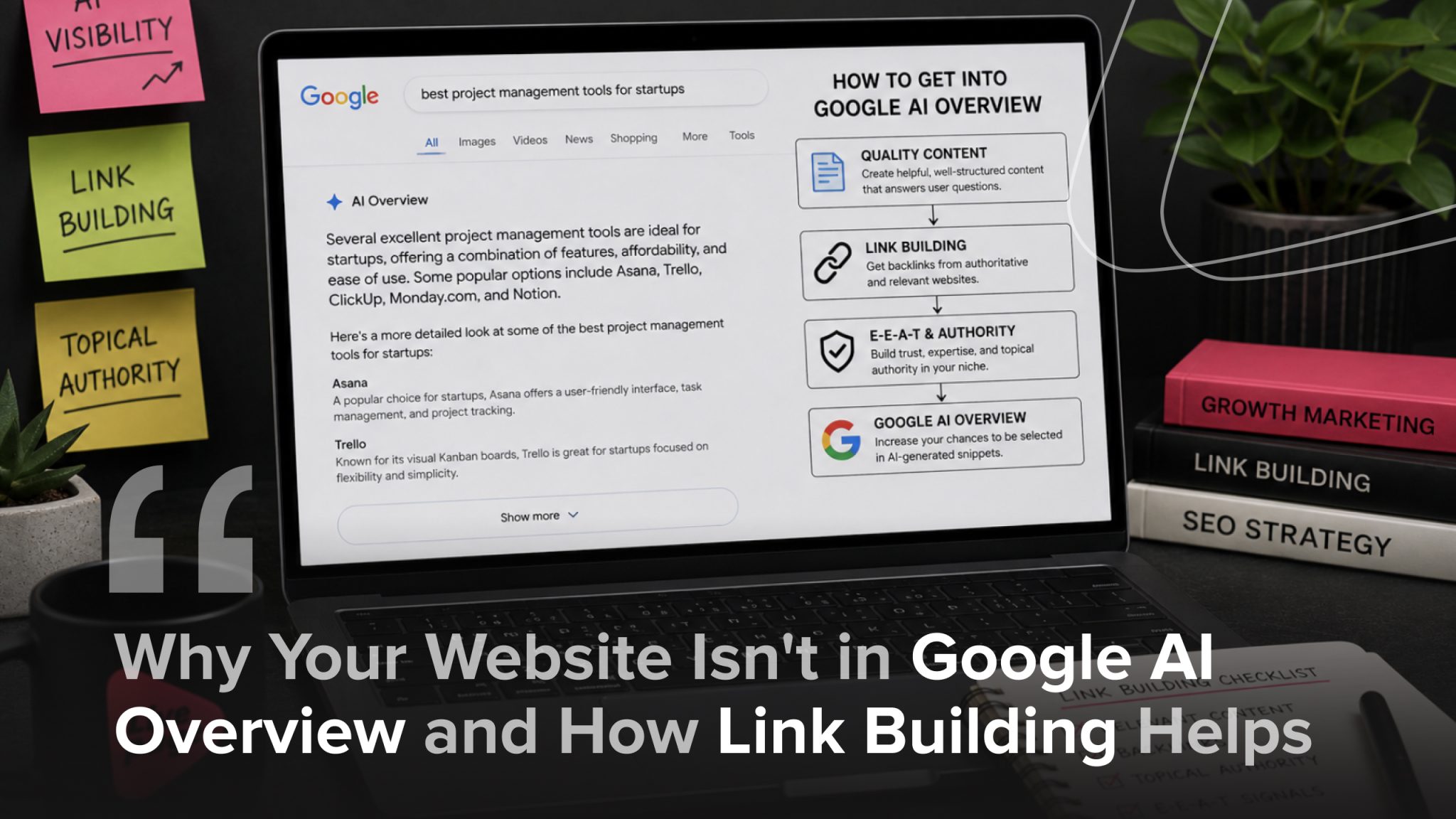
Google AI Overview is already changing the rules of organic search. Thus, even if your page ranks high in Google Search, that doesn’t guarantee it will appear in AI Overview. Google is increasingly selecting sources based not only on traditional SEO signals but also on trust, content structure, and domain authority. That’s why so many businesses are now asking the same question: Why isn’t my website in AI Overview, and how can I fix it?
In this article, we will explain how Google AI Overview works, why link building has become a key factor in getting featured in AI Overview, and how to improve your website’s visibility in the new AI-powered search.
Google AI Overview is a feature within Search Generative Experience (SGE) that uses artificial intelligence to generate concise responses directly in Google’s search results.
Instead of displaying only a list of links, the system analyzes multiple reputable sources, synthesizes the information, and generates a summarized response. For users, this means faster access to the information they are looking for. For businesses, it introduces a completely new model of organic visibility.
If your website is featured in Google AI Overview, it can gain more visibility even without ranking No. 1 on the SERP. Google may use your content as a cited source, but only if it considers your website trustworthy and reliable.
Today, AI Overview is gradually replacing some Featured Snippets and changing the way users interact with Google Search. That’s why the question of how to get featured in AI Overview has become one of the biggest priorities for modern SEO teams.
To demonstrate the real-world impact of an AI-focused SEO strategy and link building, let’s take a look at two of our client case studies after several months of consistent optimization.
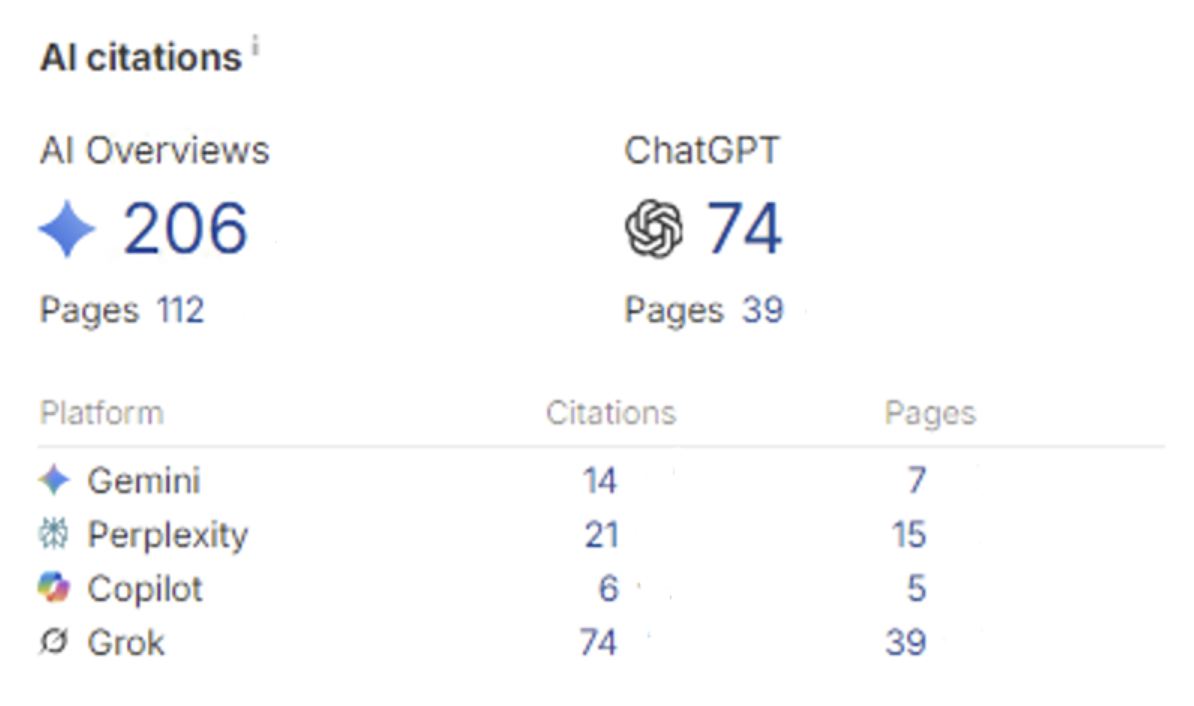
The primary focus of this strategy was strengthening topical authority, building a high-quality backlink profile, improving E-E-A-T signals, and optimizing content for AI-generated snippets. As a result, the website began appearing much more frequently not only in Google AI Overview but also in responses from other AI platforms that rely on trusted sources.
Over the course of the project, the website earned more than 200 AI citations in Google AI Overview across 112 pages. ChatGPT also started citing 39 pages in its responses on a regular basis. In addition, the brand’s visibility increased significantly across Gemini, Perplexity, Copilot, and Grok. These results were achieved through topical link building, expert-driven content, and strengthening domain authority with high-quality backlinks.
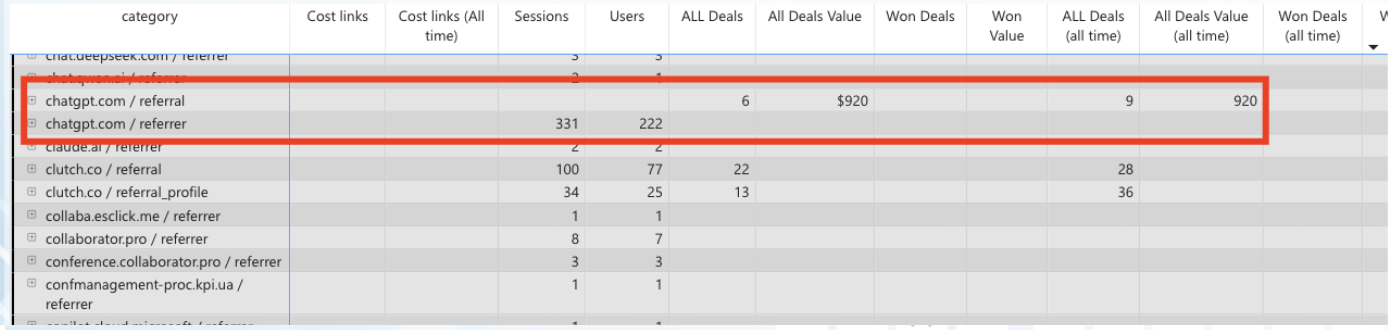
In this case, the goal went far beyond simply earning citations. Our team focused on generating real referral traffic from AI platforms. After just six months, the client’s website was consistently receiving traffic from ChatGPT, and that traffic was converting into leads and sales.
ChatGPT alone generated more than 330 sessions and 222 users who eventually became leads and paying customers. This confirmed an important takeaway: modern link building for AI Overview doesn’t just improve your website’s visibility but also delivers measurable business results.
Both case studies show how SEO is evolving and that high rankings in traditional search are no longer enough. AI systems are putting increasing weight on trust signals, content credibility, and backlink profile quality. Companies that invest in strategic link building and brand authority today gain a competitive advantage not only in traditional Google Search but also across the next generation of AI-powered search.
Many websites have already run into the same issue: a page consistently ranks in the top 10 Google search results, yet it still doesn’t appear in AI Overview. That’s because AI Overview uses its own criteria for selecting content. Google evaluates more than just how relevant a page is to a search query but also looks at domain authority, content credibility, and overall website expertise.
In many ways, AI Overview functions as a separate source-selection system, where quality and authority signals play a central role. That’s why the answer to how to get in AI Overview is different from traditional SEO best practices.
When evaluating a page, Google AI may also consider:
There are several reasons why a website may not appear in AI Overview. The good news is that most of them can be fixed without a complete review of your SEO strategy. In most cases, the issue comes down to low domain authority, an underdeveloped link-building strategy, or poorly structured content.
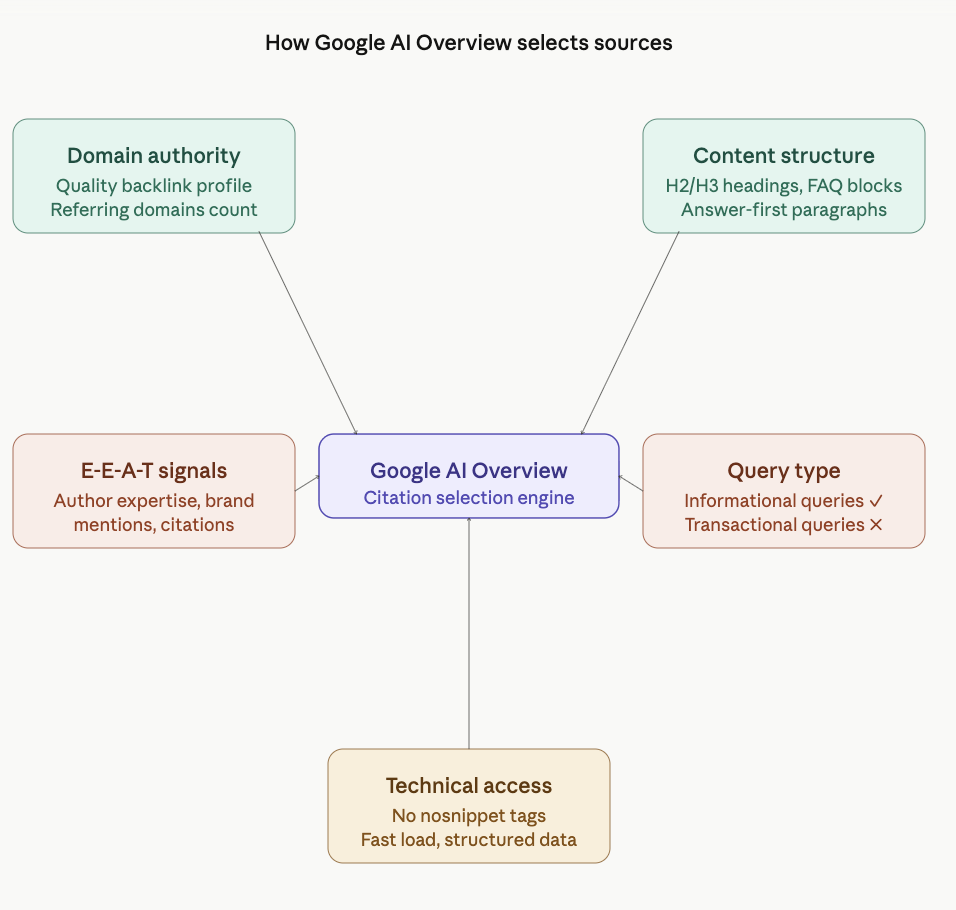
One of the main reasons your website isn’t in AI Overview is a lack of domain authority. When selecting sources for AI-generated responses, Google relies heavily on how authoritative a domain appears. If your website has low domain authority, only a small number of referring domains, or a weak backlink profile, Google is unlikely to consider it a reputable source. Even high-quality content can be overlooked by AI Overview if it lacks enough trust signals.
A weak backlink profile flags to AI systems that your website hasn’t yet established enough expertise or recognition within its niche. This is especially noticeable in highly competitive industries such as finance, healthcare, SaaS, eCommerce, and legal services. That’s why modern link building has a direct impact on your chances of getting featured in Google AI Overview.
AI systems analyze pages differently than people do. They primarily focus on headings, lists, concise logical sections, and direct answers to search queries. If a page looks like one long block of text without a clear structure, Google AI has a much harder time identifying the information it needs.
To improve your chances of being featured in AI Overview, you should:
Well-structured content can significantly increase your chances of appearing in AI-powered search, even if your domain is not yet the market leader.
E-E-A-T (Experience, Expertise, Authoritativeness, and Trustworthiness) is one of the core principles Google uses to evaluate content quality.
These signals are even more important for AI Overview, since the system is designed to cite only reliable and credible sources. If your website doesn’t provide author information, expert profiles, reputable references, or proof of expertise, your chances of being featured in AI Overview drop significantly.
Google AI may evaluate factors such as:
That’s why modern SEO is becoming increasingly combined with digital PR and brand authority.
Not every Google search query triggers AI Overview. Most AI-generated responses appear for informational searches or queries that require an explanation or in-depth research.
AI Overview is most commonly triggered by queries like:
On the other hand, AI Overview rarely appears for queries like:
As a result, if your SEO strategy is focused primarily on transactional keywords, AI Overview may not appear for most of your target queries.
Even the best content and a strong link-building strategy won’t help if Google AI can’t properly process your pages.
Some of the most common technical issues include:
If an AI system can’t quickly crawl and accurately interpret your page, it’s unlikely to use it as a source for AI-generated responses.
Today, link building has become one of the most important ranking factors for appearing in AI Overview. Google AI relies heavily on external trust signals to determine which sources are credible enough to cite.
When your website earns high-quality backlinks from reputable websites, it strengthens your domain authority and increases the likelihood of being featured in AI-generated responses. On the other hand, chaotic or spammy backlinks can have the opposite effect.
Backlinks from reputable domains remain one of Google’s strongest quality signals. They show that other trusted websites consider your content accurate and relevant.
When it comes to AI Overview, quality matters far more than quantity. Five editorial backlinks from respected media outlets or niche websites can deliver significantly more value than fifty links from low-quality directories.
When evaluating your backlink profile, Google AI may consider:
That’s why modern link building should be strategic and consistent, not focused solely on acquiring as many backlinks as possible.
AI Overview places a strong emphasis on topical authority, demonstrating deep expertise within a specific subject area. For example, if a financial website earns backlinks from banking websites, niche publications, and finance blogs, Google AI is much more likely to recognize it as a reputable source on financial topics. On the other hand, random backlinks from unrelated directories or general discussion forums contribute little to establishing expertise.
For AI Overview, it’s not enough to simply increase the number of referring domains. What matters is building a topically relevant backlink profile.
A strategic link-building campaign can directly strengthen your website’s E-E-A-T signals. When reputable publications consistently mention your brand, Google receives additional evidence of your expertise and trustworthiness.
Some of the most valuable types of backlinks include:
These backlinks do more than improve your search rankings. They also help Google AI recognize your brand as a genuine authority in its field.
To improve your website’s visibility in AI Overview, you need to work on three areas simultaneously: content, technical SEO, and domain authority. Below is a practical action plan to help your website adapt faster to the new era of AI-powered search.
Start by taking these steps:
These improvements make it much easier for AI systems to crawl, understand, and interpret your content.
Building a lasting presence in AI Overview requires systematic work on your domain authority.
Here are the key areas to focus on:
Over time, a strong backlink profile becomes one of your biggest competitive advantages in AI-powered search.
If you are looking to improve your visibility in Google AI Overview, ChatGPT, and other AI search platforms, the Livepage team can help you develop a comprehensive AI SEO strategy backed by professional link building.
We have been working in the field of SEO and link building for more than 14 years and have already adapted our strategies to the new era of AI-powered search. We offer two specialized services for companies looking to increase their visibility in AI-generated responses:
We start by analyzing your niche, competitors, and current backlink profile, then develop a customized link-building strategy and focus on strengthening your domain authority. The Livepage team creates contextually relevant content and earns high-quality backlinks via manual outreach, digital PR, editorial mentions, and guest posting. We also monitor backlink performance and remove toxic backlinks.
This service is especially effective for SaaS, B2B, eCommerce, fintech, startups, and local businesses looking to increase their organic visibility in Google AI Overview and ChatGPT.
As part of this service, we leverage link insertions, guest posts, niche directories, Quora, Reddit, and other relevant platforms to earn high-quality dofollow backlinks from reputable websites. Our approach is built around selecting relevant websites, creating SEO-focused content tailored to your niche, and continuously analyzing campaign performance.
Semantic link building is particularly well suited for IT companies, SaaS, fintech, eCommerce, startups, and local businesses that want not only to rank higher in Google Search but also to become reputable sources for AI systems.
Both services help companies:
Optimizing for AI Overview takes time, so you need to track your progress regularly.
Here are the key tools and metrics to monitor:
In most cases, you will see the first results within 4–12 weeks. The exact timeline depends on industry competition, domain authority, and indexing speed.
Google AI Overview is already changing the rules of organic search, with ranking highly in Google Search no longer enough. You also need to convince AI systems that your content is trustworthy, reputable, and well-structured.
That’s why link building has become one of the most important success factors. High-quality backlinks, strong topical authority, solid E-E-A-T signals, and technically optimized content can significantly improve your chances of being featured in AI Overview.
If you want to increase your brand’s visibility in Google AI Overview, ChatGPT, Gemini, Perplexity, and other AI-powered search platforms, the Livepage team can help you develop a customized AI SEO strategy and an effective link-building plan tailored to your business. We will analyze your current backlink profile, identify the issues preventing your website from gaining visibility in AI search, and create a step-by-step strategy to strengthen your domain authority, E-E-A-T signals, and brand presence across AI platforms. Get in touch with our team to schedule a consultation and learn how your website can start generating qualified traffic and leads from AI search in the coming months.
You may also want to explore our other case studies:
No. AI Overview most commonly appears for informational searches or queries that require in-depth research. For transactional and commercial queries, Google still primarily displays the traditional search engine results page (SERP).
Yes, but it’s more challenging. New websites need to build domain authority, earn high-quality backlinks, and demonstrate strong E-E-A-T signals faster.
Indirectly. While social signals aren’t a direct ranking factor, an active social media presence can help generate brand mentions, earn backlinks, and strengthen brand authority, which can improve your chances of being featured in AI Overview.


“Livepage has proven to be a reliable source for rapid online growth. We started with 2,000 visitors per month. In 3 years together with Livepage we have reached 70,000 visitors and more than 100 leads from the site per month.”


“As for the results, we’ve been working together since 2015, and our traffic has increased 10x. I cannot say that Livepage was our first SEO company, but they have become the first SEO partner that helped us to achieve the success we were looking for.”


“Livepage delivers SEO efforts that have led to an increase in the site’s users, traffic, and conversions. The team uses a wide range of tools to achieve the client’s goals. They are attentive to the client’s needs, working with them in real-time and bringing in additional specialists when needed.”


“I am pleased with the quick task execution and the instant replies to my messages.”

“I like the complex approach that the Livepage team offers. Absolutely all team members work together; everyone is aware of what is happening on the project. We have one common goal – to increase our service sales, and the team is making every effort to achieve the goal as soon as possible.”


“We’ve been really impressed by how Livepage quickly understood our business and centred our PPC campaign around our objectives. We have achieved good results within a very short time in both revenue and ROI.”

“Everything is clear, timely, and understandable.”


“They have leveraged ideal opportunities to reach our business goals.”