Liberta Case Study: Website Promotion for a Mirror Manufacturer With a 501% ROI
Launching a new manufacturing business online becomes much more manageable when the marketing strategy is planned correctly from day one. Our client followed this approach and worked with Livepage to create and approve a traffic acquisition strategy for a newly established mirror manufacturer.
In this case study, we explain how we promoted the website of a mirror factory and helped the company enter the B2C market.
Project Overview
Website: Liberta.ua
Promotion period: 8 months
Business niche: Mirror retail
Region: Online store promotion across Ukraine, Russian-language version
Domain age: New domain with no previous SEO history
Client goals:
- Become one of the leading mirror retailers in Ukraine.
- Outperform direct competitors in organic traffic.
- Generate a steady flow of orders through the website.
The website at the start of the project:
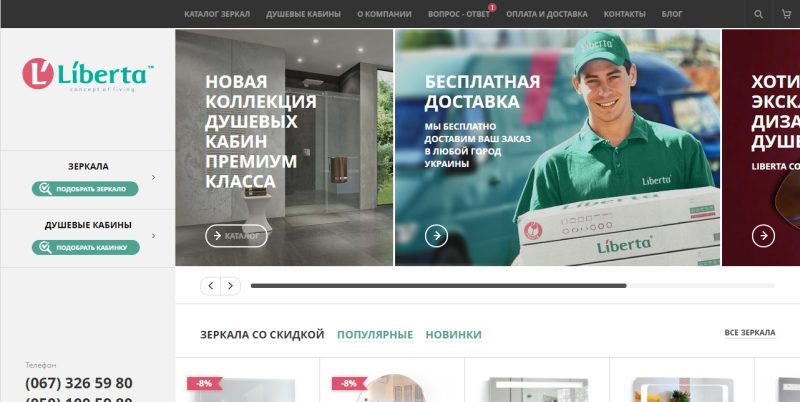
- The website structure consisted of a homepage and several technical pages that could not attract organic search traffic, such as Contact Us, Delivery and Payment, and About Us.
- The website had no backlinks from other domains.
- The site had several technical errors that limited its SEO growth.
Competitor Analysis
We began the project by analyzing competitors and carrying out a full technical audit of the client’s website. This helped us identify the most common weaknesses across competing sites.
The main issues included:
- Technical errors, including duplicate pages, incorrect layouts, slow page speed, and non-responsive design.
- Poor site structures, with missing categories that could attract search traffic or an excessive number of unnecessary sections.
- Keyword-stuffed content.
- A weak backlink profile containing irrelevant links from low-quality websites.
- Additional problems, such as categories without products, missing prices, no purchase button, and no visible contact number.
Issues like these limit the amount of revenue a website can generate. To avoid losing potential sales, businesses need to improve their sites continuously and fix problems as they appear.
What the Competitor Analysis Revealed
By analyzing competitors, we understood:
- Which pages needed to be created to attract organic search traffic.
- How to distribute keywords across the website.
- What type of category content could help the site rank above competitors.
- Which features and page elements could improve the user experience.
- How to develop a strong, results-driven backlink profile.
Based on these findings, we developed a clear action plan for promoting the manufacturer’s website.

Action Plan for Promoting a Manufacturer’s Website
- Fix technical issues on the website.
- Create landing pages based on the planned site structure.
- Write optimized content for the landing pages.
- Build a stronger backlink profile.
This approach can be used for many types of manufacturing websites. For example, it can work for furniture manufacturers, clothing brands, construction material producers, and other companies that sell their products directly to end customers.
On-Page Optimization
Every search engine has quality requirements that websites need to meet. If a site contains a large number of technical errors, it may fail to meet those standards and struggle to attract organic search traffic.
We conducted a full technical SEO audit of the website.
To Increase the Site’s Visibility in Search Results, We Completed the Following Tasks:
- Created category pages capable of attracting organic search traffic.
- Set up clean, SEO-friendly URLs for categories and products.
- Added page metadata, including Title, Description, Keywords, and H1 tags.
- Provided recommendations for improving page loading speed.
- Prepared recommendations for product page design.
- Removed duplicate pages.
- Created an XML sitemap.
- Launched a blog section.
- Optimized image file sizes.
All these improvements supported the website’s SEO growth and delivered the first results in the form of higher rankings and organic traffic.
Website Structure
Our competitor research showed that most websites organized mirrors into categories by room, shape, features, and design. We created a similar category structure, while also considering whether each category had the potential to attract organic search traffic.
The final structure looked like this:
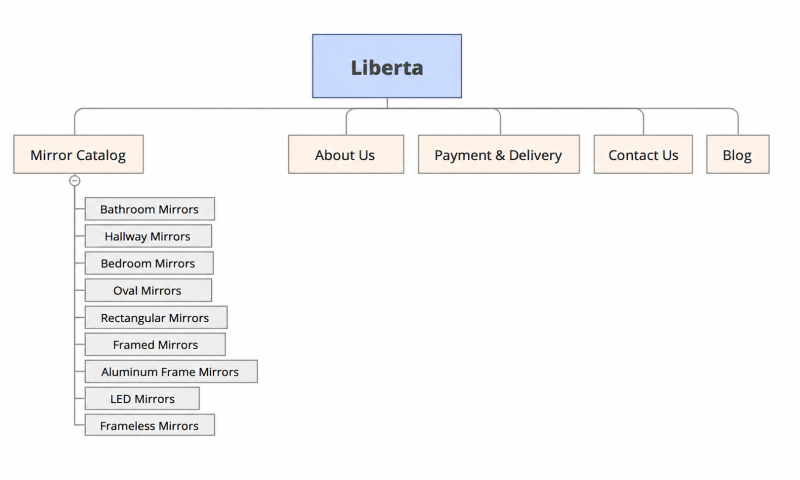
Important! This was not the final version of the website structure. We continued looking for new ways to expand it. We either suggested new product categories to the client or worked with product lines the client developed in response to market demand. As the business grows, new opportunities also appear for the website to grow.
For Liberta.ua, this worked as follows:
Liberta launched the production of glass shower enclosures, glass partitions, and other related products. This became a natural next step in the company’s development beyond mirror manufacturing.
Keyword Research for the Website
Using https://serpstat.com, we collected relevant search queries for every category on the website. Each page received its own group of keywords. For example, for the “bathroom mirrors” page, we selected queries containing combinations of “mirror+bathroom,” along with relevant synonyms.
We grouped the queries by:
- Room (bathroom, bedroom, living room).
- Shape (oval, rectangular).
- Features (with or without lighting).
- Design (molding and aluminum frames).
For each group, we selected relevant keywords while removing duplicates, awkward wording, and excessively long queries.
Each keyword group included:
- Primary commercial queries, such as “buy a bathroom mirror.”
- Location-based queries for Kyiv, Dnipro, Odesa, and other cities, such as “buy a bathroom mirror in Kyiv.”
- Low-volume, highly specific queries, such as “buy a moisture-resistant bathroom mirror.”
- Custom-order queries, such as “custom bathroom mirror,” since the client can manufacture mirrors in any shape and size.
These keywords became the foundation for the website structure and the content written for category pages.
Website Content
To understand what type of content the site needed, we assessed the quality and length of competitor copy, as well as the number of keywords used.
Common competitor mistakes:
- Large amounts of vague, low-value text, often around 4,000 characters long.
- Obvious keyword stuffing with unnatural phrases.
Example of competitor copy:
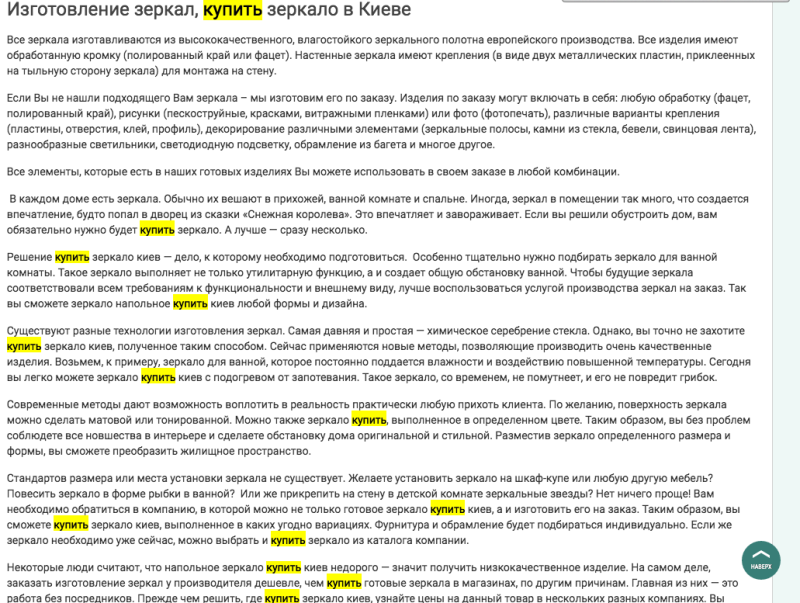
Occurrences of the keyword “buy” on the competitor’s website
After reviewing competitor websites, we developed content recommendations for Liberta.ua.
Content Writing Recommendations
- Category page content should be between 1,000 and 1,500 characters (200–300 words).
- The text should begin with an H2 heading containing the target keyword.
- The content should be divided into clear paragraphs.
- The copy should explain the main benefits of the product category.
- To improve readability, the text should include subheadings and bulleted lists.
- We also prepared a number of additional recommendations.
To avoid keyword stuffing, we limited the use of primary keyword phrases to 5–6 mentions per text. At the same time, we used a wide range of related keywords to make the content more comprehensive and relevant.
Example of the text:
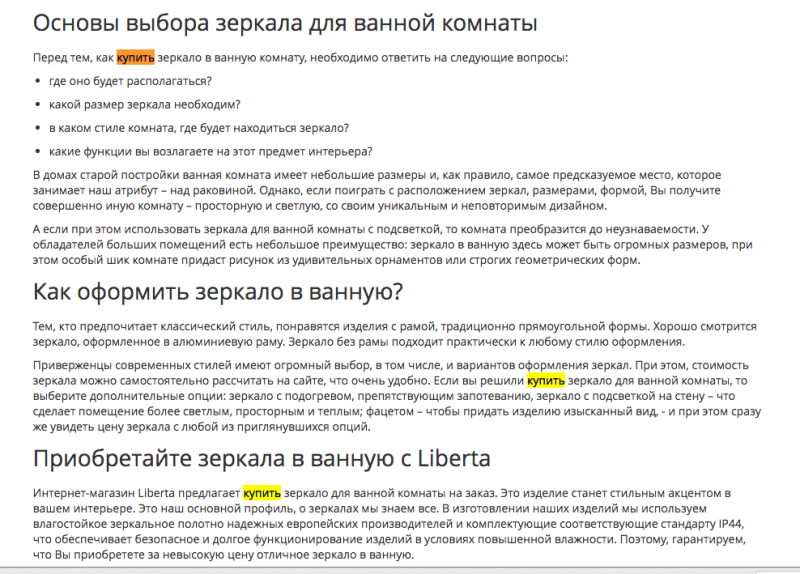
Occurrences of the keyword “buy” on our website
Writing Blog Articles
For Liberta.ua, we used a content marketing strategy to achieve several goals:
- Attract additional organic traffic.
- Build internal links to the website’s main sections.
- Diversify the site’s internal anchor text.
- Increase brand loyalty and trust.
Let’s look at each point in more detail.
Attracting additional organic traffic
We analyzed the questions users most often asked before buying a mirror and created articles that answered them.
Examples of these articles included:
- How to Choose a Mirror?
- How to Choose the Right Mirror Shape and Size?
- Choosing Mirrors for Different Rooms.
Build internal links to the website’s main sections
Internal linking made it easier for users to move from a blog article to the relevant product category. It also helped pass internal authority to the priority pages we wanted to strengthen. Each article contained around 3–4 links to the website’s main categories.
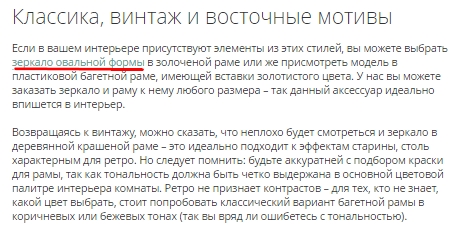
We also used internal links to diversify the site’s anchor text profile. For example, blog articles linked to the bathroom mirrors page using anchors such as:

- Bathroom mirrors.
- Buy a bathroom mirror.
- Bathroom mirror with lighting.
- Mirrors for the bathroom.
- etc.
Increase brand loyalty and trust
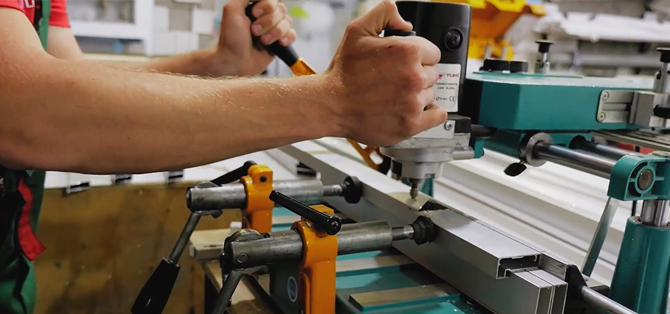
All blog content was designed to provide real value to users. The articles answered important questions and shared helpful recommendations for selecting a mirror.
Content Optimization to Improve Rankings
We encountered a situation where the website was stuck between positions 20 and 30 for several important queries and could not move any higher. To address this, we used additional content optimization.
Here is how the process worked:
- We used Google Search Console to identify keywords for which the site had weak rankings.
- We checked whether those exact keywords appeared in the page content.
- If a keyword was missing, we added it naturally to the text.
- If the keyword was already present but highly competitive, we used it once more or added a closely related variation. We applied this method to every relevant page on the website.
- We also used specialized services and automated tools to review and improve content.
As a result, several target queries moved from positions 20–30 into the top 10 within a relatively short period.
Important! This method should be used carefully. Overloading content with keywords can lead to search engine penalties.
Off-Page Website Optimization
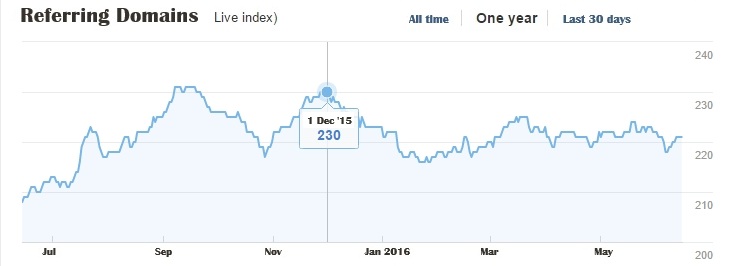
After analyzing competitors’ backlink profiles, we found that around half of the websites in the top 10 had similar link patterns, with large numbers of low-quality backlinks. These were mostly automatically generated links from forums and website directories, many of which disappeared over time.
Example of a competitor’s backlink profile:
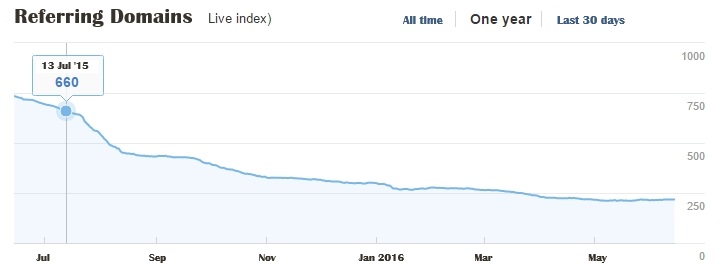
Websites ranking at the top had an average of 200–250 referring domains. To catch up with competitors within a year, the website needed to acquire approximately 15–20 new backlinks per month.
Link-Building Strategy for the Manufacturer’s Website
Our strategy focused on building backlinks carefully and gradually to achieve sustainable long-term results. The target was 15–20 new links per month. We directed backlinks to the homepage and the website’s main category pages.
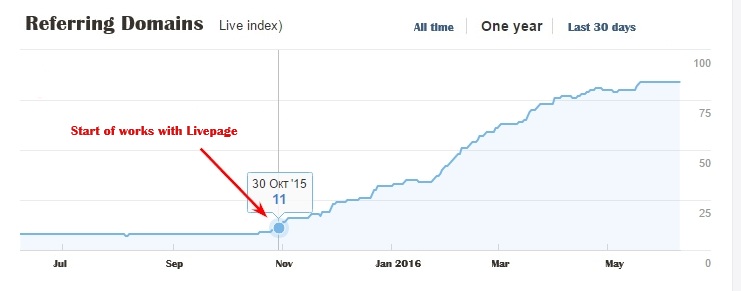
We selected publishing platforms based on several key criteria:
- Relevance: We used media outlets, home renovation and interior design websites, women’s blogs, lifestyle magazines, and other platforms relevant to the target audience.
- Traffic: We prioritized websites receiving at least 1,000 visits per day so the placements could also generate referral traffic.
- Region: We selected Ukrainian websites to attract relevant local users. We did not use platforms focused on other CIS markets because the client did not deliver products to those regions.
Liberta’s Promotion Results with Livepage
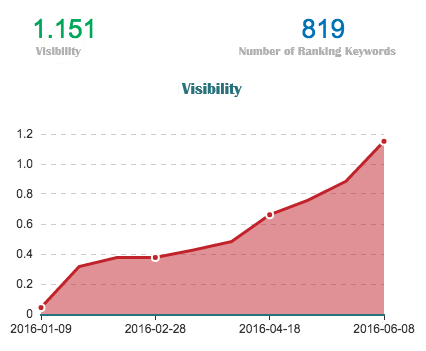
Steady growth in the website’s visibility on Google:
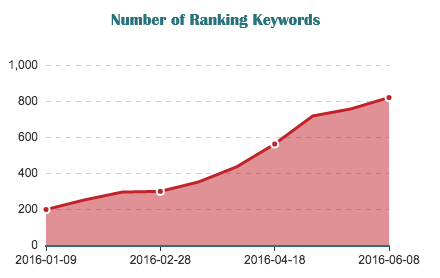
Consistent growth in rankings for target keywords:
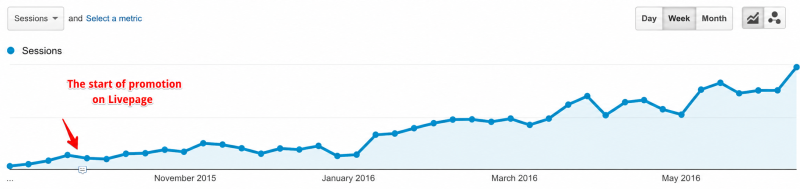
Continued growth in organic traffic:
ROI and Feedback From the Business Owner
We started working together from scratch and achieved significant growth in online sales. In the most recent month alone, ROI from this channel reached 501%.
Serhii Tiutiunyk, Owner of Liberta
Conclusion
A well-planned SEO strategy for the manufacturer’s website, combined with consistent implementation, delivered strong results, and we have no plans to stop there.
What we achieved
- Surpassed key competitors in organic traffic and rankings.
- Improved brand recognition.
- Built a steady flow of returning customers.
- Attracted wholesale clients.
Next steps
- Continue expanding the site structure with new categories.
- Improve the website’s conversion rate.
- Move all mirror-related queries into the top search positions.
- Continue building the backlink profile.
- Connect additional analytics tools, including CallTracking.
- Launch and manage paid search campaigns and remarketing.
- Increase brand visibility across the market.
Want to use a similar strategy for your company? Contact our team.