


16 min reading
What Is a GEO Audit and How Does It Help Assess Your Business Visibility in AI Search


Until recently, a PPC specialist’s work with Google Search followed a clear process: compile a list of keywords, group them by search intent, create relevant ads, manage search terms, bids, and negative keywords, and then gradually optimize campaigns based on the data collected. Today, however, a growing question is how AI is reshaping Google Ads and conventional campaign management practices.
Keywords were one of the main tools advertisers relied on to manage their campaigns. But Google Search is gradually shifting away from simply matching search queries to keywords. AI is transforming both organic search results and the underlying mechanics of paid advertising.
Google is developing AI Overviews and AI Mode while using AI in Google Ads for targeting, query matching, ad creation, and bidding. One example is AI Max for Search campaigns, a set of features designed to find relevant audiences beyond traditional keyword-to-query matching.
That’s why the question PPC specialists should be asking today is not “Do we need keywords?” but “What role do keywords play in Google Ads as Google itself increasingly takes over the task of finding the right user?”
For PPC, the main change is that Google Search is becoming more than just a place where users enter a query and receive a list of results. Search is turning into an environment for research, comparison, and decision-making. Users ask complex questions, receive answers from AI, clarify details, compare options, and only then start interacting with a specific brand.
Google reports that in the US and India, AI Overviews have already driven an increase of more than 10% in Google usage for the types of queries that trigger this feature. The company also notes an increase in commercial searches.
This is an important signal for PPC advertisers: AI is not stopping people from searching for products and services, but it is making the path to conversion more complex.
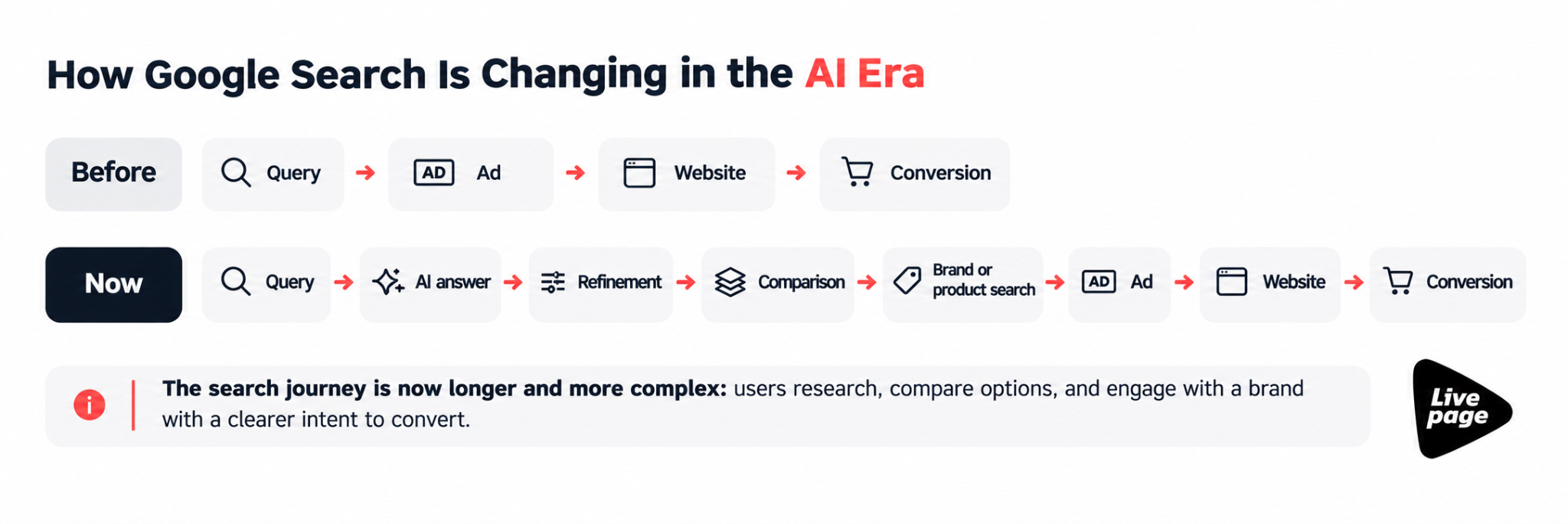
Previously, the user journey often looked like this:
Query > Ad > Website > Conversion
Now, it often looks more like this:
Query > AI answer > Follow-up query > Comparison > Brand or product search > Ad > Website > Conversion
PPC specialists need to consider not only individual search queries but also user intent at different stages of the decision-making process.
That’s why advertisers need to understand how AI is changing paid search advertising and consider not only the query itself but also the search context and the user’s readiness to convert.
The biggest change for PPC in the age of AI is the weakening of the direct relationship between what a user searches for and the specific keyword an advertiser has added to a campaign.
At first glance, this may seem paradoxical, but Google is becoming less dependent on the comprehensive list of search terms advertisers have compiled in advance through keyword research. The system attempts to determine what a person is searching for on its own and select a relevant ad. That’s why Google is actively developing broad match, Smart Bidding, Performance Max, and AI Max.
AI Max for Search campaigns uses match expansion and search term matching technologies to identify relevant queries that advertisers did not anticipate during keyword research.
According to Google, advertisers who enable AI Max see an average of 14% more conversions or conversion value at a similar CPA/ROAS. For campaigns that primarily used exact match and phrase match, Google reports a typical uplift of 27%.
The platform is therefore moving in the following direction:
Less manual listing of search queries > More focus on user intent and conversion data quality
Google Ads after the AI introduction is becoming more dependent on the quality of the data the algorithm receives and the accuracy of conversion value estimates.
Zero-click search in PPC is not a new phenomenon. For years, Google has been adding elements to its search results that allow users to get answers without visiting a website: knowledge panels, featured snippets, local packs, calculators, and other formats. AI Overviews is just reinforcing this trend.
According to research by SparkToro and Datos, in 2024, 58.5% of Google searches in the US and 59.7% in the EU ended without a click. It is important to note that these statistics cover all searches and do not automatically imply a loss of 60% of potential ad clicks. They demonstrate a broader trend toward zero-click behavior.
In 2026, the trend intensified. According to SparkToro research based on Similarweb data, 68.01% of Google searches in the US ended without a click in the first four months of 2026.
The key distinction for PPC is that a search without a click is not necessarily a search without value.
Users do not necessarily visit a website during their initial search. They may return later with a commercial query, a clearer understanding of their needs, and a greater readiness to make a purchase.
For example, a user initially searches for:
After comparing options, they move on to more specific queries:
The second type of query is much more valuable for PPC, as it often indicates a well-defined commercial intent.
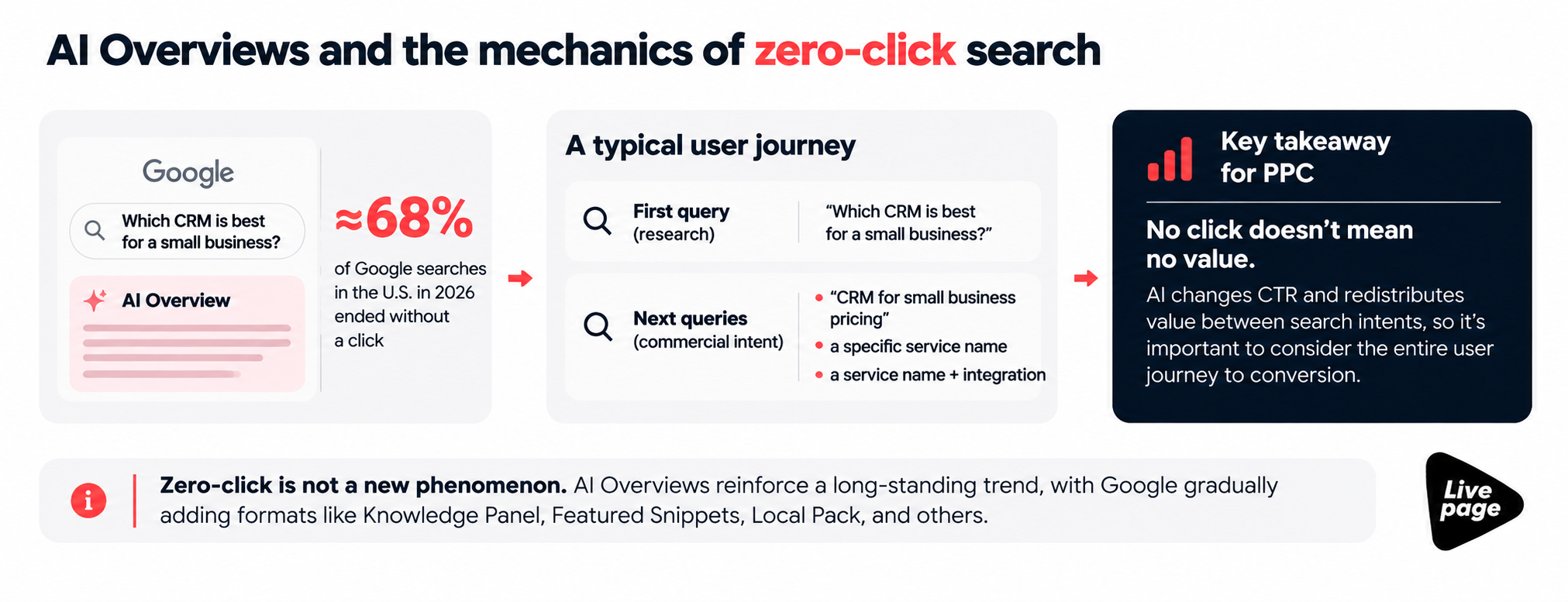
AI is changing not only CTR but also how value is distributed across different search intents. Therefore, when considering AI Overviews and PPC, it is important to evaluate not only website visits but also user behavior along the path to conversion.
In traditional search PPC, we are accustomed to analyzing:
In the new model, these metrics are no longer sufficient.
As Google covers a broader range of search queries, PPC specialists need to understand not only the keyword itself but also the user intent identified by the system and the value of the query to the business.
For example, a single broad match keyword covers dozens or hundreds of query variations that differ in terms of users’ readiness to buy. Campaign management is therefore gradually shifting from controlling individual keywords > to controlling traffic quality and the signals the algorithm receives.
At the same time, the search terms report remains relevant. In fact, it helps PPC specialists monitor relevance, identify new search intents, add negative keywords, and assess how well the algorithm understands the business.
Thus, PPC after AI Overviews requires a broader approach to performance evaluation: it is important to consider not only the direct performance of ads but also the quality of the demand they help capture.
As Google covers a broader range of search queries, PPC specialists need to understand not only the keyword itself but also the user intent identified by the system and the value of the query to the business.
Google is now placing increasing emphasis on context. The system analyzes not only the keyword but also:
Broad match uses additional signals to determine relevance and user intent. AI Max expands on this approach: Google uses AI to discover new search queries, optimize ad copy, and expand URLs based on information from the website.
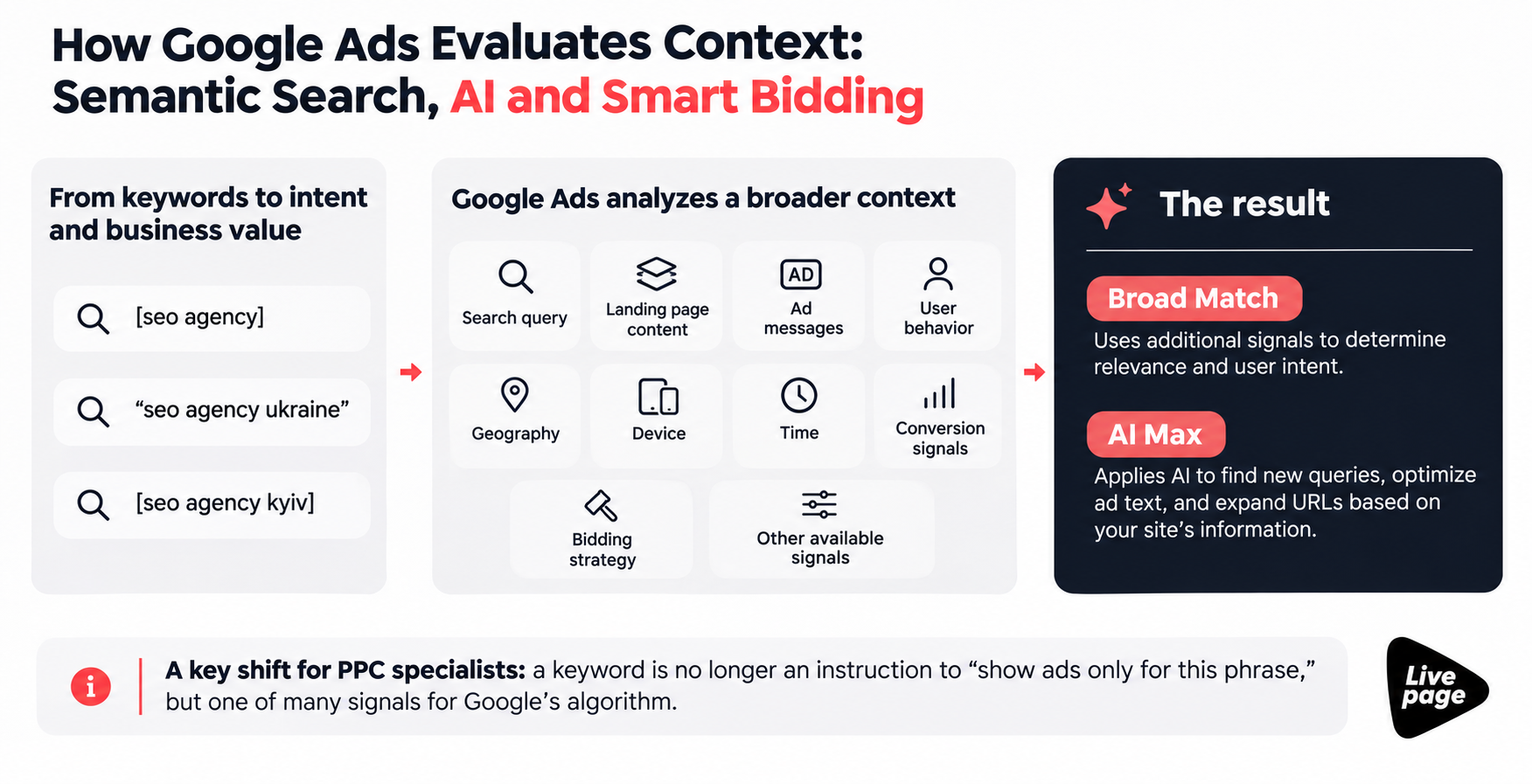
This marks a fundamental change in the role of keywords in modern PPC. Rather than telling Google to show ads only for a particular phrase, a keyword serves as one of the signals that guide the algorithm.
It may seem that a better understanding of intent makes keywords unnecessary. That’s not the case. What’s becoming less necessary is manually accounting for every variation of a search query that expresses the same underlying need.
Keywords are still essential for:
However, understanding how to optimize Google Ads for AI requires moving away from the old principle that “the more keywords we collect, the more relevant traffic we’ll attract.”
Exact match isn’t going anywhere. For many businesses, it remains an important control mechanism, especially when high precision is required or when advertisers are dealing with expensive branded or commercial traffic.
At the same time, the role of exact match is changing. Google continues to improve its automated understanding of search queries. In 2026, the platform is expanding the transition to AI Max, particularly for campaigns using campaign-level broad match, and plans to gradually transition Dynamic Search Ads to AI Max. The direction in which the platform is moving is becoming increasingly clear.
In the past, PPC specialists spent much of their time building the most detailed keyword lists possible:
keyword > match type > ad group > ad > landing page
The model gaining relevance today looks different:
business goal > intent > signals > creative > landing page > algorithm > conversion data
That doesn’t mean throwing campaign structure out the window. For complex or expensive accounts, control remains important. If a business isn’t willing to pay for impressions associated with certain types of queries, it needs clear rules, negative keywords, brand controls, and other restrictions.
Automation doesn’t eliminate the PPC specialist’s control — it changes the level at which that control is exercised.
The way people search offers a good illustration of how AI is changing Google Ads. Users are getting more specific about what they’re looking for. Google notes that as AI evolves, people are coming to Search with longer, more complex, and multimodal questions.
Traditional keyword research doesn’t always capture the full extent of actual demand. For example, an advertiser sells air conditioning systems. A traditional keyword set includes queries such as:
But a potential customer may approach the search differently: “What’s the best air conditioner for a 60-square-meter apartment that keeps it cool in the summer without using too much electricity?” The advertiser’s keyword set may not include this particular phrase, but the query still has commercial value.
Google Ads’ AI-driven approaches help the system recognize the connection between the query and the product category, identify commercial intent, and find a relevant ad. As a result, the PPC specialist’s role is gradually shifting from trying to cover every possible keyword to giving the algorithm the right signals to identify relevant demand.
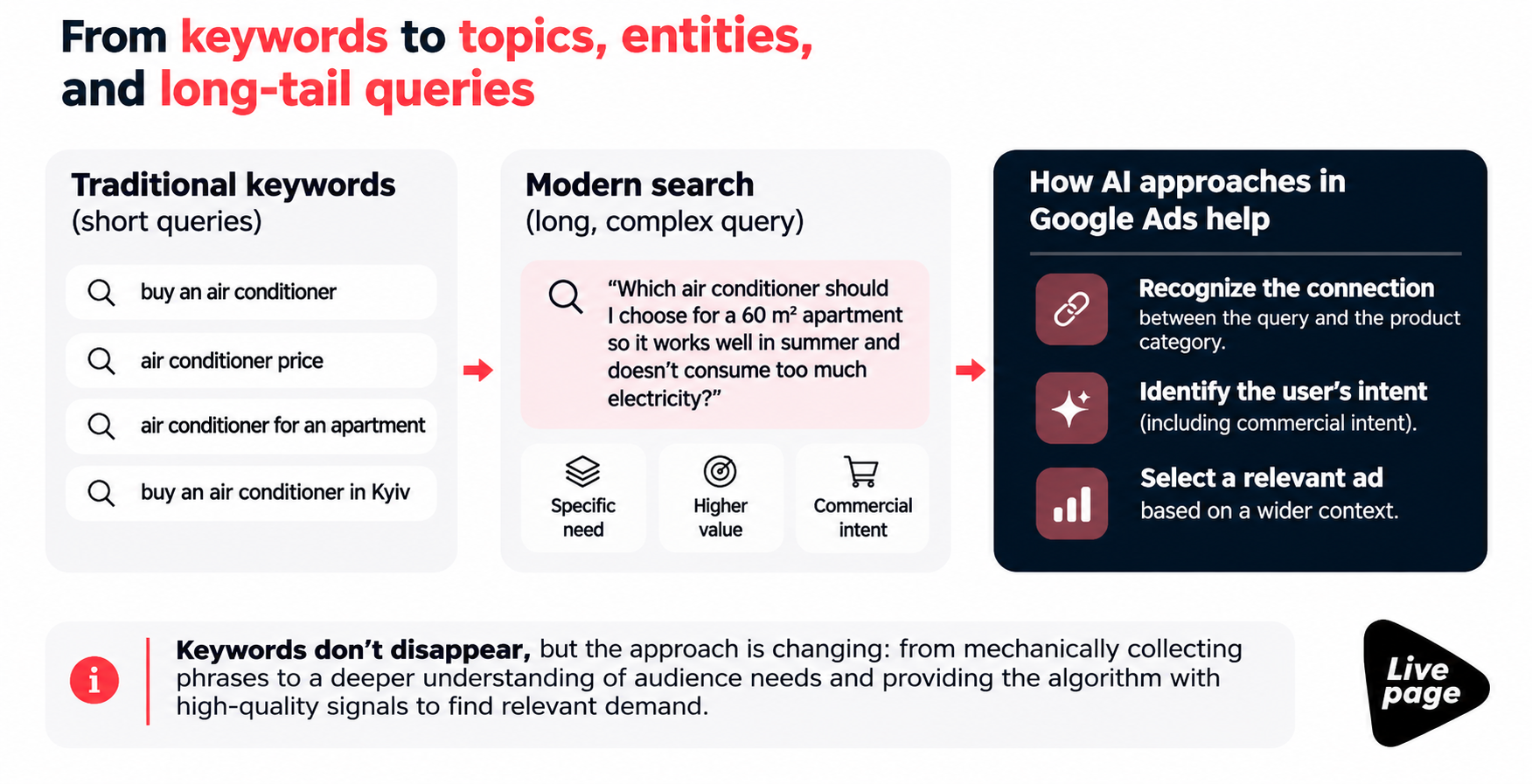
The future of PPC, then, isn’t about moving away from keywords altogether. It’s about using them differently, putting less emphasis on compiling lists of phrases and more on understanding what the audience actually needs.
AI doesn’t mean that advertisers simply need to enable AI Max and forget about the campaign. On the contrary, automation raises the standards for the quality of work PPC specialists deliver. When Google decides which search queries trigger an ad, advertisers need to be clear about:
AEO and GEO are typically considered areas of SEO, but they’re also relevant to PPC. The connection between generative search and PPC becomes particularly important when users receive an AI-generated answer before seeing traditional search results. In this scenario, brands risk losing some of their initial touchpoints with potential customers. That’s why advertisers need to align the following:
AI-generated answer > ad message > landing page > offer
If AI has helped users establish their selection criteria, the ad should address those criteria. For example, someone is looking for a CRM with a specific integration. A generic ad saying “CRM for Business” isn’t enough. A better option is something like CRM with X Integration – Sales Automation. The landing page then needs to explain the feature mentioned in the ad.
AI search raises the standards for relevance between user intent, ad copy, and landing pages. Alignment between these elements affects Quality Score and overall campaign performance in Google Ads. Therefore, optimizing ad campaigns for AI Overviews requires considering not only ad relevance but also how well the advertised offer aligns with the information users have already received during their search.
In PPC, the advertiser’s website serves as a source of signals for advertising algorithms. AI Max uses information from URLs to create relevant ad messages and expand reach. Google notes that the system analyzes marketing messages on website pages and uses them to generate new ad assets.
That’s why a landing page needs to do more than look good. It should clearly explain:
Structured data helps search engines better understand the context of a page, product, or organization. From a PPC perspective, though, what matters most is that a clear, informative website provides the system with better signals for assessing ad relevance.
If AI increases the share of zero-click informational searches, PPC strategies should place greater emphasis on commercial intent.
Take these two search queries:
For the first query, users often receive an answer without visiting a website. The second typically indicates that someone is looking for a specific service.
That’s why keyword sets shouldn’t be evaluated solely based on the number of impressions or potential search volume. It’s important to understand the business value behind the user’s intent.
For PPC, this puts greater emphasis on:
According to Google, people are also using Search more frequently for commercial queries as AI advances. In other words, AI isn’t necessarily taking demand away from Google Ads. It’s shifting that demand by satisfying some informational needs directly in search results and guiding some users toward more specific commercial queries.
PPC strategies need to account for both upper-funnel activity and the moment when potential customers are ready to act. Recognizing this shift helps advertisers adapt their Google Ads campaigns to AI and make better decisions about how to distribute their budgets across different types of search demand.
When discussing AI Overview and PPC, the biggest mistake is assuming that the growing role of AI means advertisers should switch entirely to automated campaigns. In reality, automation raises the standards for the quality of work PPC specialists deliver. If Google independently determines which queries trigger ads, advertisers must clearly define their target audience, product, and the action that brings value to the business.
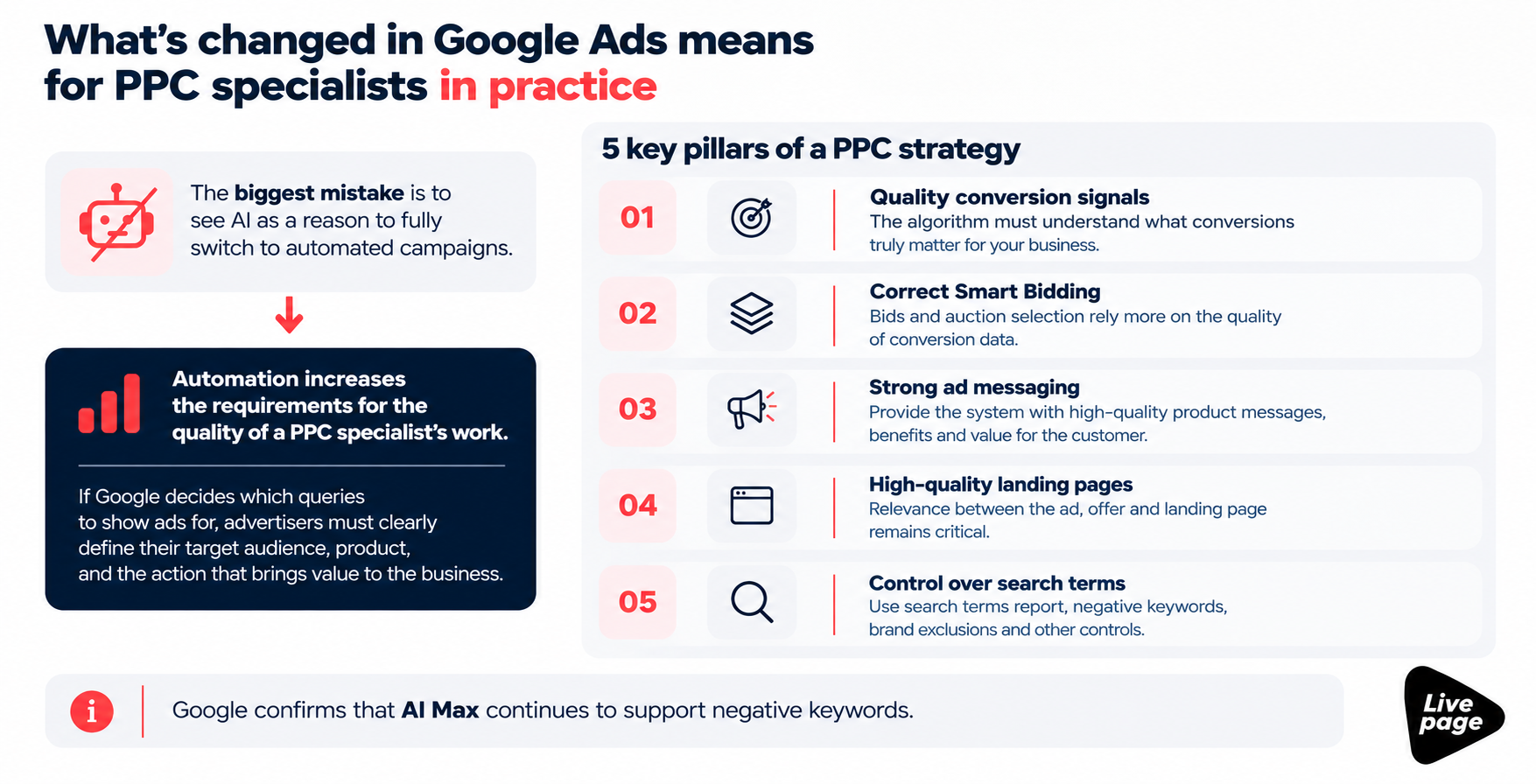
This puts five areas at the heart of PPC strategy.
The algorithm needs to understand which conversions truly matter to the business. If a campaign is optimized for every possible micro-conversion, Google risks attracting more users who complete secondary actions but don’t generate meaningful business results.
As the system gains more freedom in matching search queries, bidding and auction selection depend more on the quality of conversion data.
If Google uses AI to create and adapt ad assets, advertisers need to provide the system with high-quality messaging about the product, its benefits, and its value to customers.
The algorithm won’t compensate for the shortcomings of a page that doesn’t match the user’s query. Relevance between the ad, offer, and landing page remains critical.
Automation doesn’t mean a lack of control. The search terms report, negative keywords, brand exclusions, and other control mechanisms remain necessary. Google, for example, notes that AI Max continues to support negative keywords.
For Livepage’s PPC team, the main change is the shift from manually managing individual search queries to managing a system of signals. In practice, this doesn’t mean abandoning keyword research. During campaign launches and audits, keyword research helps us understand the business, competitive landscape, search intent, and potential growth opportunities.
The next step is to give the algorithm room to discover new sources of demand wherever expanding reach makes financial sense.
That’s why, in our modern Search strategy, we evaluate not only the number of keywords in a campaign but also:
This approach helps us keep campaigns aligned with changes in Google Search while making better use of advertising budgets. Successfully promoting a business through Google Ads in the AI era comes down to combining automation with a solid understanding of business objectives, traffic quality, and what conversions are actually worth.
Managing Google Ads is no longer just about managing keywords. It’s about working with an algorithm-driven channel to capture demand.
Are keywords dead in PPC? No. However, they are gradually losing their role as the primary unit of campaign management. Google Search is moving away from a model in which advertisers try to manually anticipate every possible query toward one in which the system independently interprets user intent and identifies relevant demand.
This transition is already evident in the development of broad match, Smart Bidding, Performance Max, and AI Max. Google is moving toward a model in which advertisers define business goals, audiences, signals, creatives, and restrictions, while the algorithm takes on an increasing share of query matching and optimization.
At the same time, keywords remain important. They help advertisers understand customer language, establish an initial campaign structure, research demand, and control traffic quality. However, the focus is moving from “Is this keyword in our campaign?” to “Is Google bringing in the right users and turning them into the conversions we’re looking for?”
How to advertise in the age of AI then? The main change for PPC specialists is in their role:
The future of PPC keywords isn’t about getting rid of them. Keywords will still provide the foundation, but the entire system will no longer revolve around them.
If you’re looking for the right approach to keyword management and automation in Google Ads, get in touch with Livepage team.


“Livepage has proven to be a reliable source for rapid online growth. We started with 2,000 visitors per month. In 3 years together with Livepage we have reached 70,000 visitors and more than 100 leads from the site per month.”


“As for the results, we’ve been working together since 2015, and our traffic has increased 10x. I cannot say that Livepage was our first SEO company, but they have become the first SEO partner that helped us to achieve the success we were looking for.”


“Livepage delivers SEO efforts that have led to an increase in the site’s users, traffic, and conversions. The team uses a wide range of tools to achieve the client’s goals. They are attentive to the client’s needs, working with them in real-time and bringing in additional specialists when needed.”


“I am pleased with the quick task execution and the instant replies to my messages.”

“I like the complex approach that the Livepage team offers. Absolutely all team members work together; everyone is aware of what is happening on the project. We have one common goal – to increase our service sales, and the team is making every effort to achieve the goal as soon as possible.”

“We’ve been really impressed by how Livepage quickly understood our business and centred our PPC campaign around our objectives. We have achieved good results within a very short time in both revenue and ROI.”

“Everything is clear, timely, and understandable.”


“They have leveraged ideal opportunities to reach our business goals.”