


1 min reading
Review of Cooperation with Livepage from BEREG


Imagine a potential client asking ChatGPT, Gemini, or Perplexity which agency they should hire to promote their online store. They specify their budget, target market, and required services, then receive a list of service providers. Is your company among them? And if so, does the system accurately describe its experience and specialization? Businesses need answers to these questions before they start working on generative search optimization.
What is a GEO audit? A GEO audit is a comprehensive assessment of how a brand and its website are represented in responses from generative AI systems. During the audit, a specialist collects responses, examines the technical accessibility of website pages, analyzes content and external mentions of the company, and compares its presence with that of competitors. The report documents the current level of visibility and recommends changes, explaining how to evaluate their effectiveness in the future.
In this article, we’ll explore why a GEO audit is needed, how to audit a website for AI, and how it helps set priorities for promotion in AI search.
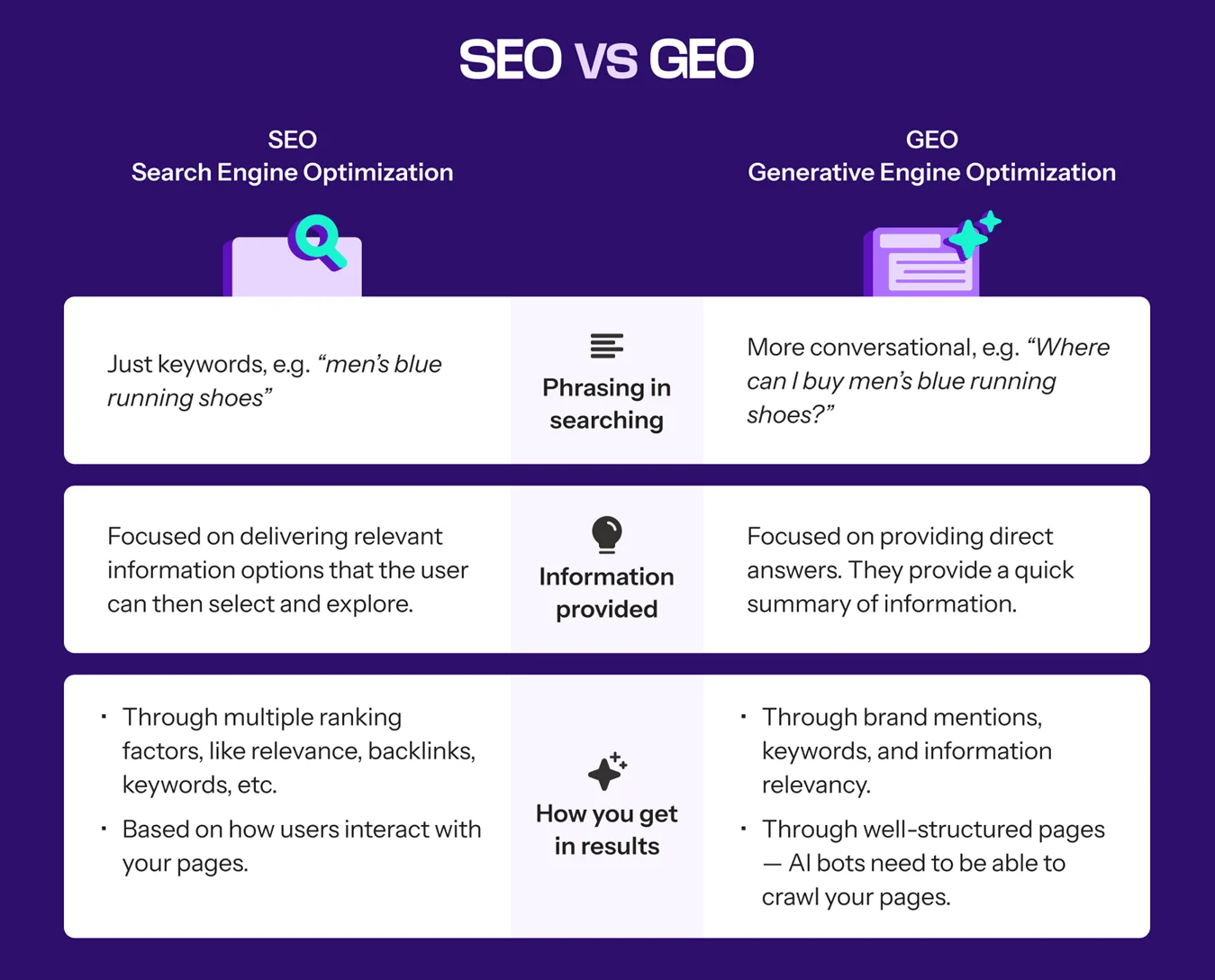
An SEO audit identifies the issues holding a website back in traditional organic search. A GEO audit takes that analysis further by examining whether a company appears in AI-generated answers, how it’s positioned in recommendations, and which sources AI systems rely on.
For example, a service page might rank in Google’s top 10, yet the company doesn’t appear in any of the AI-generated provider shortlists. Or the AI mentions the brand but links to an industry directory rather than its official website. Search ranking data alone doesn’t explain why this happens.
There’s some overlap between the technical aspects of GEO audit vs SEO audit. Both require accessible pages, a logical website structure, and strong content. But a GEO audit for businesses also examines the questions potential customers ask AI, where and how the brand is mentioned or cited, and which competitors appear in AI-generated answers. That’s why GEO auditing doesn’t replace SEO auditing or simply repackage the same processes under a different name.
A GEO report helps businesses understand which queries surface their brand, which competitors AI recommends alongside them, and how their services are described. By keeping a record of AI-generated responses, businesses can also verify the audit findings and revisit questionable mentions in future assessments.
A GEO audit for website visibility is appropriate when you’re planning to promote your business in AI search and want to establish a measurable baseline. Without one, it’s difficult to assess whether your brand’s presence has changed after content updates, technical improvements, or media publications.
If your company regularly fails to appear in responses to commercial queries, that’s another reason to conduct an audit. Who does AI recommend instead of you? Which sources does it cite? Start with a few priority topics and repeated checks. A single response that doesn’t mention your company doesn’t prove that your brand is consistently losing out to competitors.
Before expanding into a new market or introducing a service, examine how AI presents your company’s expertise. For instance, your business might already specialize in eCommerce, while older directory listings still describe it as a corporate website development company. A GEO audit will reveal whether that outdated information is appearing in AI-generated answers.
Once you’ve implemented GEO recommendations, compare the latest responses against your original baseline. Use the same methodology and query groups to ensure you’re measuring changes in brand visibility rather than differences in the sample.
A GEO website audit for AI begins by gathering AI-generated responses about your brand and services. The next step is to examine your website, checking whether important pages are accessible, what information they provide, and where customers need clearer explanations.
Simply asking “Does AI know about our company?” doesn’t tell the whole story. A website AI visibility check also looks at which businesses AI recommends for specific customer needs. The specialist reviews service descriptions, checks the consistency of business information across online sources, and analyzes the references AI uses when discussing your company and its competitors.
AI visibility shows how visible a brand is within a selected sample of AI-generated responses. Results are grouped by platform, topic, and query type. For example, a company may be frequently mentioned in explanations about website development but rarely recommended when users are choosing a service provider. This difference gets lost in the overall percentage of mentions, so commercial queries are analyzed separately.
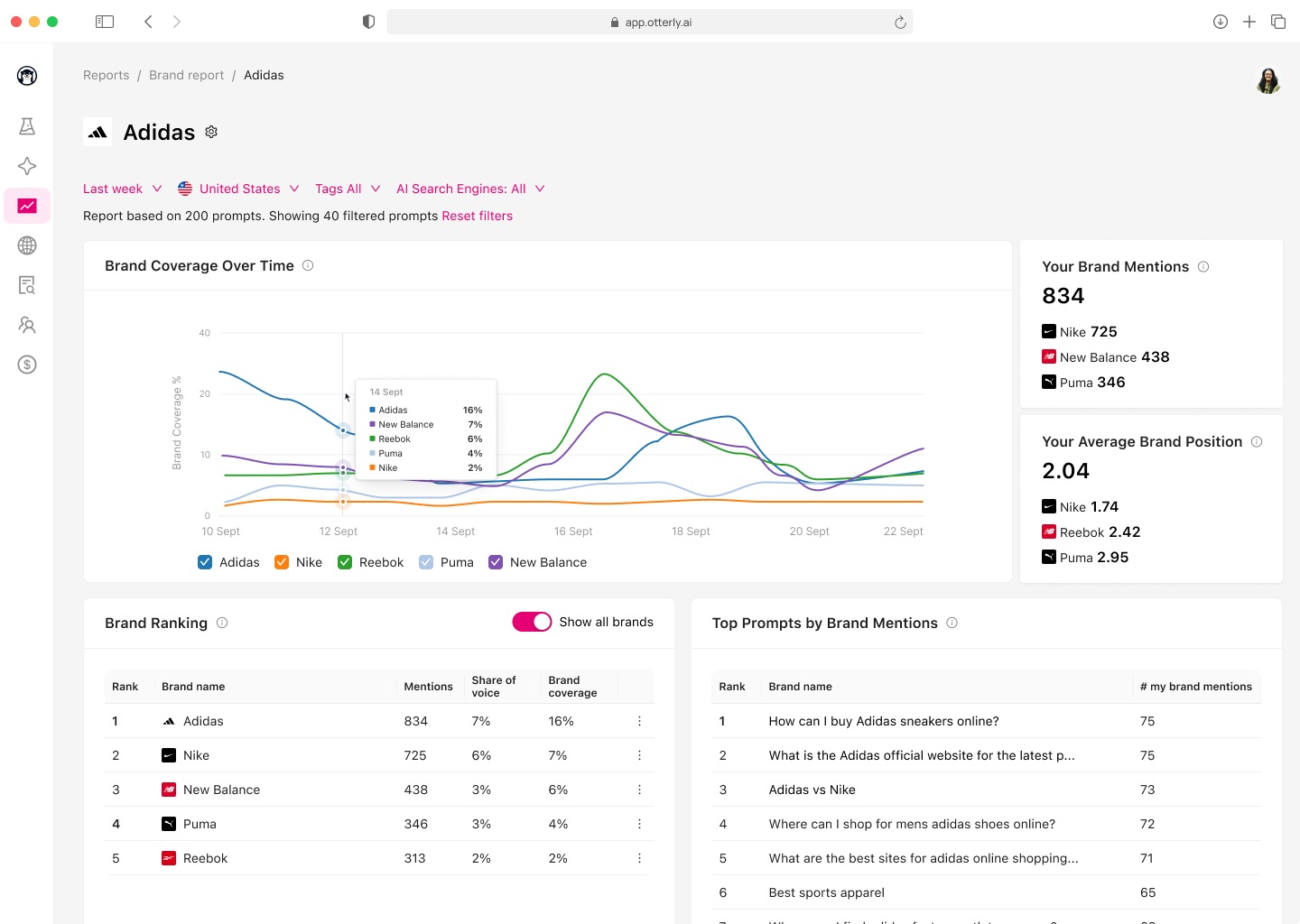
Brand coverage refers to mentions of the company name, while domain citations refer to links to your website’s URLs in AI-generated responses. A brand name without a website link counts as a mention. A link to a company article counts as a citation, even if the system doesn’t recommend its services. Both metrics are calculated separately in the report.
Share of Voice is used to compare your brand with competitors. Before calculating it, you need to define the methodology. For example, you can measure your brand’s share of mentions among all mentions of an agreed-upon list of competitors. It’s important to understand that this represents a share within the sample being analyzed, not a measure of presence across the entire market or all AI queries.
Here’s a hypothetical example: your brand appears in 20 out of 100 responses reviewed. That means the percentage of responses mentioning your brand is 20%. If the same sample contains 80 mentions of all selected brands, 20 of which belong to your brand, its Share of Voice under this methodology is 25%. Different metrics describe different aspects of brand presence.
Another important part of the analysis is a GEO audit of website visibility. It examines how frequently AI systems mention your brand, whether they cite pages from your website, and how they position your company when recommending providers to potential customers.
The audit goes beyond counting mentions to assess their accuracy and relevance. Does AI correctly describe your services, geographic coverage, and areas of expertise? Are its recommendations relevant to the user’s query? When AI provides a ranked list, the brand’s position can also be recorded, although it shouldn’t be interpreted as a consistent ranking in traditional search results.
AI visibility audit reveals where your brand appears, where it’s absent, and where AI systems misrepresent your business. Website traffic and customer inquiries are assessed separately, since appearing in an AI response doesn’t automatically result in a website visit or sale. For a practical example of evaluating an individual platform, see our article on how to check whether ChatGPT recommends your company.
A technical GEO audit examines whether search engines and AI crawlers can access your service pages, product pages, case studies, and articles. For each priority URL, the specialist checks what content bots receive and whether they encounter any errors.
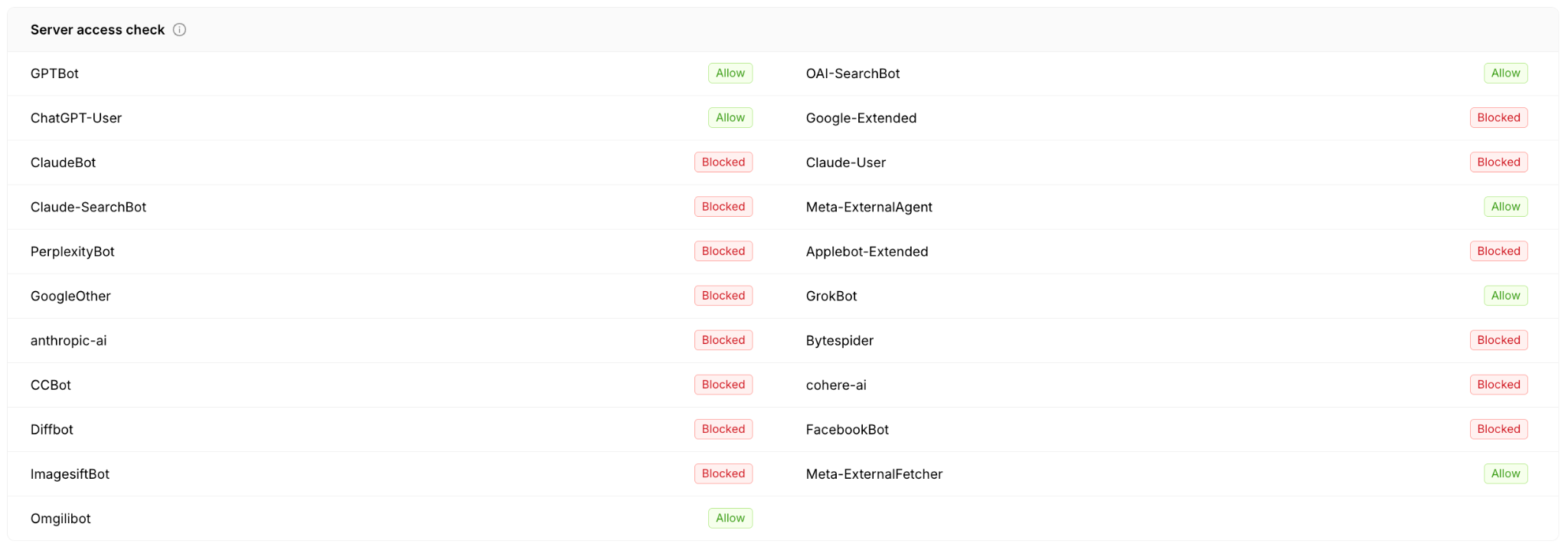
The audit starts with robots.txt and access rules for the relevant bots. Search crawlers and bots designed to collect data for model training serve different purposes. For example, OpenAI’s documentation distinguishes between OAI-SearchBot, which is intended for search, and GPTBot, which is used to collect data for model training. Therefore, blocking a training bot doesn’t necessarily mean that a search bot will also be unable to crawl the website.
Next, the specialist checks server responses, redirects, and restrictions imposed by CDN/WAF systems, which handle content delivery and website security. A page might open normally in a browser but return an error or an access verification challenge to a bot. Request logs and test results help confirm this issue. However, simply spoofing a bot’s user-agent name during testing doesn’t always reproduce its actual access.
The audit also examines HTML and rendering to determine which content is included in the initial server response and which becomes available only after JavaScript runs. If a key service description is loaded dynamically, the specialist needs to verify whether the target system can retrieve it. Not all crawlers have the same capabilities.
A website AI readiness check also involves reviewing internal linking and validating structured data, including Schema markup. This markup must accurately reflect the content visible on the page. Google explicitly states that no special AI markup is needed for AI Overviews or AI Mode. Instead, pages must be indexed and eligible to appear with a snippet. Even then, meeting these requirements doesn’t guarantee full citation.
The technical brief document includes the URL of the problematic page, test results, and a method for verifying the fix. The developer needs to see exactly where the issue occurs and what website behavior is expected after the changes.
Read a service page from the perspective of a customer visiting the website for the first time. What do they learn from a phrase like “comprehensive solutions for your business”? Almost nothing about timelines, terms, or the service provider’s experience. In contrast, detailed service descriptions and project examples give readers a basis for making a decision and AI systems the information they need to generate an answer.
The brand name, specialization, products, and geographic coverage are checked for consistency across service pages, case studies, and external profiles. Any discrepancies are documented with links to the sources. Maintaining a consistent description of the company and its relationships with services, people, and topics is part of what’s known as Entity SEO.
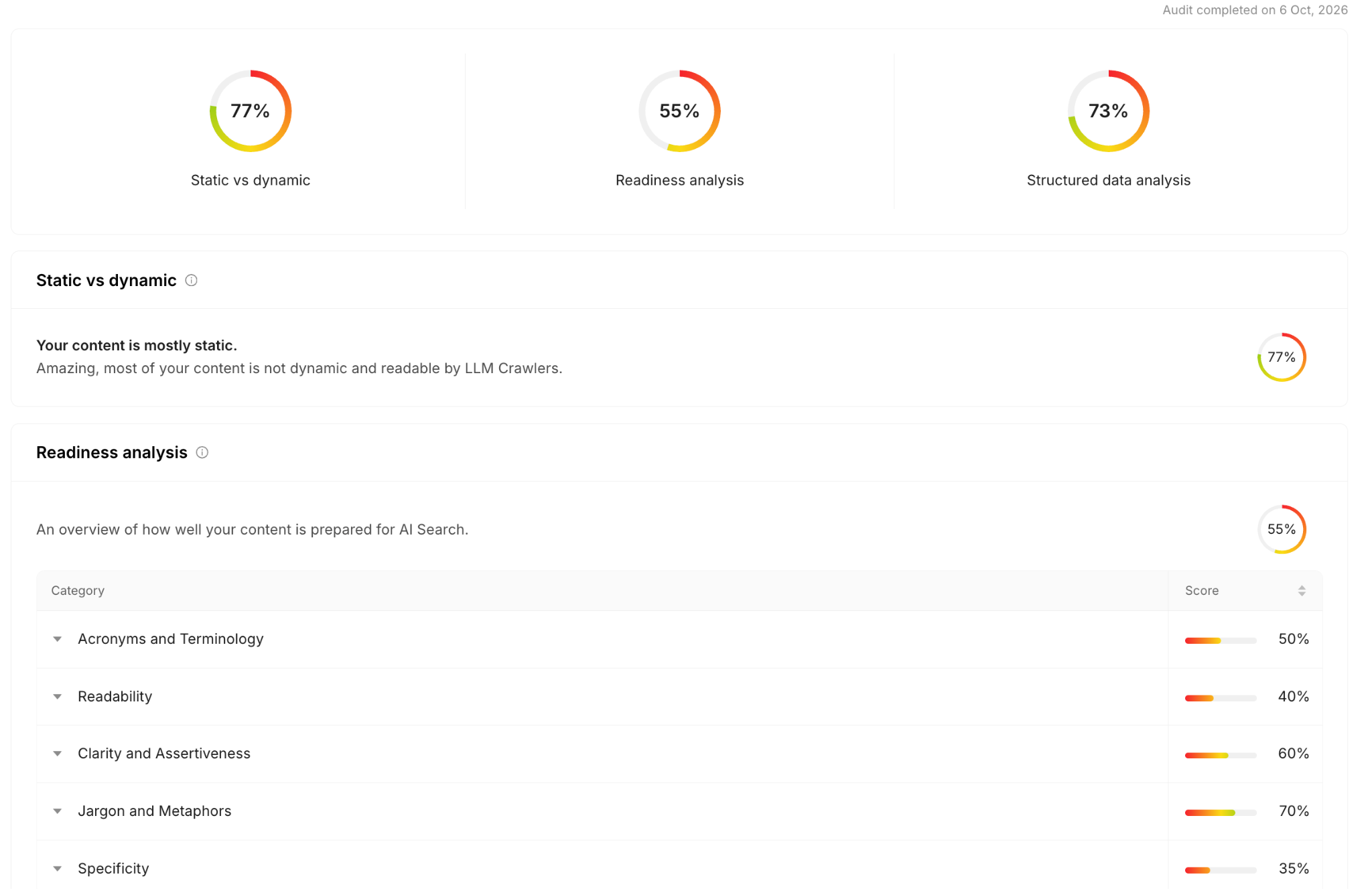
Expertise is evaluated based on verifiable content. Does a case study describe the initial problem, the work performed, and the results achieved? Does an article explain where its data came from? Are the service terms up to date? Having this information helps readers evaluate an offer, but it doesn’t guarantee automatic inclusion in AI-generated responses. If generative tools are used to create content, it’s worth separately assessing the risks of AI-generated content and checking the text’s factual accuracy, originality, and value to readers.
Another area of analysis is how thoroughly the content addresses audience needs. Google describes query fan-out as the ability to perform multiple related searches on subtopics when generating an AI response. For an audit, this is a reason to examine related customer questions rather than create a separate page for every possible query variation.
For example, a customer choosing a CRM for an online store compares services based on integrations, data migration timelines, and support terms. A general description of CRM benefits won’t answer their questions. That’s why, during an audit, the specialist determines which explanations should be added to the service page and which topics would be better covered in a separate guide or case study.
How does a GEO audit work? It starts with defining the business objectives, including which services, target markets, and customer decision-making scenarios to analyze. The specialist then develops a set of target prompts, gathers baseline AI responses, and compares the findings with information from your website and competitors.
Simply being absent from an AI-generated answer doesn’t reveal the underlying cause. The specialist looks for evidence, such as page accessibility errors, missing service information, or inaccurate details in sources cited by AI. When the evidence is insufficient, the report documents a hypothesis that needs further testing. However, even a thorough audit cannot fully uncover the internal factors driving an AI system’s choice of sources.
To build a pool of target prompts, collect customer questions, sales inquiries, and search keywords. Select topics related to the company’s priority services. The prompts should include informational questions, comparisons of options, and questions related to choosing a company.
For example, suitable prompts for an agency include “how to evaluate SEO results for an online store,” “what to look for when choosing an SEO provider,” and “which agencies work with Ukrainian eCommerce businesses.” Each corresponds to a different stage of the decision-making process, from learning about a service to finding a specific provider.
Branded prompts should be evaluated separately. Asking “what services does Livepage offer?” helps verify whether AI describes the agency accurately, but it doesn’t reveal whether AI recommends the company to users who aren’t familiar with its name. Keeping branded and non-branded results separate is therefore important.
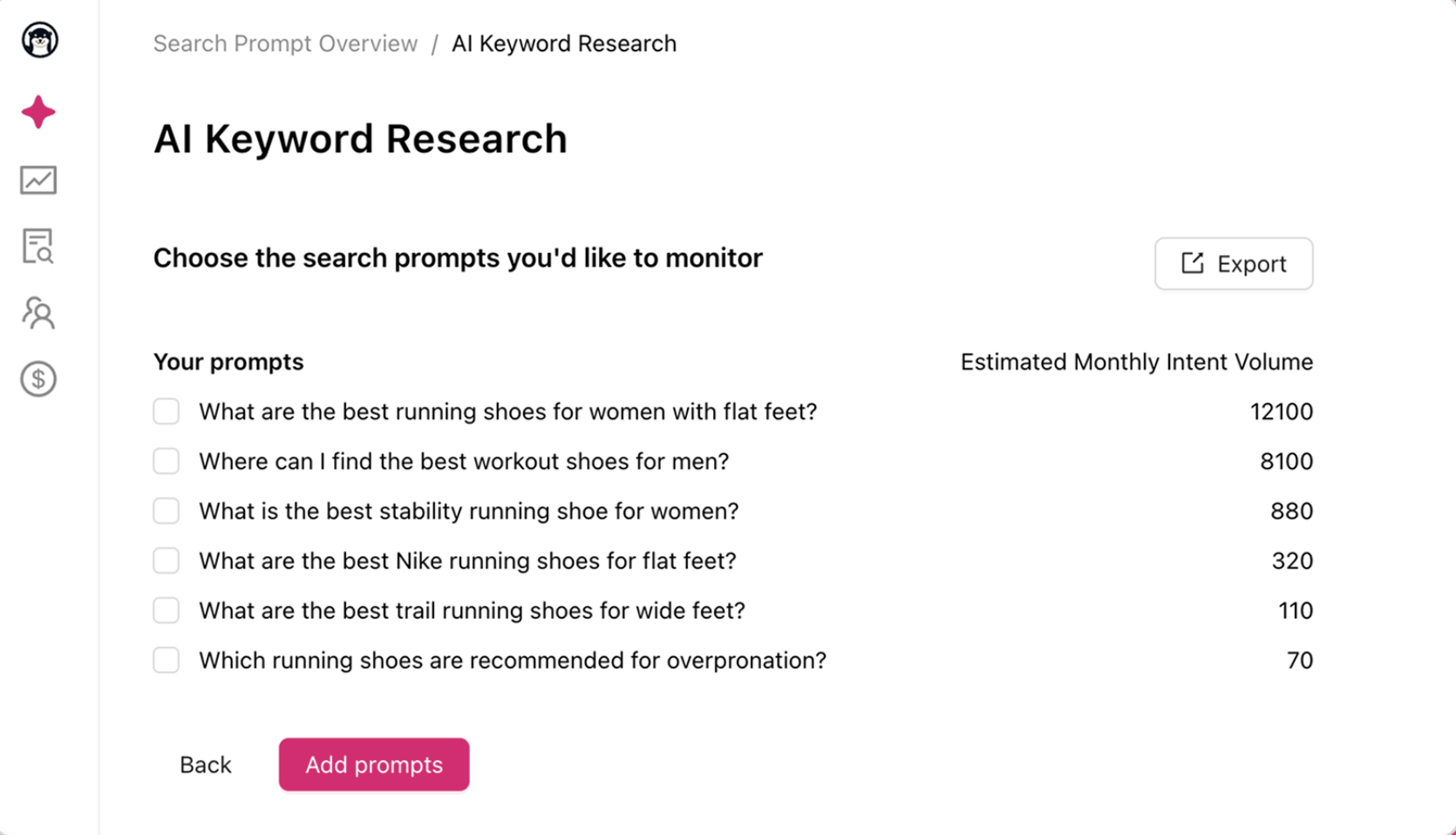
For every test, document the language, target market, AI platform, search mode (depending on the AI model), and date. Preserve the exact wording of each prompt. When running repeated manual tests, start a fresh chat session each time to prevent previous conversations from influencing the AI with your brand name. Comparing results across runs helps identify how much AI responses change.
Don’t remove prompts just because your brand isn’t mentioned. If a query reflects a real customer need and relates to a priority service, it belongs in the sample. Excluding these prompts would make your baseline visibility report look better than the actual results suggest.
This stage involves documenting AI-generated responses, the companies mentioned in them, and links to cited sources. Automated monitoring tools like Otterly and Ahrefs Brand Radar help gather data, while manual review helps evaluate the relevance of recommendations, detect inaccurate descriptions, and ensure brands are identified correctly. Any findings produced with AI tools must be reviewed by a specialist. For a closer look at the advantages and limitations of this approach, see our article on using AI in SEO.
Organize the findings by topic and AI platform. Identify where your company appears in informational answers versus where it’s recommended as a service provider. Determine whether the information comes from your own website or an independent publication. Responses that don’t cite sources should be flagged separately rather than assigned an unverified source.
A GEO competitor audit looks at both your direct business competitors and other companies appearing in the AI responses you’ve collected. These aren’t necessarily the same businesses that dominate traditional organic search rankings. The analysis identifies which queries trigger competitor recommendations, how AI describes their services, and which pages it cites.
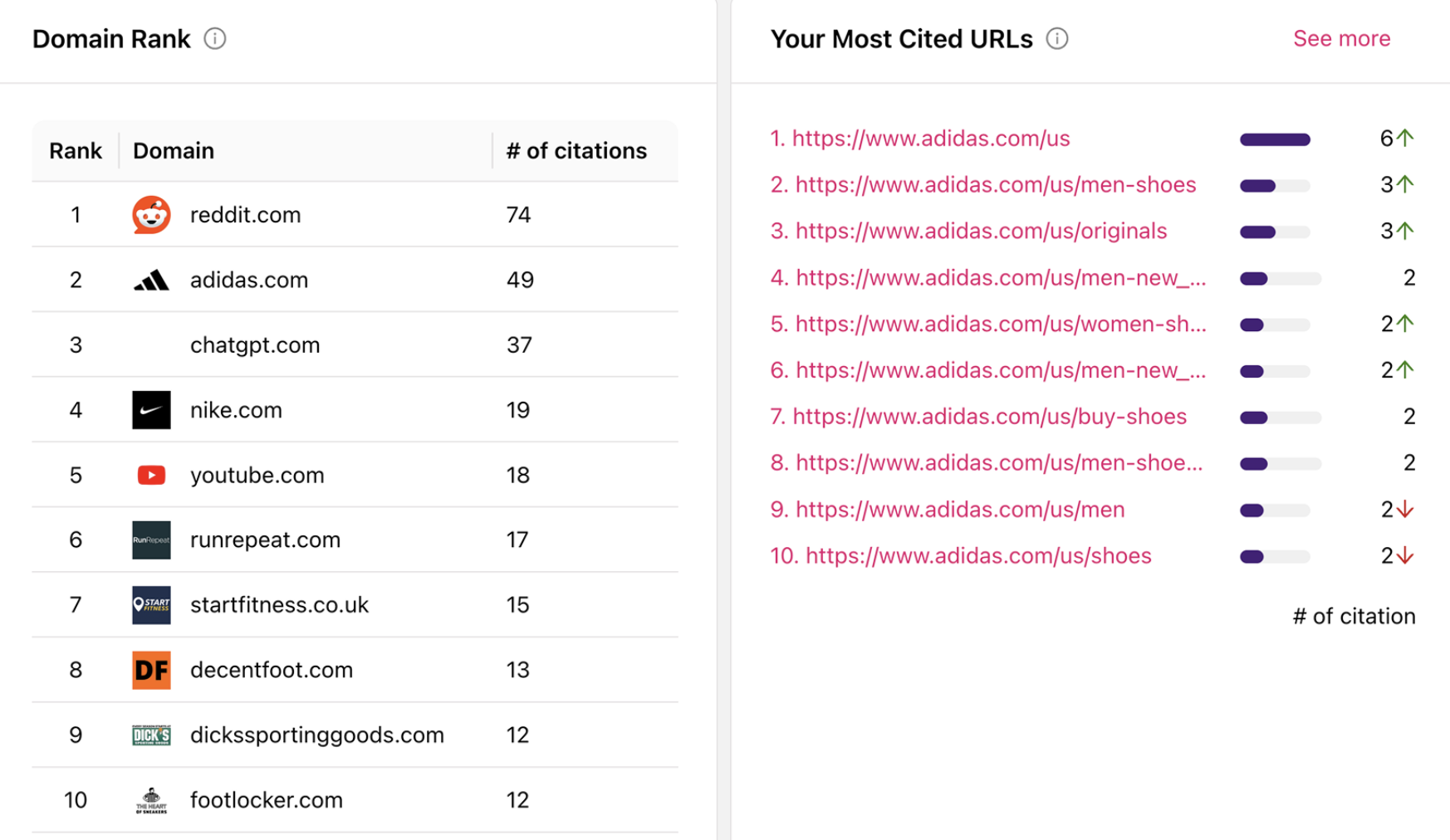
The next step is to review the cited content. What customer questions does it answer? Does it provide specific terms, comparisons, or documented examples? For instance, a competitor might publish a dedicated guide to integrating its service with a CRM, while your website mentions the integration only in passing. This points to a potential content gap worth investigating, but it doesn’t establish why AI chose that source.
In parallel, the specialist reviews your website’s technical setup and content. The report clearly distinguishes verified findings from hypotheses. An access error confirmed by testing, for example, is an established fact. The idea that updating a particular page will lead to more citations, however, remains a hypothesis to test.
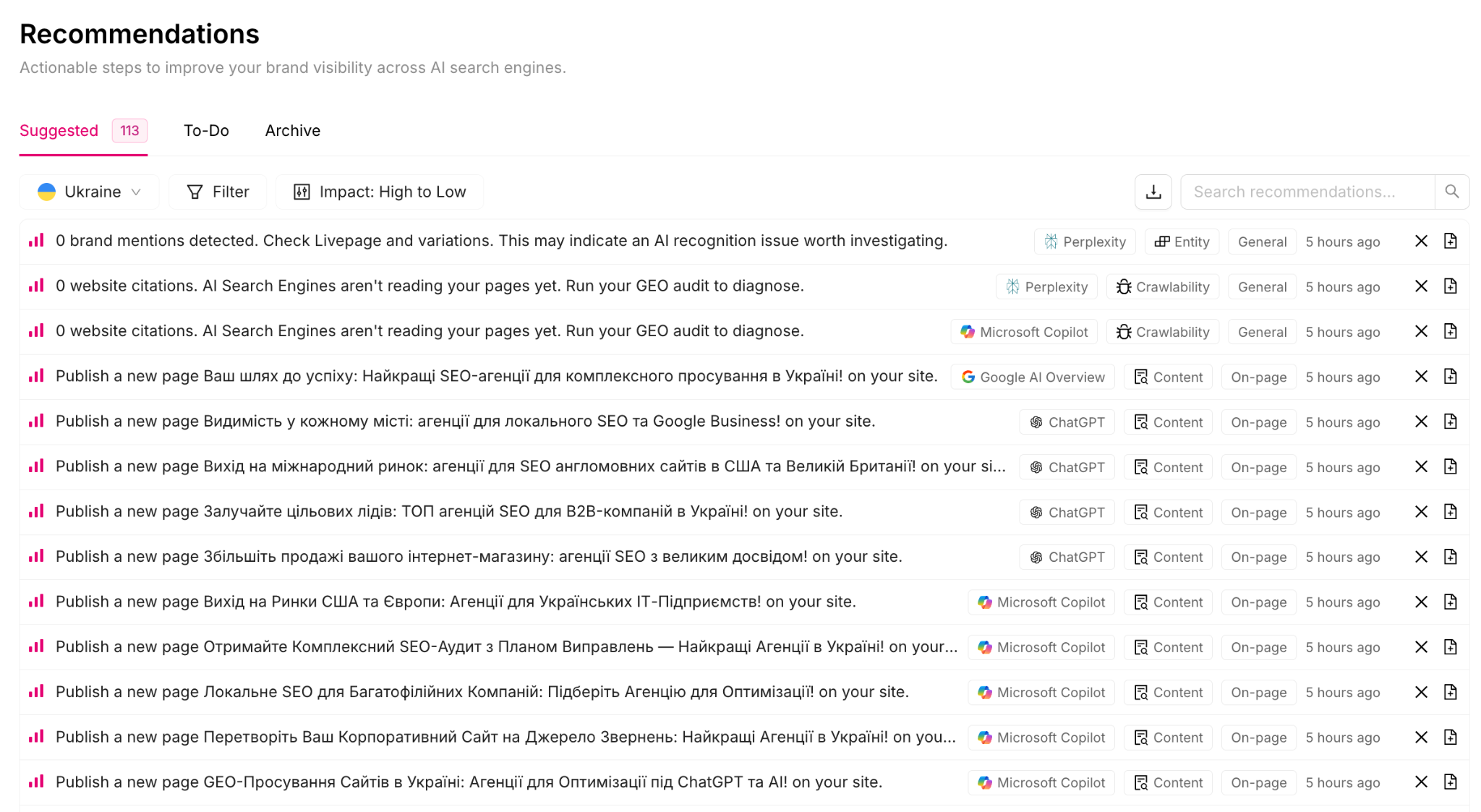
The LLM visibility audit then compares performance across topic areas, highlighting where your brand has an established presence, where competitors are more visible, and where AI provides inaccurate information about your business. The findings are supported by examples of AI responses and a list of pages that need improvement.
The final step is to translate audit findings into a prioritized action plan. Every GEO recommendation should clearly outline the issue, the proposed solution, and how success will be measured. Each task should also have an assigned team, an estimated level of implementation effort, and any dependencies on other work.
Start with confirmed issues affecting high-priority pages. For instance, if a search crawler encounters an error instead of the content describing a core service, the first step is to remove the access restriction and retest the page. Once that’s resolved, attention can shift to improving website content, case studies, and third-party brand mentions.
Recommendations need to be specific rather than simply stating “improve content.” For example, a task might involve updating the CRM implementation page to list supported integrations, explain the data migration process, and link to a relevant case study. After the changes are published, verify that the updated information is accessible and rerun the tests using the predefined set of prompts.
External business profiles also need attention. Correct outdated descriptions of your company’s expertise in industry directories and make sure your service listings are accurate. Develop expert content with firsthand examples for relevant industry publications. After publishing, monitor how AI describes and cites your brand. The number of articles published doesn’t, by itself, indicate improved AI visibility.
The action plan should also establish a schedule and methodology for follow-up measurements. Technical fixes can be verified immediately after implementation, but changes in AI visibility require repeated monitoring. Compare these results against a record of completed tasks, while accounting for possible changes in AI models, source materials, and competitor activity.
A completed GEO audit report should make it clear where to begin, which team owns each task, and how to evaluate the outcome. Without a defined methodology, supporting examples, and clear priorities, an “AI readiness score” has limited practical value.
So, how does a GEO audit differ from an SEO audit? First and foremost, it helps assess a brand’s presence not only in traditional search results but also in responses from generative AI systems. Why do you need a GEO audit? It shows which queries lead AI to mention a business, where it gets its information, and how accurately it describes the company’s services. A review of your website and competitors provides additional insights, helping the specialist identify verified issues and create an actionable plan to address them.
Start with baseline measurements. Fix access errors and inaccurate descriptions, and expand your content with answers to customer questions. After making changes, repeat the assessment using the agreed-upon methodology. Look at results across multiple checks rather than expecting any single update to secure an AI recommendation.
Want your business to show up when potential customers ask AI for recommendations, instead of leaving all that visibility to your competitors? The Livepage team will conduct a GEO website audit for your business, identify gaps in your brand’s visibility, and prepare a detailed plan for GEO optimization of your website. Reach out to discover which changes will help your business appear more frequently in the AI answers your potential customers receive.


“Livepage has proven to be a reliable source for rapid online growth. We started with 2,000 visitors per month. In 3 years together with Livepage we have reached 70,000 visitors and more than 100 leads from the site per month.”


“As for the results, we’ve been working together since 2015, and our traffic has increased 10x. I cannot say that Livepage was our first SEO company, but they have become the first SEO partner that helped us to achieve the success we were looking for.”


“Livepage delivers SEO efforts that have led to an increase in the site’s users, traffic, and conversions. The team uses a wide range of tools to achieve the client’s goals. They are attentive to the client’s needs, working with them in real-time and bringing in additional specialists when needed.”


“I am pleased with the quick task execution and the instant replies to my messages.”


“I like the complex approach that the Livepage team offers. Absolutely all team members work together; everyone is aware of what is happening on the project. We have one common goal – to increase our service sales, and the team is making every effort to achieve the goal as soon as possible.”


“We’ve been really impressed by how Livepage quickly understood our business and centred our PPC campaign around our objectives. We have achieved good results within a very short time in both revenue and ROI.”

“Everything is clear, timely, and understandable.”


“They have leveraged ideal opportunities to reach our business goals.”