



1 min reading
Review of Cooperation with Livepage from MISSIA Bridal



According to Statista, nearly one-third of US consumers say that authentic business content they can relate to makes them more likely to make a purchase. Still, for many business owners, content feels like extra work with a small payoff. Some would rather spend their budget on improving the service, hiring additional staff, buying equipment, or running ads. Others simply hit a wall when trying to come up with new ideas for every week of publishing.
In this article, we’ll explain how content marketing can support business promotion and what other benefits it brings, how to keep finding useful topics even in a narrow niche, which formats to choose, and how to select the right channels. Read on to find everything about content marketing for businesses.
Whether you’re only starting your own business or already have an established company, you probably know the struggle of competing with brand giants. You can’t spend the same budgets, hire entire marketing teams, or consistently post on every single social media platform. However, what you can do is efficiently use content marketing for business growth as a way to show up online, explain what you offer, and little by little become more familiar to your audience.
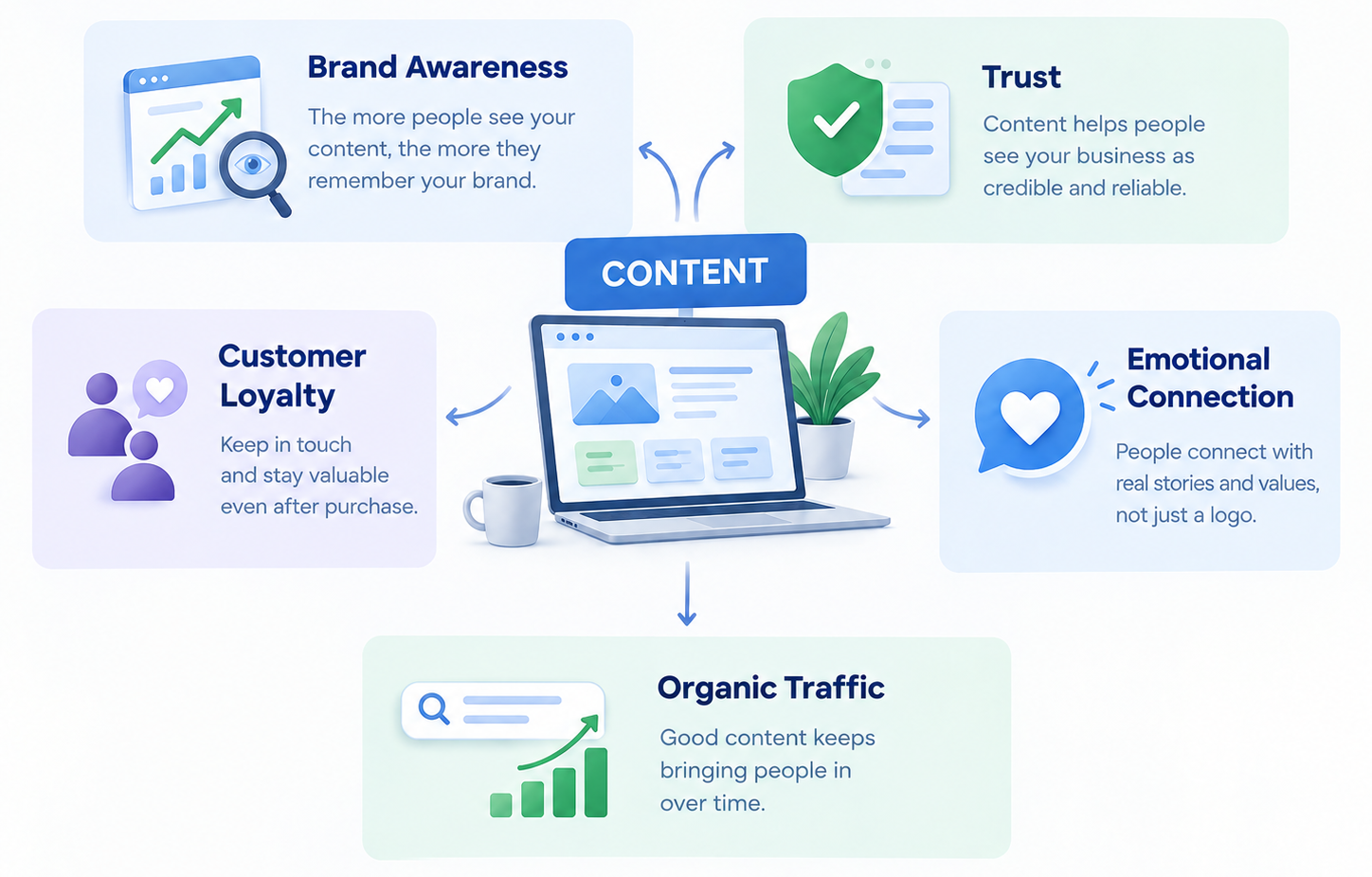
Through content, businesses can:
As you can see, content gives even small businesses quite a few ways to stay visible and top of mind without trying to outspend your competitors. However, it only becomes true if you know what to write about, where to publish it, and when to share it.
If you want to see how content marketing helps grow a business, stop thinking of every piece of content as a sales pitch: “Here is our product, now buy it.” Sure, there is nothing wrong with promoting your services, but if that is all a company publishes, customers have little opportunity to learn anything meaningful about the business itself.
The problem is, not every customer approaches your company with a clear intent to buy. They can still be looking for a DIY solution to their problem, comparing different products or services, trying to understand how a particular service works, or deciding whom to trust. Your content should meet them at every stage of this journey and provide something valuable at each step.
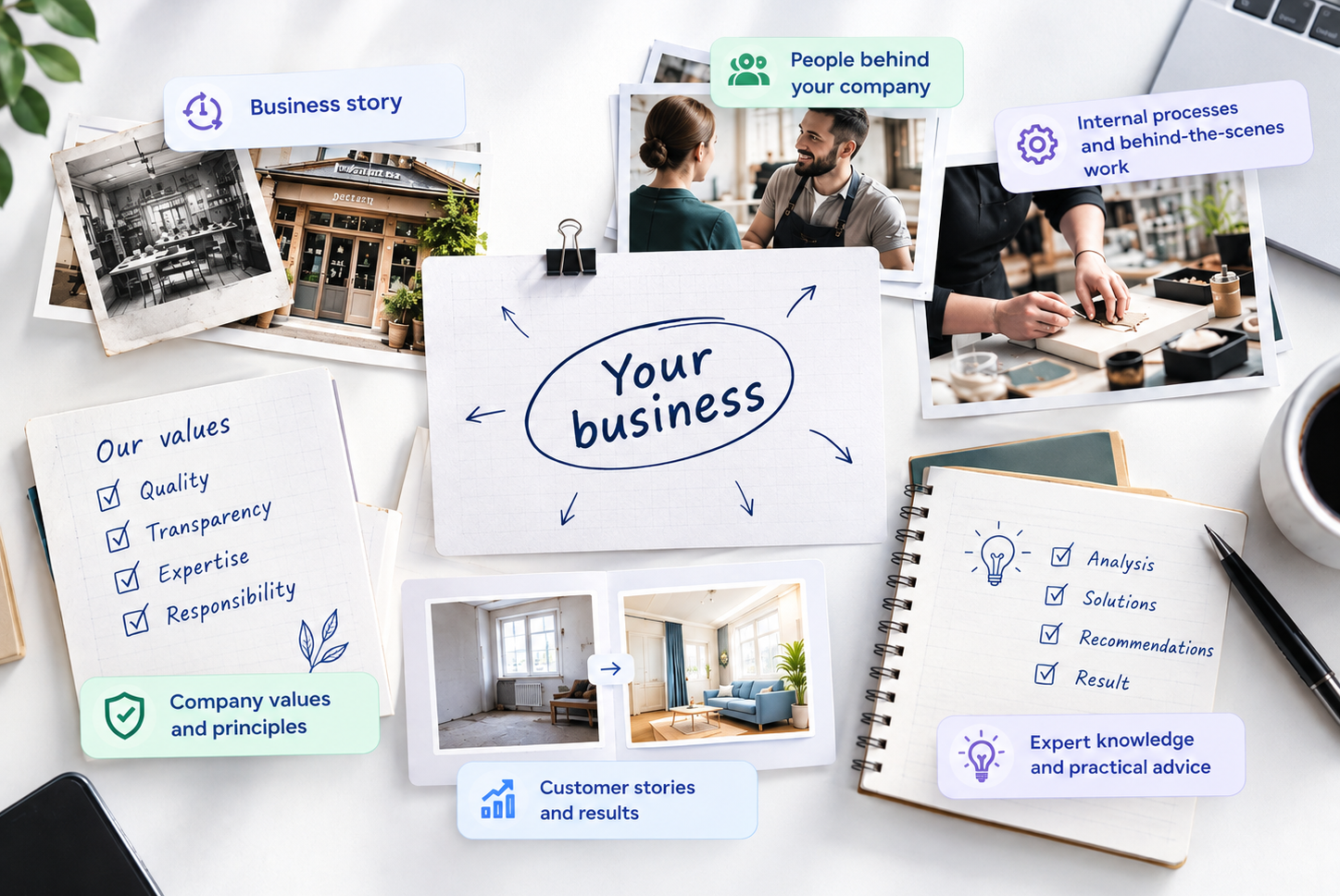
Sharing your business story gives customers a chance to understand the people, motivation, and journey behind the company, making it feel more genuine and sometimes even inspiring.
If you’re wondering how to tell your business story through content, a good place to start is to explain how the business actually came to exist. Tell how you started with a single customer before realizing you could actually grow into something bigger. Or maybe how your product or service back then was entirely different from what you offer now. The most engaging stories usually focus on challenges, turning points, and changes that give people a reason to remember the business.
Don’t hide your employees behind the brand name or logo. Give your audience a chance to meet their dentist, trainer, or consultant before they even contact your business. It doesn’t have to be something elaborate — by sharing short introductions, everyday moments, or simple Q&As, you are already making your business much more approachable.
There is probably a big part of your work customers never see, only the final result. Content can show everything that happens before that point. A restaurant can show how ingredients are selected and prepared, a repair company can explain their diagnostic process, and a service business can walk customers through what happens after they submit a request. Not only does it satisfy curiosity, but it also shows how much care goes into delivering the service or product.
If you’re trying to figure out how to promote your business with content marketing, simply saying that you value “quality,” “transparency,” or “expertise” is not enough. The business should show how it lives by those values. If transparency matters, explain how you handle estimates or unexpected costs. If quality matters, show what your team checks before completing a job. And if expertise matters, share how you diagnose difficult problems or explain complex topics. Actually showing your principles in action makes them far more credible than simply stating them.
You might already have some of your best content in the work you’ve done for customers. A short before-and-after post, a customer quote with a few lines of context, or several photos from a completed project can communicate more about your skills and experience than a long description of how professional your team is. However, don’t try to oversell yourself. The more you prioritize the customer’s problem and result rather than turning it into praise for your company, the more credible such a story becomes.
Whatever your niche, your team probably knows plenty of things that your customers do not. This knowledge can be a treasure trove of content. That is, you can explain common issues, help customers avoid mistakes, compare different solutions, or show them when they can deal with something themselves. Practical advice lets your expertise speak for itself and shows your audience that your business understands the problems they are dealing with.
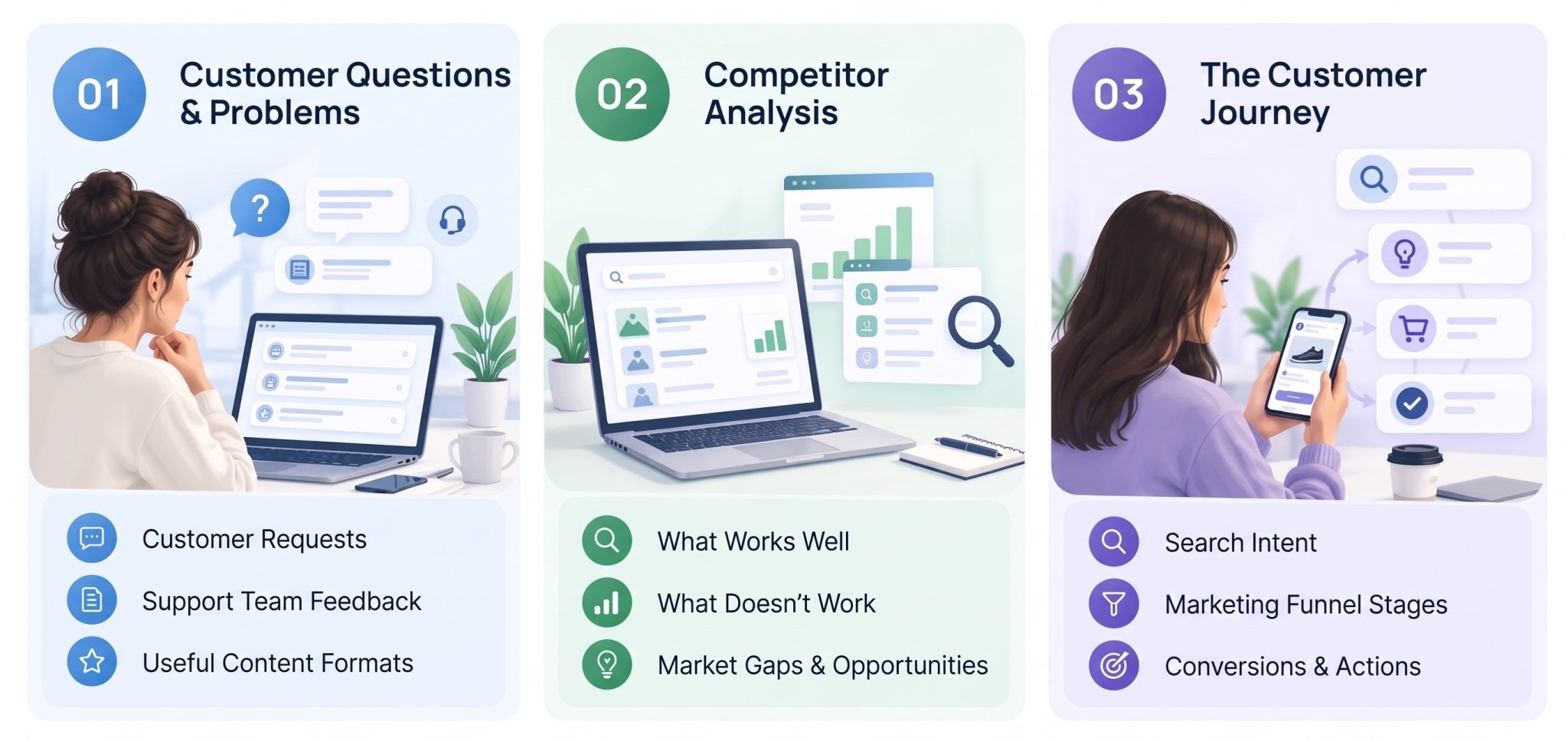
A content plan becomes much more successful when it is built around real customer needs, pains, and challenges rather than a gut feeling alone. Therefore, to create content to grow your business that will resonate with your audience, you need to:
Pay special attention to questions your support team or managers have to answer daily: “How do I return an item?”, “How do I reset my password?”, “What time is check-in?”, “How do I book an appointment?”, etc. Instead of having to answer those questions over and over again, ask your team to keep a running list of the ones that come up most often. By turning those questions into FAQ sections, how-to articles, posts, or even entire guides, you can avoid confusion and increase the chances of completing the action.
Competitor analysis is a great instrument to learn what works and what doesn’t. It makes sense to see which topics your competitors cover, which pages bring in traffic or leads, and which keywords are ranking in search engines.
However, blindly following in your competitors’ footsteps means you will always be at least one step behind. Therefore, you need to notice gaps in their strategy you can fill with content that promotes your business and offers something genuinely more helpful rather than simply repeating what is already available.
To create content for every stage of the marketing funnel, you first need to understand how a person’s search intent changes as they get closer to making a decision.
Imagine someone whose washing machine suddenly starts making a loud noise. Most likely they’re not looking to buy a new machine or book a repair straight away. Their first instinct would be to Google something like, “Why is my washing machine making a loud noise?” On the other hand, if they have exhausted all the DIY options or don’t have time to deal with it themselves, they might start looking for a local repair company and reading reviews.
Creating valuable materials that match the customer’s intent in their journey is a great way to gain leads and boost conversions.
Not every idea needs to become an article, and not every business needs to spend its time filming videos. The right types of content for businesses depend on what they need to accomplish.
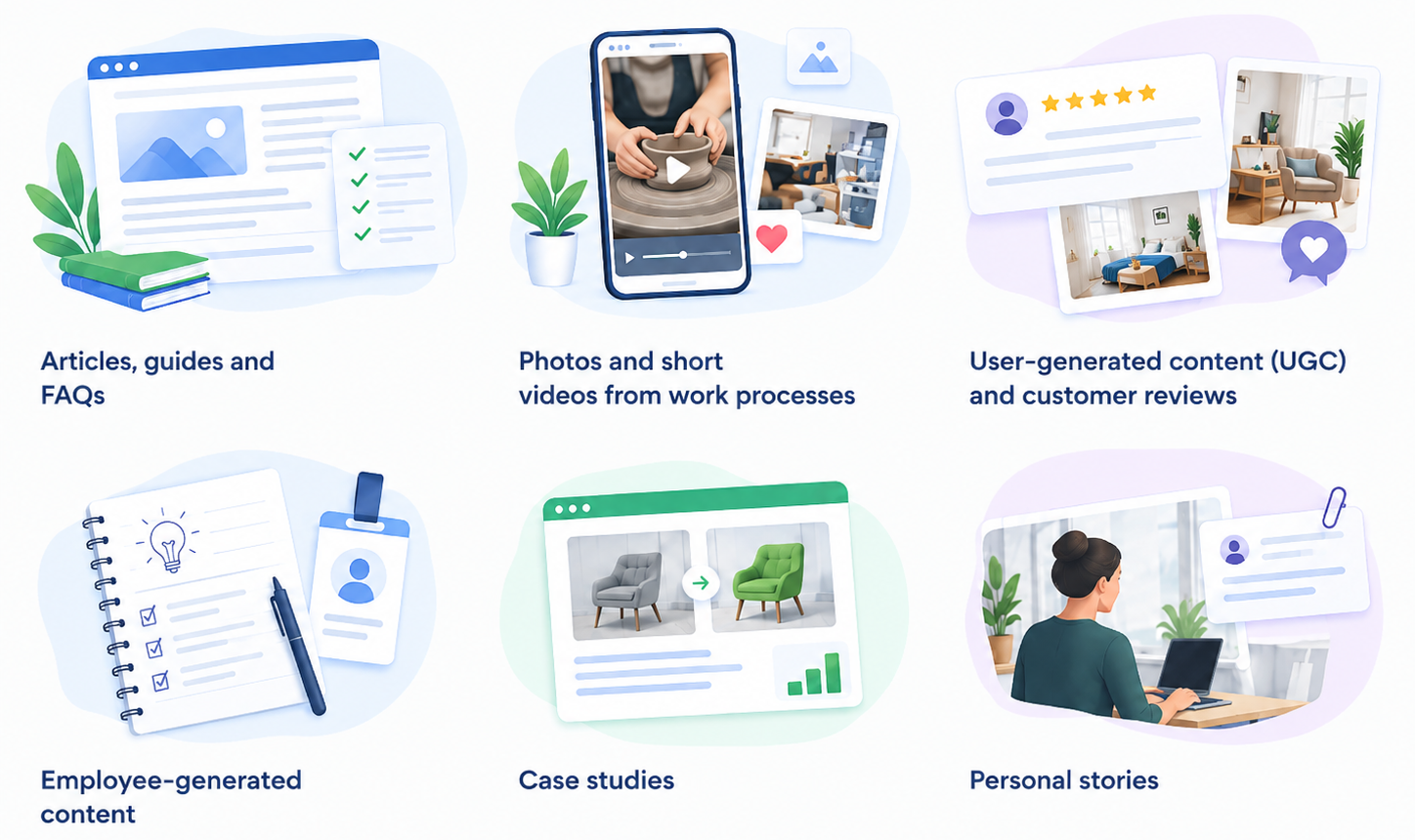
Use written content when a topic requires more than a quick answer. Thus, articles and guides can explain complicated processes, compare different products, or cover topics people repeatedly search for online. FAQs are also helpful for questions that keep coming up before a purchase (pricing, timing, guarantees, etc.).
Visual formats are great when it’s easier to show something than explain. These can be used for showing before-and-after content, working processes, new products, behind the scenes, etc. You do not need a complex production setup either. In many cases, a thirty-second video filmed on a phone can feel more natural and authentic than a heavily polished commercial.
According to statistics, 69% of people check customer reviews before making a purchase from an unfamiliar retailer. That is why UGC for businesses is so valuable. If you do not want to miss out on that large share of the market, encourage people to leave reviews, and make sure you respond to them, whether the feedback is positive or negative.
Copywriters and marketers aren’t the only sources of content for your website. Your employees might have valuable knowledge, interesting stories, or new perspectives that the company account simply cannot communicate the same way. They can answer questions from their area of expertise, describe what their work involves, explain certain processes in detail, or share their insight on a strong case.
Case studies are basically proof of what your company can actually do. Instead of claiming that your team is experienced, you can show a real problem your team has solved and what approach they used to achieve this. Thus, potential customers can see how your expertise works in practice and what a similar result might look like for them.
It’s easier to connect with individuals than with a faceless brand. Potential customers often want to know who stands behind the business, what motivates those people, and what brought them into this work in the first place. Personal stories can answer those questions and thus make a company feel more human and relatable.
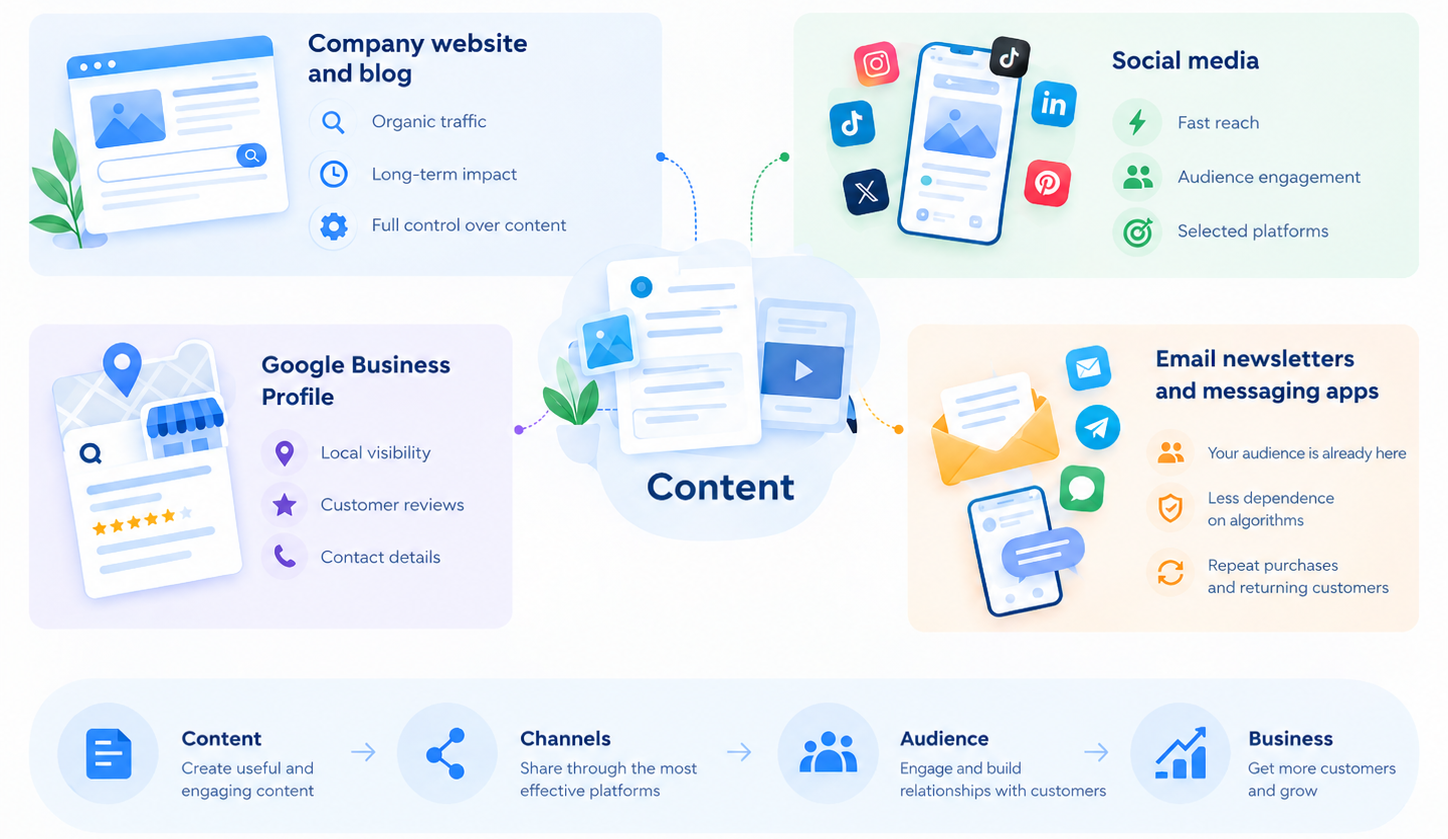
If you are just getting started with content, it is easy to fall into one of two extremes: publishing everything only on your website and hoping people stumble across it, or trying to be present on every possible platform out there. Neither strategy will work well for your SEO promotion.
A better approach is to define the ideal target audience for a business and choose two or three channels that work best, rather than having half-empty accounts with the latest post dated six months ago.
If your main goal is to attract organic traffic, the first place you should publish your content is your own website. The obvious advantage is that you have full control over your messaging, internal linking, and calls to action. Thus, you don’t have to adjust your articles, guides, FAQs, or case studies to fit the guidelines of social media platforms or other channels.
Moreover, publishing on your website supports long-term growth, as your content can continue to generate leads, drive traffic, attract backlinks, and increase conversions years after it was first published.
With social media platforms, you’re usually more limited in terms of content length, format, and presentation. However, they are also one of the best ways to get your content in front of your audience quickly.
Are you a B2B service provider? Your potential clients are likely to regularly visit LinkedIn for industry news, professional insights, and business updates. Looking for homeowners interested in renovations? They are probably on Instagram or Pinterest, searching for some ideas or inspiration. Running a restaurant or café? Instagram and TikTok can help you reach people searching for new places to eat.
As you can see, there’s no need to target every possible platform. You just need to find the ones where people who will be interested in your products already spend their time.
If you have a local business that relies on foot traffic or services a particular area, Google Business Profile is one of the most important publishing channels. It puts your info and updates directly where interested customers may encounter your business in Search and Maps. Posts, photos, reviews, and up-to-date business info can help people understand what you offer and how to contact you before they even visit your website.
Email and messaging app channels are useful when you want to reach people who already know your business and have interacted with it. You don’t need to rely on algorithms to put your content in front of them, and they are more likely interested in what you have to say. These channels work well for sharing new articles, product updates, offers, event announcements, and other content that gives subscribers a reason to return.
You don’t need to come up with an entire content strategy for businesses full of complicated formats or map out everything you will publish six months ahead. For the first month, introduce your business to the audience, answer their common questions, and give reasons for your potential customers to trust you. It will be a solid foundation for your future business promotion.
To help you get started, here are 15 content ideas for businesses that are applicable for almost any niche:
Start with the topics that are most relevant to your customers and build from there. These ideas can also be adapted for different channels, from blog posts and social media to newsletters and Google Business Profile updates.
Digiteum is a good example of how to create content for your business around real expertise and turn organic search into a meaningful customer acquisition channel.
When we started working with the client, their blog was being developed without a clear understanding of traffic potential or which topics could support business growth. We analyzed the competitive landscape, Digiteum’s experience, and the areas where the company had the strongest expertise and chose IoT as one of the main directions to develop.
From there, we’ve created a focused SEO strategy around niche content, technical optimization, competitor research, and link building. Together with Digiteum, we published more than 40 IoT-related articles within a year and optimized important commercial pages to compete for much harder service keywords.
The results we achieved during our collaboration:


For a content strategy for websites to work, you do not necessarily have to pour a huge budget into the marketing department. You already have valuable knowledge about your customers’ questions and problems. All you need to do is combine it with proper keyword research, competitor analysis, and an understanding of search intent to create content for business growth that meets your audience’s needs while improving your visibility in organic search over time.
Livepage can help you with that. We can identify the topics your potential customers are searching for, determine which commercial and informational pages you need, and build a content plan designed to increase relevant organic traffic rather than simply add more articles to your website. Contact us now and start building a better SEO content strategy today.


“Livepage has proven to be a reliable source for rapid online growth. We started with 2,000 visitors per month. In 3 years together with Livepage we have reached 70,000 visitors and more than 100 leads from the site per month.”


“As for the results, we’ve been working together since 2015, and our traffic has increased 10x. I cannot say that Livepage was our first SEO company, but they have become the first SEO partner that helped us to achieve the success we were looking for.”


“Livepage delivers SEO efforts that have led to an increase in the site’s users, traffic, and conversions. The team uses a wide range of tools to achieve the client’s goals. They are attentive to the client’s needs, working with them in real-time and bringing in additional specialists when needed.”


“I am pleased with the quick task execution and the instant replies to my messages.”


“I like the complex approach that the Livepage team offers. Absolutely all team members work together; everyone is aware of what is happening on the project. We have one common goal – to increase our service sales, and the team is making every effort to achieve the goal as soon as possible.”


“We’ve been really impressed by how Livepage quickly understood our business and centred our PPC campaign around our objectives. We have achieved good results within a very short time in both revenue and ROI.”


“Everything is clear, timely, and understandable.”


“They have leveraged ideal opportunities to reach our business goals.”