




1 min reading
Review of Cooperation with Livepage from MISSIA Bridal


Just a few years ago, competing for users’ attention in Google largely meant fighting for a place in the top 10 search results. Today, a generated answer increasingly appears above organic listings: Google AI Overviews. Since May 2025, AI Overviews have been available in more than 200 countries and territories and in over 40 languages, including Ukrainian. As a result, they occupy the first screen of search results for many informational queries.
For businesses, understanding how to rank in AI Overviews starts with recognizing how Google selects and cites sources in generated answers. This makes getting featured in AI Overviews and becoming one of the sources cited in generated answers a distinct SEO objective, with its own logic, content requirements, and ways to measure performance.
In this article, we explain how Google selects sources for AI-generated answers, which queries trigger AI Overviews, and how to get featured in AI Overviews by improving your website’s content and search visibility.
At the end, we also share a mini case study in which an IT company gained more than 900 mentions in AI Overviews within three months.
Traditional search rankings are straightforward: there are ten positions on the first page, and a website either makes the top 10 or does not. AI Overviews work differently because they do not have conventional ranking positions.
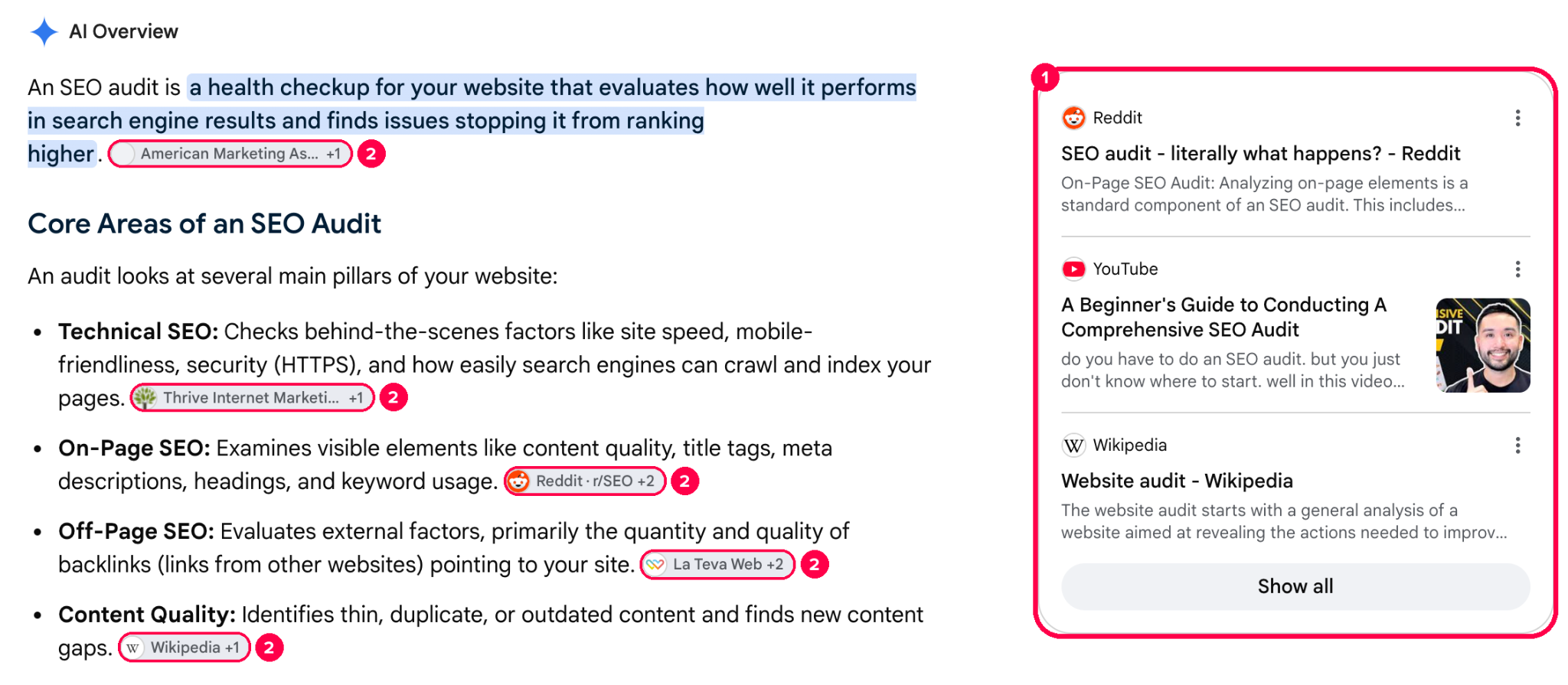
Ranking in AI Overviews means having a page included among the sources Google cites in a generated overview. Source links may appear in cards beside the answer, as links within the text, or in an expanded list. Therefore, when SEO specialists talk about rankings in AI Overviews, they mean citations: whether the system has selected a website page as one of the sources used to answer a query.
The answer is generated by Gemini, a model adapted for search. However, it does not operate from scratch; it draws on Google’s index. This explains Google’s official position: for a page to appear in AI Overviews, it must be indexed and eligible to appear in Google Search with a snippet. No separate markup, special files, or dedicated AI optimization are required, according to Google’s documentation.
For businesses, a citation can be valuable even when users do not click through to the website. The brand name and link appear near the top of the search results, alongside the answer to the user’s question. Those who do click have already received a basic explanation from the overview and may visit the website for additional information, such as comparing prices, learning about service terms, or placing an order.
Google began testing generative search answers in 2023 under the name Search Generative Experience. We covered the origins of this development in our article about Google’s new AI-powered search. Now, let’s look at how the system decides which pages to cite.
The key to understanding how Google selects sources for AI Overviews is a mechanism known as query fan-out. Rather than searching for one ideal page, the system breaks a query into several subqueries covering different aspects of the topic. It searches for answers to these subqueries in parallel and builds a response using information extracted from multiple pages.
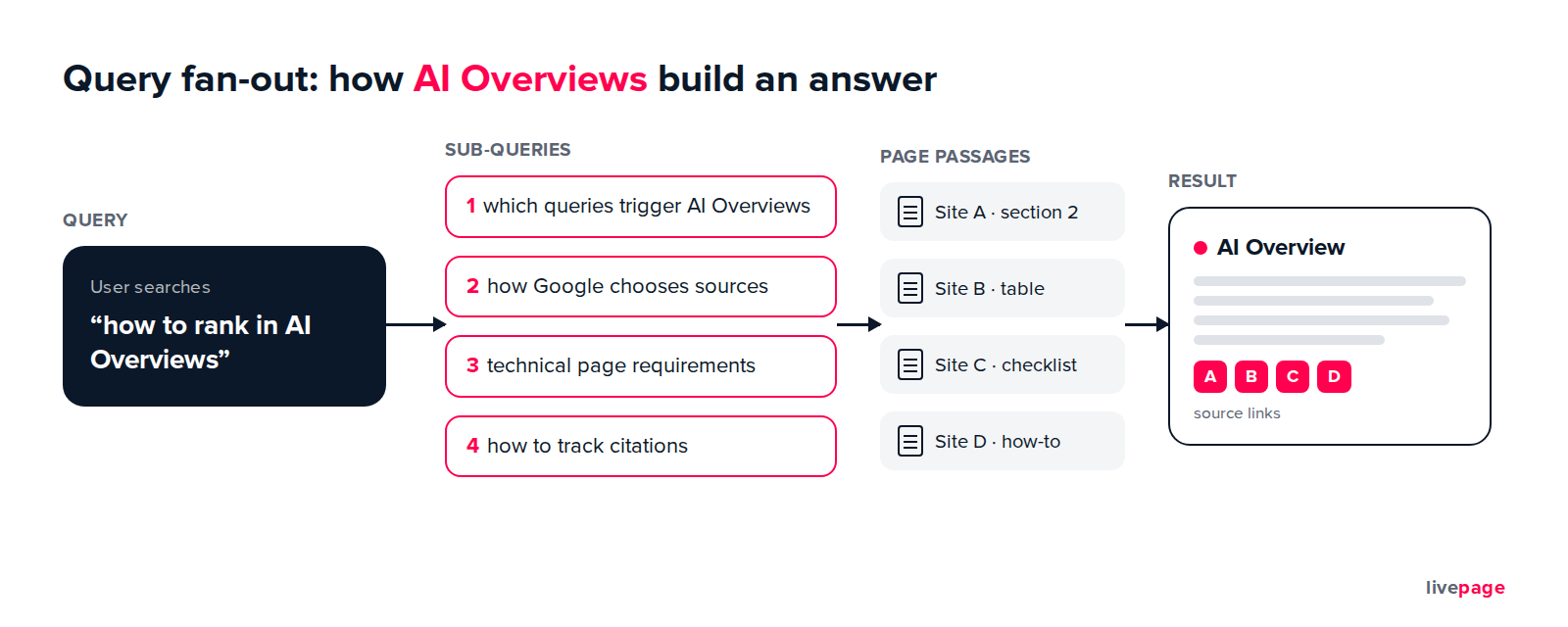
So, how does Google choose sources for AI Overviews? It identifies relevant passages across multiple pages that help answer the original query and related subqueries. For example, in response to the query “how to get featured in AI Overviews,” Google might search separately for information about which queries trigger overviews, how to track them, and what technical requirements pages must meet. Each subquery represents another opportunity for a website to be included among the sources.
At the same time, the connection between AI Overviews and traditional organic search remains strong. According to Ahrefs, 76% of links cited in AI Overviews point to pages that rank in the top 10 organic search results. This finding is based on an analysis of 1.9 million citations. The median position of the most frequently cited URLs is second. These figures suggest that AI Overviews largely rely on pages Google already considers relevant to users’ queries.
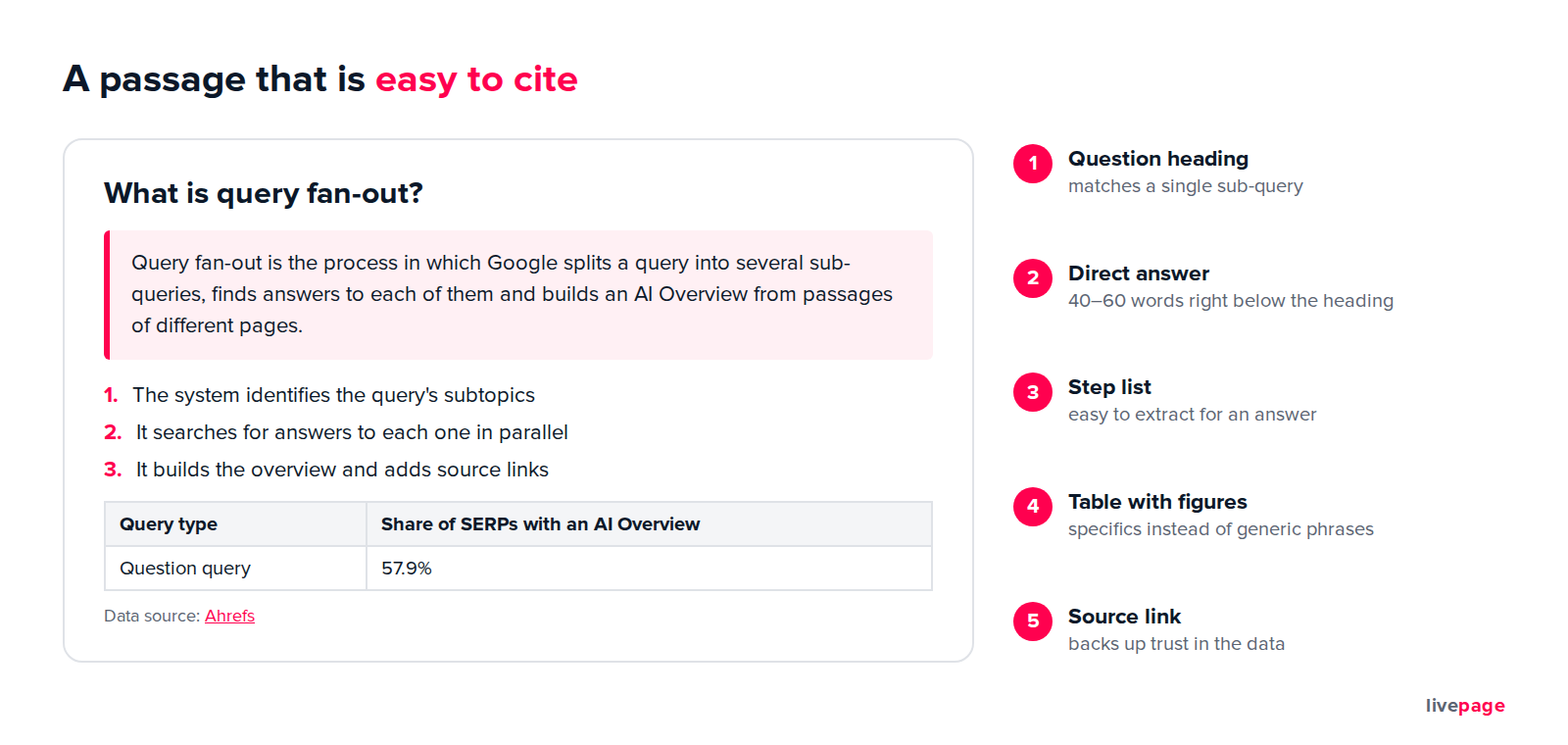
One important detail is that the system may cite a specific passage rather than an entire page. If a particular passage provides the clearest answer to a subquery, it may be selected for inclusion. As a result, even a high-quality article may be overlooked if the relevant information is buried in general paragraphs and difficult to extract.
AI Overviews are often confused with other search features, even though they work differently.
A Featured Snippet displays an excerpt from a single page. AI Overviews generate a summary and cite multiple sources. AI Mode is a separate search experience that users open themselves. It works in a conversational format, uses additional subqueries, and differs from the conventional search results page.
| Criterion | Featured Snippet | AI Overviews | AI Mode |
| How it appears | Automatically, above organic results | Automatically, above organic results | The user opens a separate search mode |
| Answer format | An excerpt from one page | A generated summary based on multiple sources | An extended conversational response |
| Number of sources | One | Several | Usually more than in an overview |
| Organic search results | Displayed below | Displayed below | Not displayed in the conventional format |
For SEO, this means that optimization approaches partially overlap. A clear structure and a direct answer to a query can help a page appear in both Featured Snippets and AI Overviews. However, AI Overviews also benefit from broader topic coverage, including the related subqueries the system may generate itself.
AI Overviews do not appear for every query. Before starting optimization, it is worth identifying which search queries trigger them.
They most commonly appear for informational queries in which users are looking for explanations. These include questions beginning with words such as “how,” “why,” and “what is,” as well as longer, more specific queries.
According to Ahrefs, AI Overviews appear in 57.9% of search results for question-based queries, compared with 15.5% for other queries. A similar pattern emerges when query length is considered. For queries containing seven or more words, AI Overviews appear in 46.4% of cases, compared with just 9.5% for single-word queries.
| Query Type | Example | Percentage of Search Results Featuring AI Overviews |
| Question-based query | “how to get featured in AI Overviews” | 57.9% |
| Non-question query | “AI Overviews SEO” | 15.5% |
| Long query (7+ words) | “how to optimize a blog post for AI Overviews” | 46.4% |
| Single-word query | “SEO” | 9.5% |
However, AI Overviews are gradually expanding beyond purely informational search intent. According to Semrush, the share of informational queries among those triggering AI Overviews fell from 89% in October 2024 to 57% in October 2025. This suggests that AI Overviews are increasingly appearing for commercial queries as well.
Optimization for AI Overviews is therefore particularly relevant to informational content, including blog articles, guides, FAQ sections, and knowledge bases. If a website’s keyword portfolio consists mainly of short commercial queries, AI Overviews may appear less frequently in its search results. We discussed how to work with more specific query formulations in our article about long-tail keywords.
To find queries for which your website triggers AI Overviews, use the “AI Overview” SERP feature filter in Ahrefs, Semrush, or SE Ranking. These tools can help you identify which keywords trigger an overview and whether pages from your domain are cited in it. Priority queries should also be checked manually, using incognito mode and the relevant search region.
In practice, our specialists often begin this analysis with informational blog pages that already rank in the top 10. These pages are among the strongest candidates for optimization and may have a better chance of being cited after improvements. New content, by contrast, usually needs to work its way up the conventional organic rankings first.
There is no separate AI Overviews optimization process that operates independently of SEO. AI Overviews rely on many of the same quality signals as traditional search, but they place additional demands on content: answers must be clear, topics must be covered comprehensively, and sources must be sufficiently trustworthy. Understanding how to optimize for AI Overviews begins with the same fundamentals as traditional SEO: useful content, strong organic visibility, and a technically accessible website.
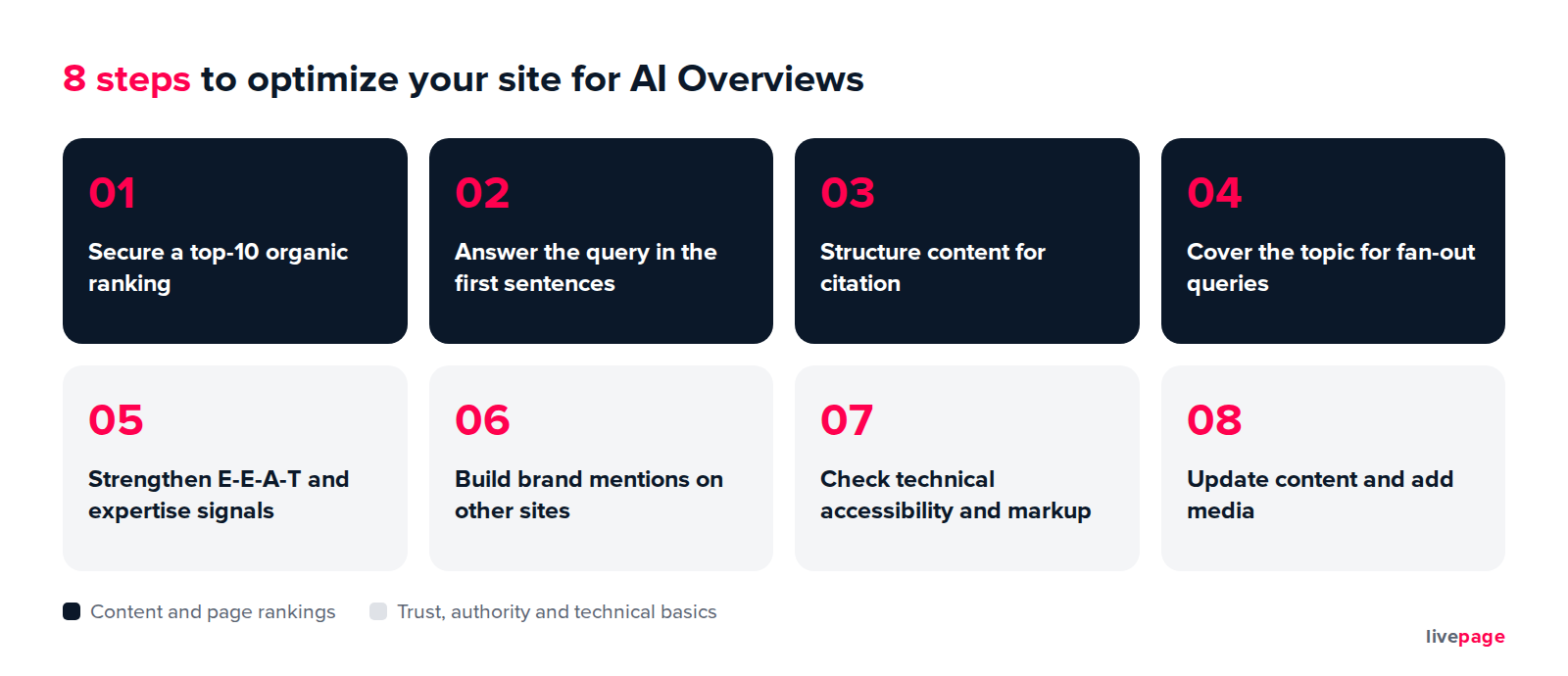
SEO for AI Overviews is therefore not about a collection of isolated tricks. It requires a systematic approach to improving website quality and content.
In short, this guide explains how to get cited in AI Overviews in eight steps, from improving organic rankings to updating content regularly. Let’s examine each one.
Rankings in conventional search results are an important prerequisite for appearing in AI Overviews. As noted above, most citations go to pages in the top 10, while pages on the third or fourth page of search results are cited much less frequently. There is little point in looking for a shortcut into AI Overviews that bypasses organic search.
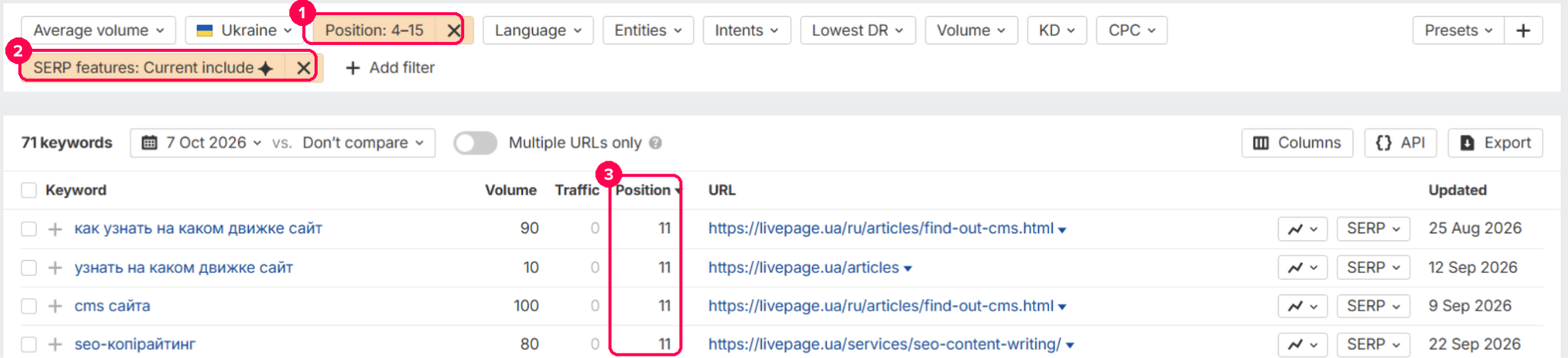
Start with queries that already trigger AI Overviews and identify your website pages ranking between positions 4 and 15. These are often the easiest to improve. You can expand the content, strengthen internal linking, and fix technical issues that may be limiting rankings.
If there are numerous problems and you are unsure where to begin, conduct an SEO audit. It will help identify the factors holding back your pages.
Google cites individual passages, so each section of an article should make sense even when read independently of the rest of the page.
The answer-first approach works well here. Immediately below a question-based heading, provide a concise, direct answer of around 40–60 words. Then expand on the topic with details, examples, and relevant qualifications.
The easiest way to identify suitable questions for headings is to review Google’s “People also ask” section and search suggestions. This helps structure the article around the way users actually formulate their queries.
A common mistake is to begin with a long introduction in which the author gradually approaches the main point, recounts the history of the topic, or describes broad market trends. For readers, this can feel like filler. For a system looking for a specific answer, it creates a passage from which the relevant information is difficult to extract.
| Before optimization | After optimization |
|---|---|
| “Artificial intelligence is rapidly changing search, and AI Overviews are now a major topic among marketers. To understand the subject, let’s first look at how Google has developed generative answers since 2023…” | “To appear in AI Overviews, a page must be indexed, perform well in organic search, and provide a direct answer near the beginning of the relevant section. Google selects the specific passage to cite automatically.” |
This approach does not make content dry or simplistic. Once the direct answer is established, you can add context, examples, and insights from your own experience. The key is to make sure the opening sentence of each section contains a meaningful answer that can be understood and cited on its own.
The easier it is for a system to identify logical content blocks, the easier it becomes to find a relevant passage for a generated answer. To understand how to get cited in AI Overviews, start by structuring content into clear, logically organized sections:
Specificity matters, too. According to SE Ranking, articles cited in AI Overviews contain 62% more facts than articles that are not cited. Figures, dates, tool names, and concrete examples can make a passage more useful as a source than general statements that appear on dozens of other websites.
Because Google breaks a query into subqueries, a page that answers only one question may have fewer opportunities to appear in an overview than a page that covers the topic comprehensively.
Query fan-out changes how SEO keyword research should be approached. Instead of focusing on a single keyword, it is important to cover the broader topic, including specific variations, related questions, and the next steps a user may want to take.
Google’s “People also ask” section, AlsoAsked, and search suggestions can help identify these subquestions. Some can be addressed in dedicated subsections of the main article, while broader topics may deserve separate articles within a topical cluster.
According to Ahrefs, pages that rank for a greater number of fan-out subqueries are cited in AI Overviews 161% more often.
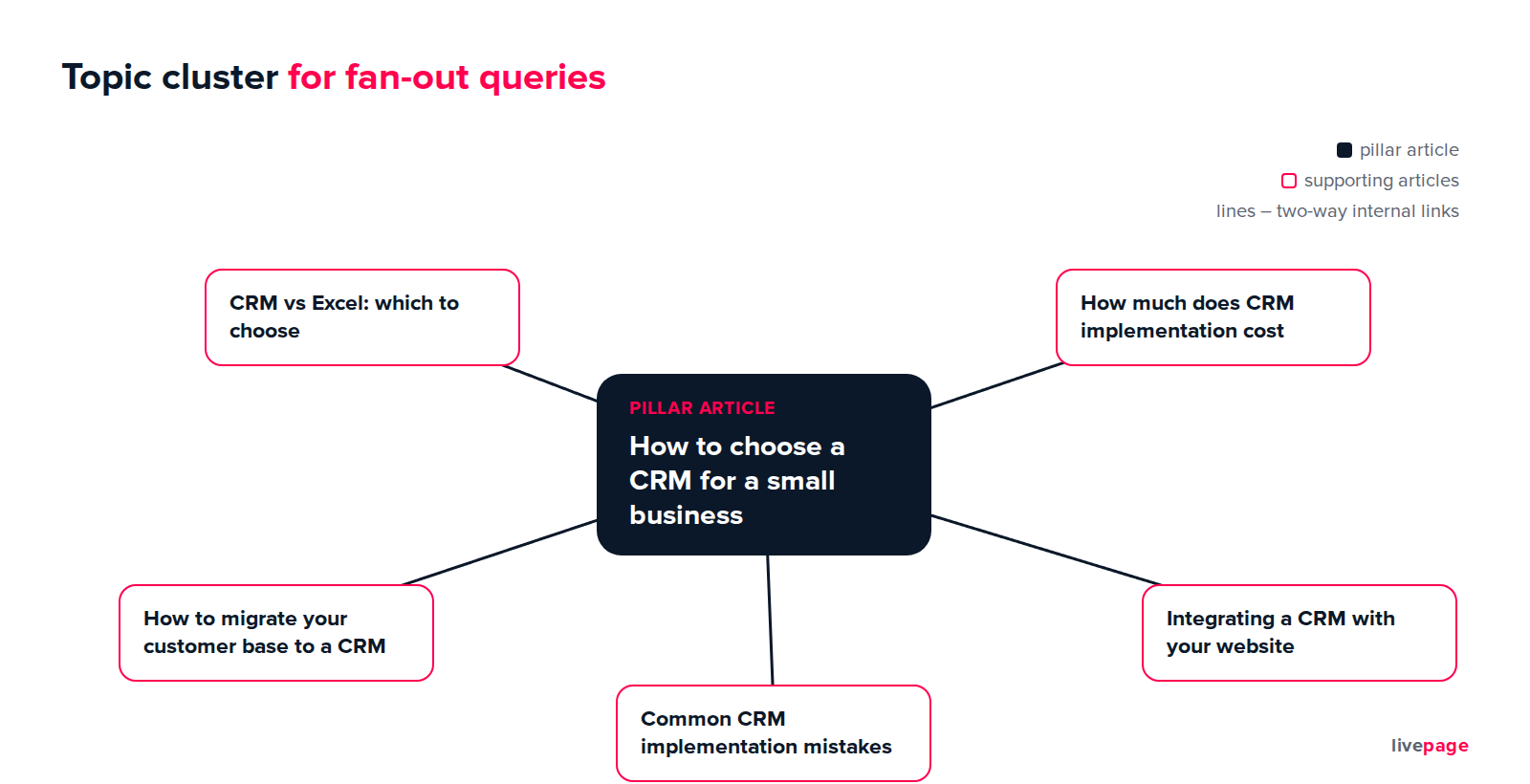
For a topical cluster to work as a coherent whole, its articles need logical internal links. The main article should link to supporting content, and those supporting pages should link back to the main article. We explain how to build these connections in our article about internal linking for SEO.
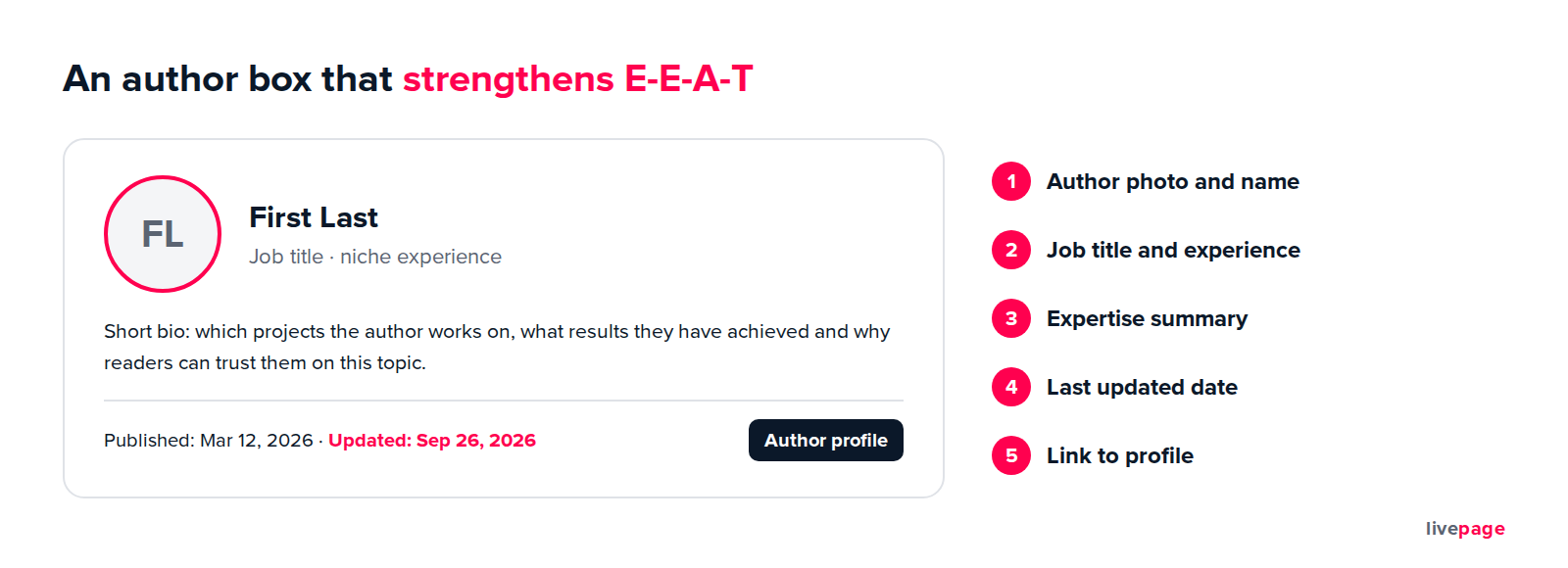
Although Google does not publish a definitive list of AI Overviews ranking factors, organic relevance, content quality, and source credibility are useful areas to focus on. When several pages answer a subquery equally well, trust signals can become important. Google considers who created the content and whether it can be trusted. These considerations can also influence the choice of source for an overview.
Relevant signals include:
Mass-produced AI content that has not been properly edited does not automatically provide these signals. It may sound convincing but offer little that cannot be found in other sources. We explored why this happens in our article about the SEO risks of AI-generated content.
In our view, original data and case studies unavailable from competitors are among the strongest ways to make content worth citing. Google can generate a general answer using information from many websites, but unique figures and real-world results can make your content a particularly valuable source.
AI Overviews more frequently cite brands that are discussed across other sources. According to Ahrefs, online brand mentions correlate with visibility in AI Overviews more strongly than most other factors, with a correlation of 0.664. Mentions on YouTube show an even stronger correlation.
This means that factors associated with visibility in AI Overviews extend beyond a website’s own pages.
Important sources of brand mentions include:
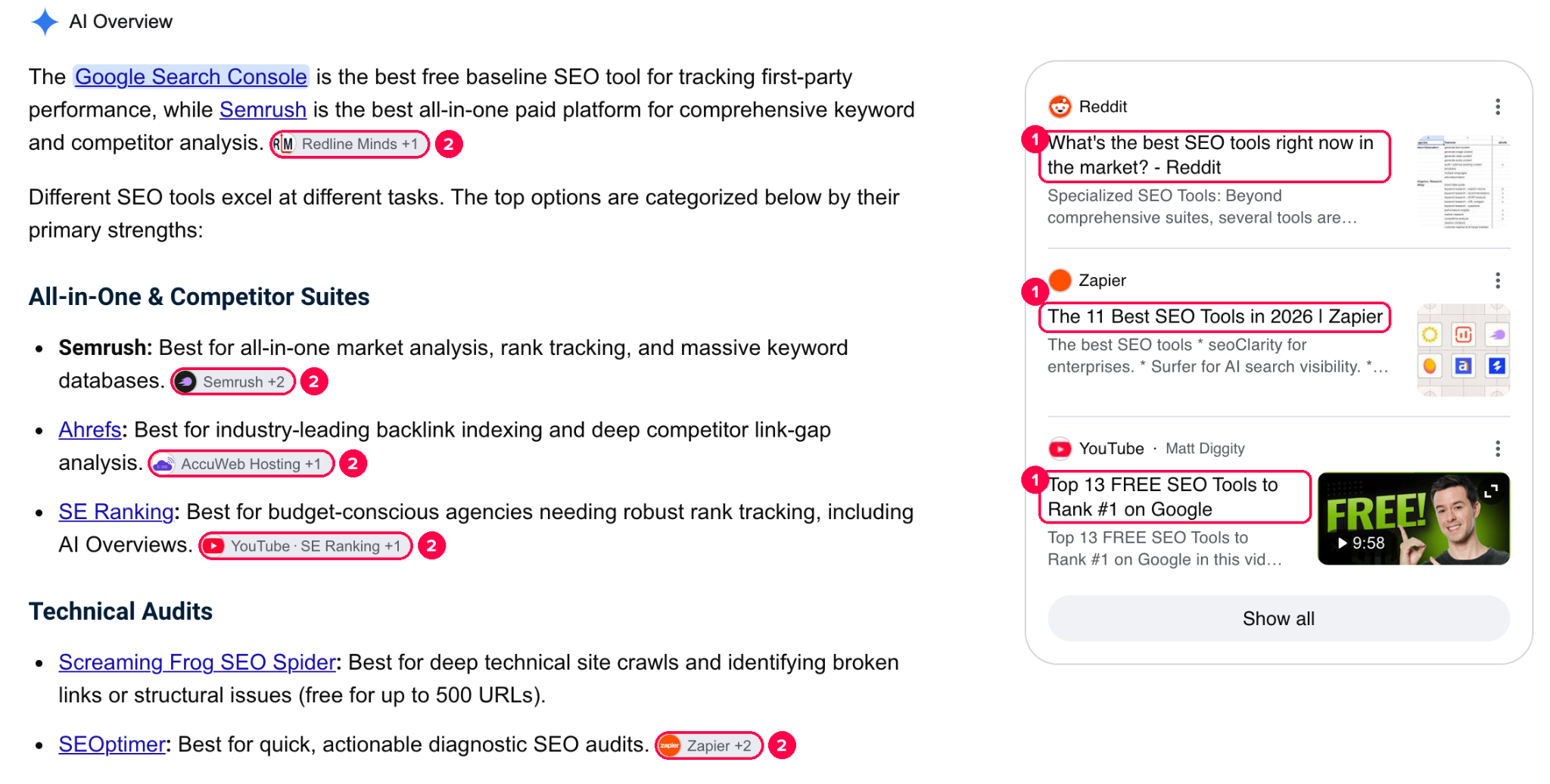
Brand mention building should be systematic, combining PR, guest posts, and quality links from relevant websites. We explain how to organize this work in our article about link building for SEO.
Even high-quality content may not appear in AI Overviews if Google cannot access it or display it in search results.
The technical essentials include making sure that Googlebot can crawl the page and that the page is indexed. The main content must be available to Google as text, rather than existing only in images or scripts. The page must also not contain nosnippet or restrictive max-snippet directives that limit the search snippet and can prevent the page from being displayed in AI Overviews.
Schema.org structured data is not a mandatory requirement for AI Overviews, but it can help Google understand the page more accurately. The key rule is that structured data must match the content visible to users.
| What to Check | Where to Check It | What You Should See |
| Googlebot access | robots.txt and URL Inspection in Search Console | The page is not blocked from crawling |
| Indexing | The Pages report under Indexing in Search Console | The page is included in Google’s index |
| Snippet directives | Page source code and the X-Robots-Tag HTTP header | No nosnippet or overly restrictive max-snippet directives |
| Text content | URL Inspection and the rendered page view | Key answers are available as text |
| Structured data | Rich Results Test and Schema Markup Validator | Structured data matches the visible content |
| Speed and mobile usability | PageSpeed Insights | The page loads quickly and works well on smartphones |
If a page does not appear in Google Search at all, the underlying issue may be more significant. Start with our article about why a website does not appear in Google.
AI Overviews frequently cite up-to-date material. According to SE Ranking, more than half of the publications used as sources in AI Overviews were published within the previous two years.
Key articles should therefore be reviewed regularly. Update figures, screenshots, and examples, remove outdated information, and display the date of the latest update on the page.
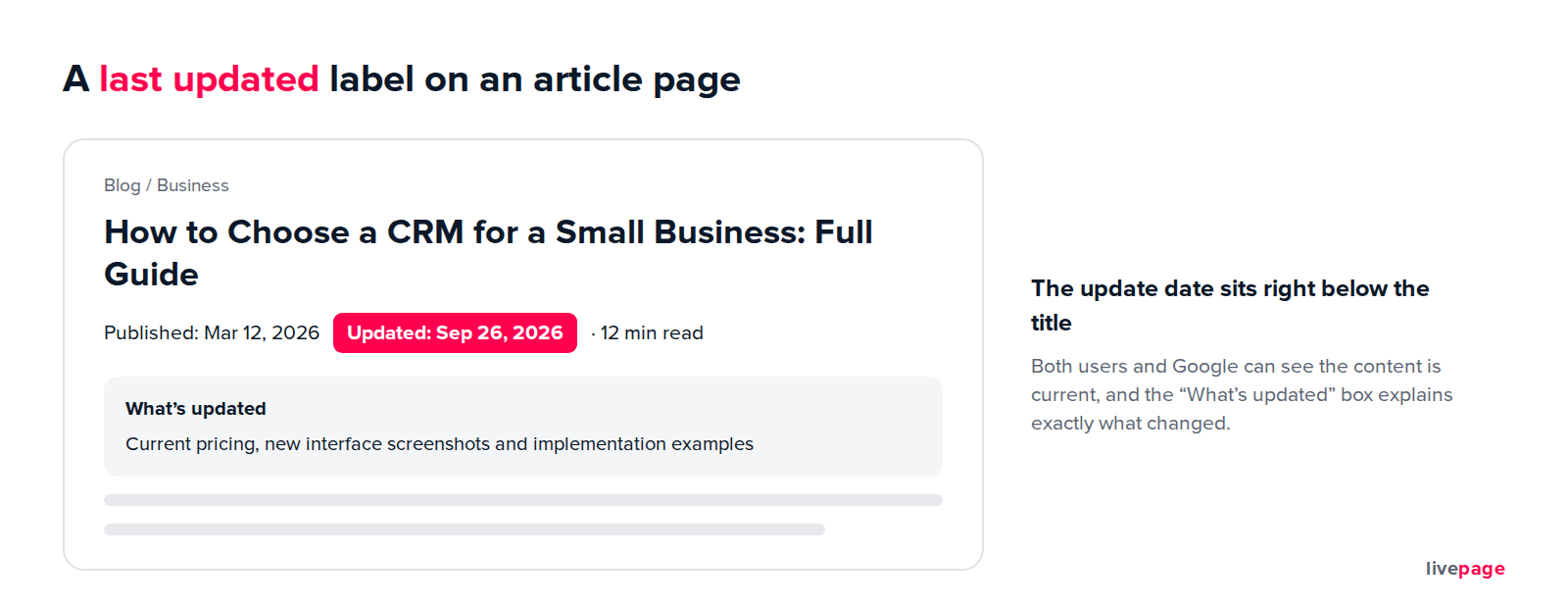
Multimedia also deserves attention. Google recommends supporting text with high-quality images and videos, and YouTube is one of the domains frequently cited in AI Overviews. Where the subject is suitable, a video tutorial published on a company’s YouTube channel can provide another potential route into AI Overviews.
Several misconceptions about AI Overviews have already taken hold. They can lead businesses either to postpone optimization or to spend resources on actions that do not deliver the expected results.
| Myth | Reality |
| AI Overviews are available only in English and the United States. | Since May 2025, AI Overviews have been available in more than 200 countries and territories and in over 40 languages, including Ukrainian. |
| Longer articles are more likely to appear in AI Overviews. | According to Ahrefs, the correlation between text length and citations is close to zero. The accuracy and relevance of the answer matter more than word count. |
| Blocking Google-Extended removes a website from AI Overviews. | Google-Extended controls the use of content for Gemini training and grounding. Eligibility for AI Overviews is governed by Google’s Search crawling and display systems. |
| Appearing in AI Overviews automatically generates more traffic. | According to Pew Research, users clicked links in 8% of visits when an AI Overview was present, compared with 15% when it was absent. Citations may therefore contribute to brand awareness even when they do not generate a click. |
Other common mistakes include leaving nosnippet directives in place unintentionally, writing vague introductions without a direct answer, and allowing articles to go years without updates. Each can reduce a page’s chances of being selected as a source.
In practice, our specialists often find that the greatest improvements come not from searching for secret ranking factors but from systematically refining existing pages: making answers clearer, covering topics more comprehensively, and keeping information current.
A mini case study from our team illustrates how these principles can work in practice.
At the beginning of the project, the IT company’s brand appeared very rarely in AI-generated answers. Its backlink profile was weak, and it had few mentions on authoritative websites.
The work focused on three areas:
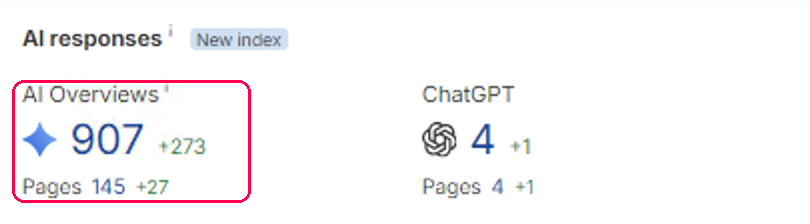
Over three months, the number of brand mentions in AI Overviews increased from zero to 907, while the number of source pages reached 145. The company also received four mentions in ChatGPT.
This case demonstrates that visibility in AI-generated overviews depends not only on optimizing a company’s own website but also on where and how other sources discuss the brand. Work on brand mentions and authoritative placements should therefore run alongside on-site optimization rather than being postponed until later.
Understanding how to get featured in AI Overviews starts with systematic SEO work rather than treating AI optimization as a separate technique. Google generates overviews using its own index and frequently cites pages it already considers relevant and trustworthy. Strong organic rankings, clear content structure, expert information, and brand mentions across other sources can all contribute to visibility.
To determine how your website can appear in Google AI Overviews, start by identifying queries that already trigger an overview and pages ranking close to the top 10. Then focus on providing direct answers at the beginning of each section, covering topics comprehensively to address fan-out subqueries, strengthening E-E-A-T signals, and ensuring that pages are technically accessible.
Measure results not only by referral traffic but also by citation frequency and changes in brand visibility.
If you want your brand to appear in AI Overviews and other AI-generated answers, the Livepage team can help you develop a strategy, from query analysis to GEO optimization and brand mention building.


“Livepage has proven to be a reliable source for rapid online growth. We started with 2,000 visitors per month. In 3 years together with Livepage we have reached 70,000 visitors and more than 100 leads from the site per month.”


“As for the results, we’ve been working together since 2015, and our traffic has increased 10x. I cannot say that Livepage was our first SEO company, but they have become the first SEO partner that helped us to achieve the success we were looking for.”


“Livepage delivers SEO efforts that have led to an increase in the site’s users, traffic, and conversions. The team uses a wide range of tools to achieve the client’s goals. They are attentive to the client’s needs, working with them in real-time and bringing in additional specialists when needed.”


“I am pleased with the quick task execution and the instant replies to my messages.”


“I like the complex approach that the Livepage team offers. Absolutely all team members work together; everyone is aware of what is happening on the project. We have one common goal – to increase our service sales, and the team is making every effort to achieve the goal as soon as possible.”


“We’ve been really impressed by how Livepage quickly understood our business and centred our PPC campaign around our objectives. We have achieved good results within a very short time in both revenue and ROI.”


“Everything is clear, timely, and understandable.”


“They have leveraged ideal opportunities to reach our business goals.”