


19 min reading
How to Get Featured in Google AI Overviews: A Step-by-Step Website Optimization Guide



Until recently, a brand’s digital presence was assessed primarily through traditional SEO and marketing metrics: Google rankings, organic traffic, media mentions, backlink profiles, and brand awareness among target audiences. However, the rise of ChatGPT, Gemini, Perplexity, Claude, and other AI systems is gradually creating a new layer of interaction between brands and potential customers.
Understanding how AI can mention your brand is becoming increasingly important for businesses that want to remain visible in the changing digital landscape.
“Which company should I choose for my needs?” This is the kind of question users may now ask AI. In response, they might receive a list of providers, descriptions of their areas of expertise, or product comparisons. That is why tracking brand mentions in AI-generated responses is becoming an important part of assessing a company’s digital presence. When a brand appears in an AI-generated response, these are known as an AI Brand Mentions. Importantly, the mention does not necessarily include a link to the company’s website.
It is not enough to track whether a brand name appears. You also need to assess the accuracy of the information provided. Imagine that AI regularly recommends a company but repeatedly attributes a service to it that the company no longer offers. The number of mentions in your report increases, but potential customers are receiving misleading information. Measuring AI Brand Visibility without reviewing the actual responses can easily conceal this problem.
This is why AI Brand Mentions should be treated as a distinct element of a company’s digital reputation. They show how well a brand is represented in today’s information landscape and what impression users may form of it before even visiting its official website. This is particularly important in competitive industries. If AI regularly mentions and recommends other companies while leaving your brand out of its responses, potential customers may build their shortlist of providers before they even encounter traditional search results.
In this article, we’ll explore how to collect AI brand mentions across different platforms, assess their accuracy, and compare monitoring results. We’ll also look at how content strategy and external publications can help strengthen your brand’s presence in AI-generated responses.
Brand mentions in AI are references to your brand, company, product, or service in responses generated by AI systems. Therefore, businesses should monitor not only whether their names appear but also the context in which AI systems mention them.
They can take different forms: a direct recommendation, an entry in a list of companies, an example within a particular category, or a mention as part of a broader topic discussion. Importantly, an AI Brand Mention does not necessarily come with a link to your website. AI can mention your brand in its response without explicitly citing your website as a source.
That is why AI brand mentions should be distinguished from LLM Citations. The former focus on whether and how a brand is mentioned, while the latter refer to the specific sources an AI system uses to generate its response. These are two different metrics: a company may be mentioned frequently without its website being directly cited. Conversely, individual pages or articles may be used as sources without the brand itself having a prominent presence in the main body of the response.
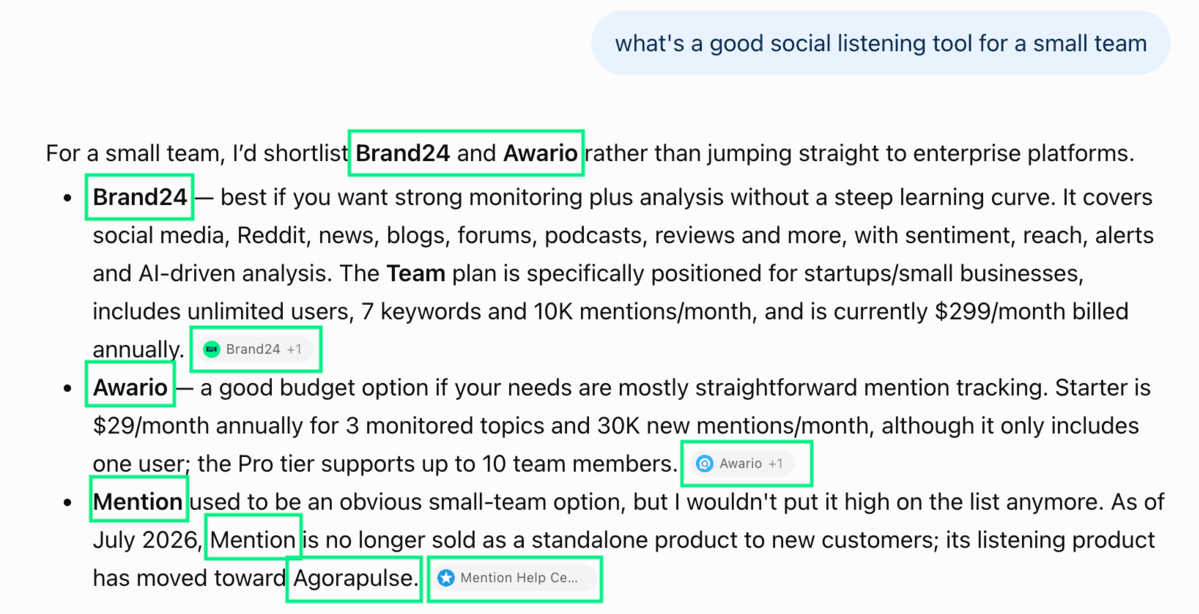
The quality of a brand mention depends on the prompt and the accuracy of the response. A product recommendation tailored to the right audience introduces potential buyers to the company’s offering. An inaccurate description of a company’s services or brand category, on the other hand, can create false expectations. That is why it is important to distinguish relevant recommendations from incidental brand mentions when evaluating results. In particular, you need to understand the different ways AI can mention a brand: recommending it as a service provider, listing it among alternatives, citing it as an example, or including it in a curated selection of relevant companies.
Pay attention to the role your brand plays in the response, too. Does AI present it as a market leader, suggest it as an alternative, or simply mention it as an example? These are different scenarios, even if each generates exactly one mention in your tracking report. Preserving the original wording will help you assess the results far more accurately than looking at mention counts alone.
In competitive industries, AI Brand Mentions are gradually becoming an integral part of a company’s digital reputation. If competitors regularly appear in responses to relevant queries while your company does not, they gain additional exposure to potential customers at the research and decision-making stages. That is why analyzing AI brand mentions helps you understand not only your level of AI Brand Visibility but also where your company stands within its industry’s information landscape.
Understanding how to check AI brand mentions requires more than running a single query in ChatGPT or another AI system. Businesses need a consistent methodology for tracking company mentions in AI, comparing responses across platforms, and evaluating how accurately their products and services are represented.
Understanding how to check brand mentions in AI requires a systematic approach: using multiple prompts, running repeated checks, and comparing different AI systems under consistent conditions.
Start with the questions customers typically ask before making a purchase: Which provider should I choose? How do different providers compare? Which solution is best suited to my specific needs? Group your prompts by intent: finding a provider in a particular industry, choosing a solution for a specific need, or getting an explanation of a particular topic. Save the exact wording for future checks. If you modify a prompt, record the change in your tracking spreadsheet to avoid comparing different conditions as if they were part of the same monitoring period.
For each response, record your brand’s position in the list, the names of competing companies mentioned alongside it, and the exact wording used to describe your services. Check whether the geographic information, areas of expertise, and service offerings are accurate and up to date. Track sentiment separately: a positive assessment does not necessarily mean the information is factually correct.
Establish a monitoring schedule, such as weekly or monthly. Compare results using the same set of prompts and keep previous responses for reference. Repeated checks will help you determine whether changes in mention frequency represent a consistent trend or merely fluctuations in a single run. This approach to AI brand mention monitoring makes it easier to track changes in your company’s presence and identify emerging trends in a timely manner.
Manual reviews are essential for evaluating the actual content of AI responses. AI Visibility tools can handle repetitive data collection and consolidate results by brand and topic. Choose the level of automation based on the number of prompts your team can realistically review on a regular basis.
To check AI Brand Mentions manually, open your selected AI systems and prepare a results spreadsheet. Record the date, model name, query text, and response. Add fields for the companies mentioned, description errors, and links to sources. This format will allow you to return to a specific response during your next comparison. This process also provides valuable material for AI brand mention analysis, helping businesses identify recurring patterns, changes in brand positioning, and discrepancies in AI-generated descriptions.
Test several selection scenarios. For an SEO agency, example queries might include: “Who should I hire for SEO for an online shop?” and “How do I choose a contractor to carry out a technical website audit?” Put queries containing your company name in a separate group. They will help you check what AI systems know about your brand, while queries without the name will show whether your company appears among the alternatives.
Compare the company description with the up-to-date information on its website. Are its services named correctly? Does the geographical coverage match? Has the brand been confused with another company with the same name? Record any errors in the spreadsheet, along with the relevant part of the response. Analyse how AI systems mention your company to determine how accurately they describe its specialisation, services, and experience. Simply marking a brand as “mentioned” is not enough, as you may miss discrepancies without looking at the details.
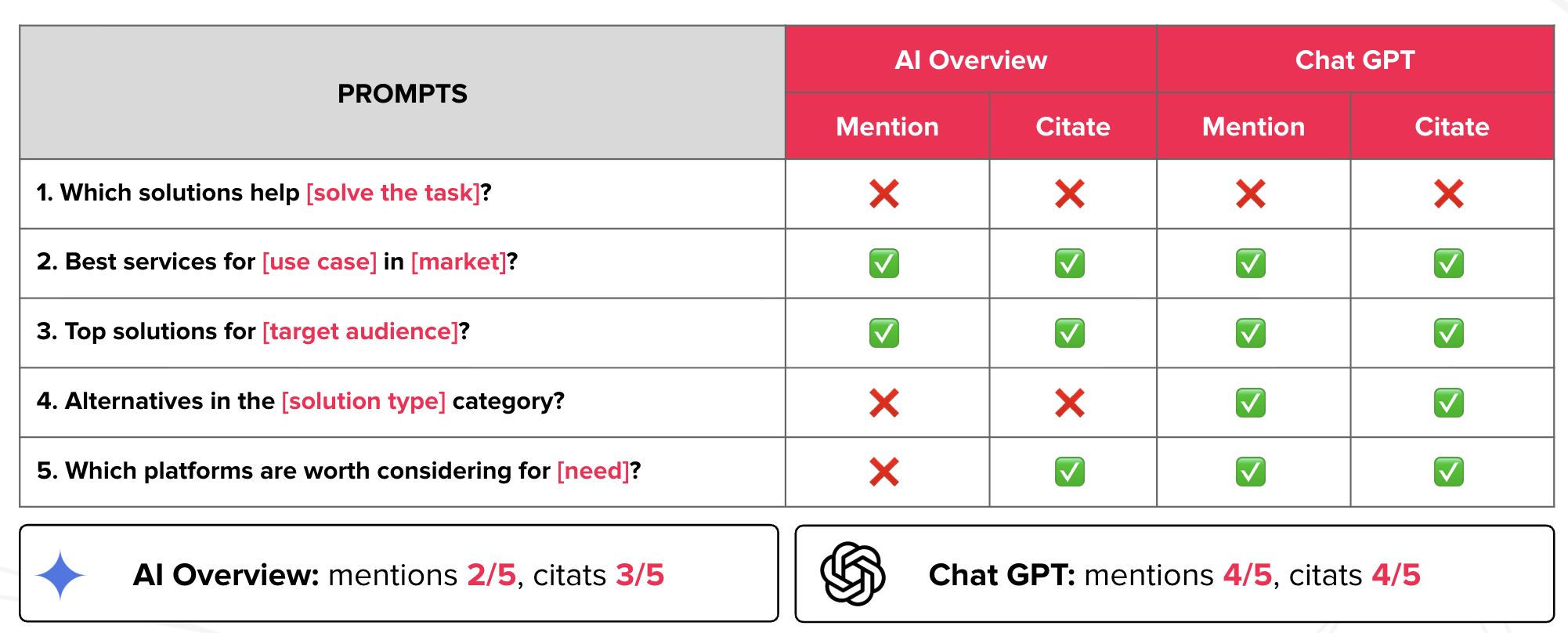
Run your key queries several times. Record the AI model, language, and whether web search is enabled. Whenever possible, start each check in a new chat to prevent previous conversations from influencing the context. If testing conditions differ, make a note of this alongside the results. Even an identical prompt does not guarantee exactly the same response every time.
Initial manual checks will help you identify which queries are worth monitoring on an ongoing basis. Discard prompts that are not relevant to your services or target market. Save the remaining ones along with a note explaining the customer need or question behind each query.
Automation becomes necessary when your team can no longer keep up with scheduled checks manually. AI brand visibility tools collect brand mention monitoring data and maintain a history of changes. Before choosing a platform, determine which markets and AI models you need to monitor, as well as how frequently checks should run.
These platforms support AI brand mention monitoring by allowing businesses to upload their own lists of prompts, add competitors, and regularly track how often their brands appear in responses generated by different AI systems. Depending on the tool, you can analyze mention frequency, your brand’s position in recommendation lists, its share of visibility compared with competitors, mention context, and other AI Brand Visibility metrics.
For example, you can use Ahrefs Brand Radar or Otterly.ai for this purpose.
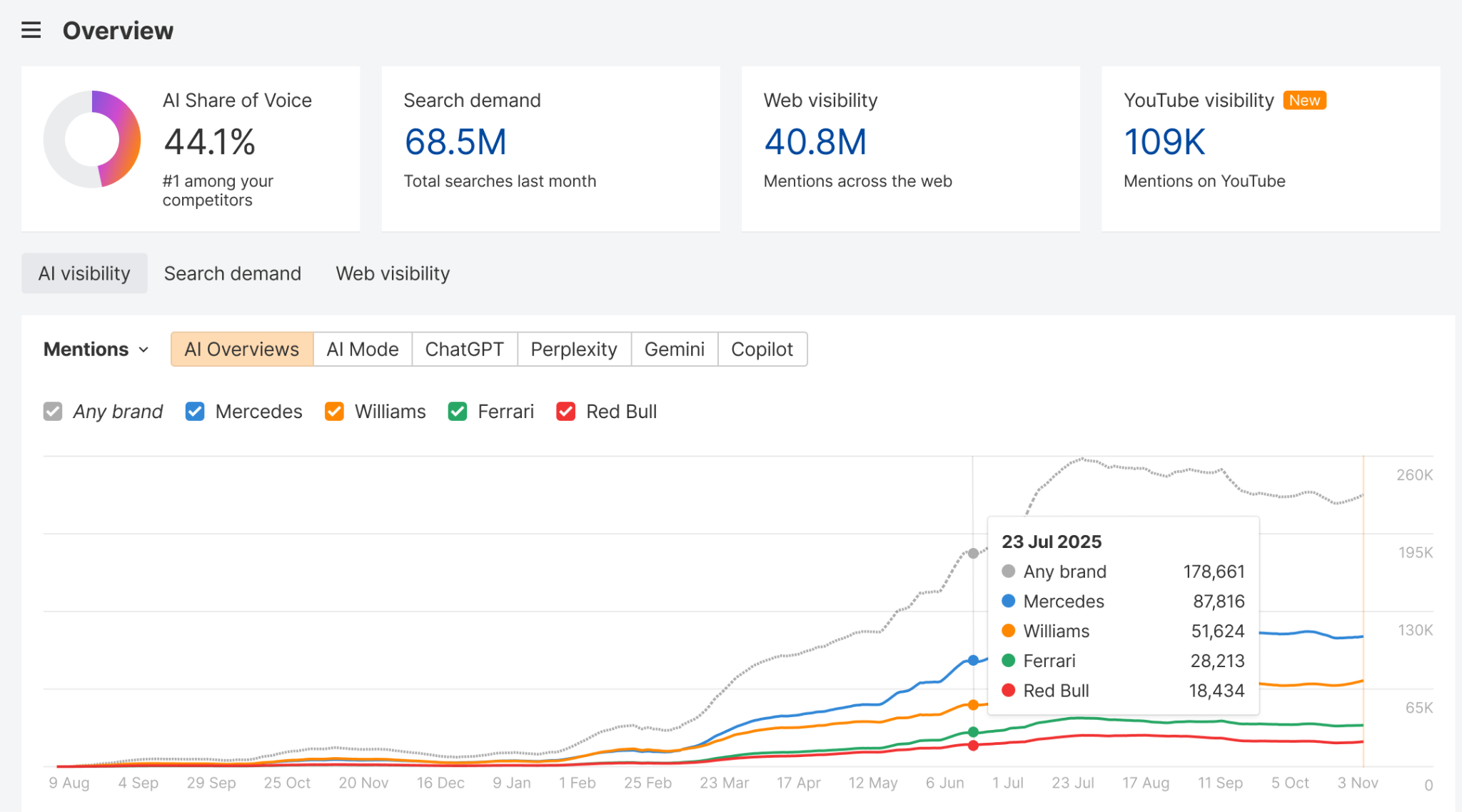
Ahrefs is a useful tool for analysing brand and competitor visibility in AI-generated responses on a broader scale, while Otterly is well suited to regularly tracking brand mentions, positions in AI responses, and the competitive landscape across a specific set of prompts.
At the same time, it is important not to treat the data from any single tool as an absolute source of truth: different tools may use different models, geographical settings, checking frequencies, and data collection methodologies.
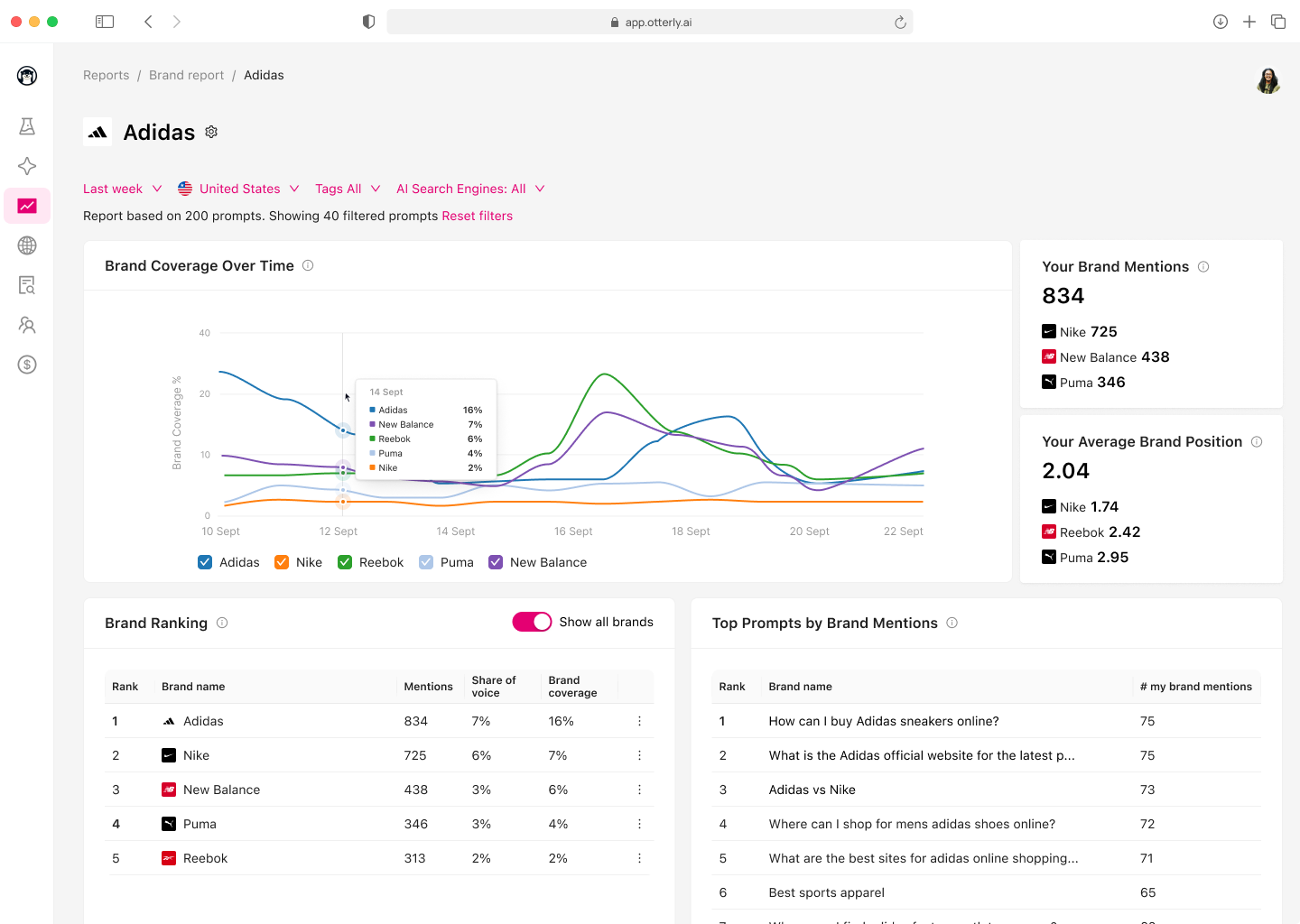
After the data has been collected automatically, manually review a sample of the responses. Start with significant metric changes, new competitors, and unusual descriptions of the company. Check whether the tool has correctly identified the brand name and whether its assessment accurately reflects the content of the recommendation.
Assign someone to review the reports and agree on which changes require action. For example, an incorrect description of a service calls for checking the sources, while a drop in mention frequency requires running the analysis again and comparing the results with previous data.
AI Brand Mentions metrics answer different questions: how often the company is mentioned, who it is recommended to, and how accurately it is described. Agree on the counting rules before generating the first report. In particular, decide whether to count every repetition of the brand name or only one brand mention per response.
Use the following metrics for your analysis:
| Metric | What to analyse | Why it matters |
| Brand Mention Frequency | How often the company appears in responses across the selected pool of prompts | Shows the baseline level of brand presence across AI systems |
| Share of Voice | What share of mentions the brand receives compared to its main competitors | Helps assess the company’s actual visibility within its niche |
| Position in the Response | How prominently the brand appears in recommendation lists or roundups | Brands mentioned first generally receive more user attention |
| Mention Context | The topics, categories, and scenarios in which AI mentions the company | Shows which areas of the business AI associates with the brand |
| Description Accuracy | Whether AI correctly describes the company’s services, products, geographical coverage, specialisation, and benefits | Helps identify outdated or inaccurate information about the brand |
| Mention Sentiment | Whether the description is positive, neutral, or negative | Influences the first impression users form of the company |
| Competitive Landscape | Which brands are most frequently mentioned alongside the company and which ones dominate the responses | Helps identify actual AI competitors, who may differ from competitors in Google |
| Mention Trends | How mention frequency, Share of Voice, and mention context change over time | Helps assess whether GEO, SEO, PR, and content activities are delivering results |
Tracking these metrics also helps evaluate overall AI brand visibility. However, understanding how AI describes your company requires reviewing the actual responses, not just relying on numerical indicators. A brand may receive frequent mentions while being associated with outdated services, incorrect expertise, or irrelevant customer needs.
Consider a hypothetical example: a brand frequently appears in responses to general questions but is absent from contractor recommendations for the company’s core service. The overall metric looks good, even though the target audience is not receiving recommendations for the company. Breaking down the results by topic will reveal this difference. At the same time, neutral sentiment does not, in itself, indicate a low-quality mention.
Include the number of responses analysed and the sample composition in every report. Without this information, an increase in the number of mentions can easily be mistaken for an increase in the number of runs. Compare Share of Voice using an unchanged set of competitors and the same counting methodology.
Before deciding how to improve AI brand mentions, businesses should understand why their brands are missing from relevant responses or receiving inaccurate descriptions. Identifying why AI doesn’t mention your brand is an important first step in developing an effective visibility strategy.
AI systems build their understanding of a brand based on a combination of signals: what external sources say about the company, how consistently it communicates its expertise, whether it publishes useful content, and how frequently it appears in relevant industry discussions.
Start by reviewing what has already been published about the company. Compare service pages with directory profiles, media mentions, and the business’s current offering. Identify any gaps: which areas of expertise are not covered, where outdated information remains, and which customer questions have not been answered.
This work can broadly be divided into three areas: strengthening digital reputation, developing expert content with Query Fan-out in mind, and continuously monitoring changes in the brand’s AI Presence. This approach helps you understand how to improve AI Brand Mentions not only in terms of quantity but also the quality and relevance of those mentions.
Define a specific task and a way to measure results for each area. For example, after updating service descriptions, check AI responses to queries about the company’s specialisation. Website changes do not guarantee that the brand will appear in recommendations, so the results need to be measured.
The description of a brand on its own website is only part of the information available about it. Review independent publications, industry directories, and customer reviews as well. Find out which services they mention and whether they include specific details about the company’s experience. For businesses wondering how to get your brand mentioned by AI, building a consistent and credible digital reputation is an important starting point. Relevant external publications, industry-specific resources, and detailed case studies can help establish clear associations between a company and its areas of expertise.
A strong digital reputation is built through a combination of external mentions, industry publications, ratings, directories, industry roundups, case studies, reviews, and PR activities. Mentions on resources that are already authoritative within a particular niche and well represented in AI-generated responses are especially valuable. When a brand regularly appears in these sources in a relevant context, it becomes easier for AI systems to associate the company with a particular category, product, or service.
To understand how a brand can get mentioned in AI responses, focus on developing expert content, securing external publications, and maintaining consistent company information across different platforms.
Check the company name, list of services, and geographical coverage across different platforms. If a directory still lists an outdated specialisation, update the profile or contact its editor. Conflicting information may lead to an inaccurate brand description. However, the mere presence of discrepancies does not explain why a company is missing from a particular AI response.
When choosing a platform for publication, assess its subject matter, audience, and content quality. An industry case study explaining the task and its outcome gives readers more reasons to evaluate a company than a simple brand mention without context. Use monitoring data to assess the impact of external publications on the brand’s presence in AI-generated responses: the number of placements alone does not prove such an impact.
Keep a record of external publications, including their dates and topics. If AI later cites one of them, you will be able to check exactly which information made it into the response. This provides a concrete basis for analysing the sources behind brand mentions.
Another important factor in increasing AI Brand Mentions is not simply having content available, but covering the topics a brand wants to be associated with in sufficient depth. When a company regularly publishes expert materials, answers common audience questions, and systematically develops topic clusters, AI systems can more easily understand its specialisation and associate the brand with specific areas of expertise.
Query Fan-out plays an important role here. It is the principle by which an AI system may break down an initial query into a series of additional subtopics, refinements, and related questions when generating a response. In simple terms, a user asks one question, but the model simultaneously looks for answers to several related aspects to provide a more comprehensive recommendation.
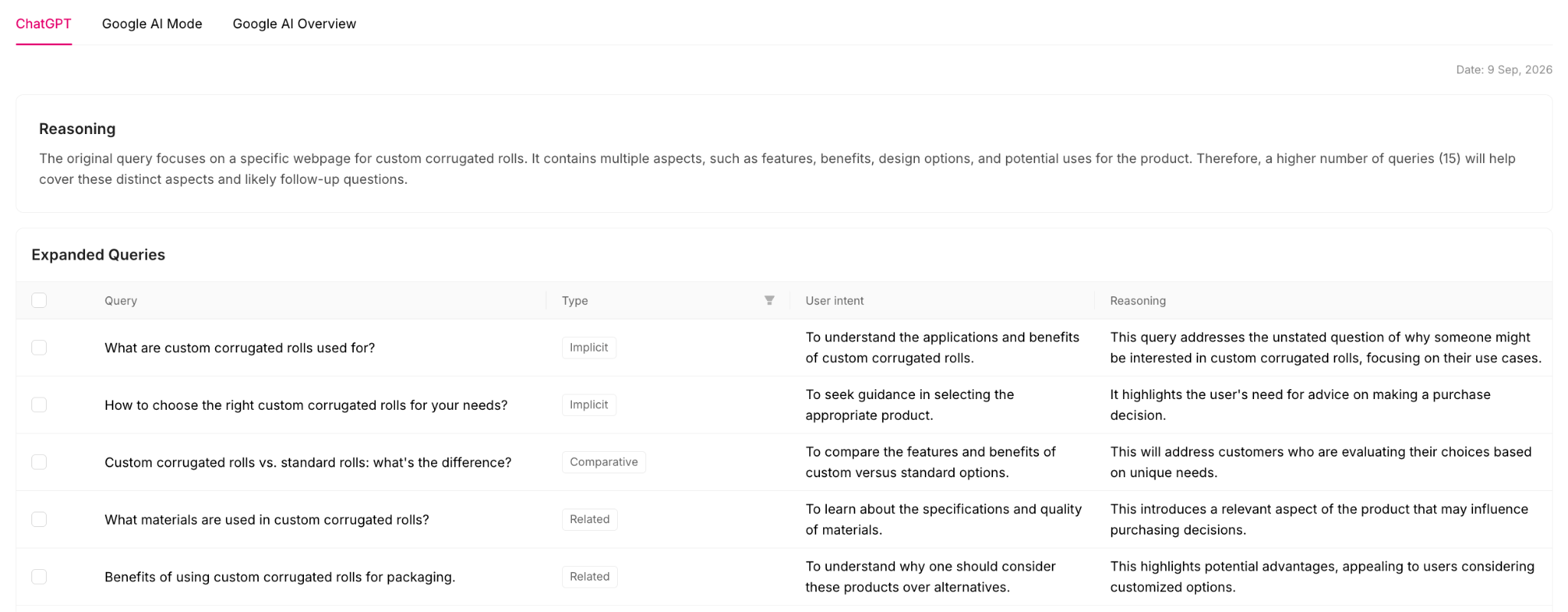
For your main service, compile a list of related customer questions. Identify which ones need a brief explanation on the service page and which deserve a separate article or case study. Link the materials by topic so readers can find the next answer without having to search the website again.
For example, alongside an eCommerce SEO page, relevant materials could cover filter indexing, category structure, keyword cannibalisation, and internal linking. For each topic, explain the problem, how to check for it, and the limitations of the proposed solution. Include your own results and examples wherever you have verified data.
Use Query Fan-out as a guide to identifying content gaps. A list of related topics is not yet a ready-made publishing plan: first, check whether they align with your services and audience questions. Measure the results by tracking whether the brand and its content start appearing in responses to relevant queries.
A brand’s AI Presence should not be assessed just once. AI-generated responses change as models evolve, new sources emerge, content is updated, and competitors become more active. This means that even if a company is regularly mentioned for important prompts today, its share of visibility may decrease over the next few months, or the context of its mentions may change.
In each new report, compare the results with previous checks: which topics now generate more brand mentions, where the brand description has changed, and which competitors have been added to recommendations. Create a separate group for new prompts so that expanding the sample does not distort previously recorded trends.
Maintain a change log, recording the publication dates of new materials, updates to service pages, and the release of media articles. Then check the relevant prompt group. An increase in mentions following a publication does not, by itself, prove a causal relationship: the model or information sources may have changed at the same time. Therefore, compare monitoring results and review the cited materials.
If a company does not appear in AI-generated responses, investigate why AI is not mentioning the brand. The reason may be insufficient information about its specialisation, conflicting details across external sources, or content that does not cover the target audience’s queries.
Keep a separate list of inaccuracies in the company description. After correcting the information, check whether the error has disappeared from new responses and record the date of verification. Even when the overall number of mentions increases, accuracy remains an open issue as long as the system continues to repeat outdated information.
Ultimately, AI Presence should be treated as a continuous cycle: measurement, analysis, implementation of changes, and repeated checks. This approach makes it possible to gradually strengthen a brand’s presence across AI systems and understand which SEO, GEO, content, and PR activities influence the quantity and quality of AI Brand Mentions.
AI Brand Mentions show whether a company appears in responses to potential customers’ queries. For a business, the value of a mention depends on its relevance and accuracy: whether the recommendation matches the buyer’s needs and whether the company’s offering is described correctly.
Start by creating a set of queries and a tracking spreadsheet. Repeat checks according to an agreed schedule, save the responses, and record any inaccuracies. As the workload increases, automate data collection while keeping manual reviews to verify the content.
Build your improvement plan around the gaps identified: update inaccurate information, answer customer questions, and supplement existing materials with verified examples. Measure the results of each stage using the same methodology. No single publication or technical change guarantees that AI systems will start recommending your brand.
If you want to understand how AI describes your company, which competitors receive a larger share of mentions, and where your business is losing AI Presence, the Livepage team can help you analyse your current visibility, develop a monitoring system, and identify opportunities to improve your AI Brand Mentions.


“Livepage has proven to be a reliable source for rapid online growth. We started with 2,000 visitors per month. In 3 years together with Livepage we have reached 70,000 visitors and more than 100 leads from the site per month.”


“As for the results, we’ve been working together since 2015, and our traffic has increased 10x. I cannot say that Livepage was our first SEO company, but they have become the first SEO partner that helped us to achieve the success we were looking for.”


“Livepage delivers SEO efforts that have led to an increase in the site’s users, traffic, and conversions. The team uses a wide range of tools to achieve the client’s goals. They are attentive to the client’s needs, working with them in real-time and bringing in additional specialists when needed.”


“I am pleased with the quick task execution and the instant replies to my messages.”


“I like the complex approach that the Livepage team offers. Absolutely all team members work together; everyone is aware of what is happening on the project. We have one common goal – to increase our service sales, and the team is making every effort to achieve the goal as soon as possible.”


“We’ve been really impressed by how Livepage quickly understood our business and centred our PPC campaign around our objectives. We have achieved good results within a very short time in both revenue and ROI.”

“Everything is clear, timely, and understandable.”


“They have leveraged ideal opportunities to reach our business goals.”